
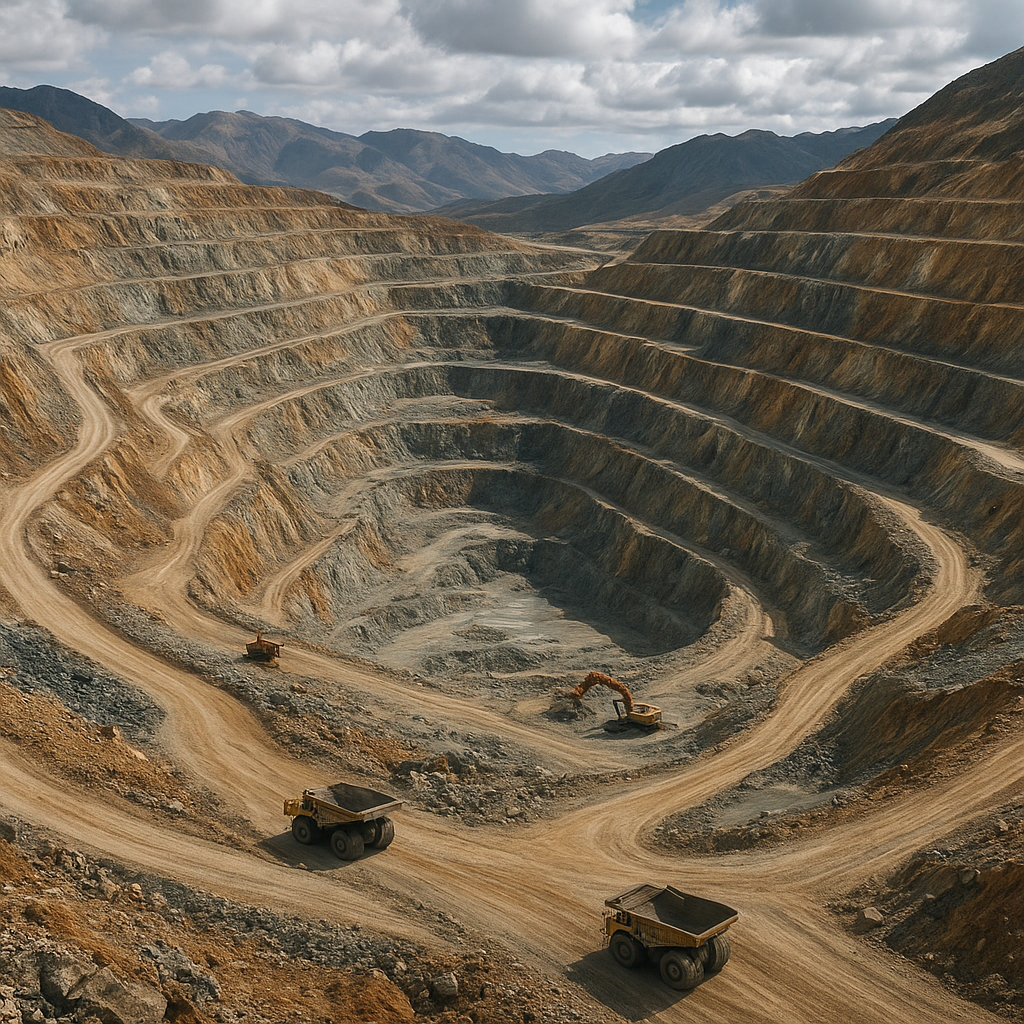
The San Cristóbal Mine sits high on the Andean plateau, a major source of mineral wealth for southwestern Bolivia and an important node in global supply chains for silver, zinc and lead. Its presence has reshaped local economies, generated heated debates about environmental stewardship, and illustrated how modern mining techniques can transform a remote mountain landscape into an industrial complex. This article explores where the mine is located, what is produced there, its economic significance, its technical and environmental characteristics, and several noteworthy aspects that make San Cristóbal a compelling case study in contemporary mining.
Location and geological setting
San Cristóbal is located in the southwestern part of Bolivia, within the Potosí Department. The mine sits on the high puna of the Altiplano, at elevations commonly exceeding 4,000 meters above sea level. The site lies within a sparsely populated region characterized by cold, arid conditions, high solar radiation and large temperature swings between day and night. Access is typically via long haul roads that connect the mine to regional hubs and export terminals.
Geologically, the mineralization at San Cristóbal is part of a broader sequence of Andean mineral provinces where hydrothermal fluids, structural controls and favorable host rocks combined to form polymetallic deposits. The ore is dominated by zinc and lead sulfides—primarily sphalerite (zinc sulfide) and galena (lead sulfide)—with silver commonly occurring both as native metal and incorporated within sulfide minerals. In many polymetallic systems such as this, mineralization forms in stratabound or vein-related bodies where fluids interacted with carbonate and volcanic strata, replacing host rocks and filling structural spaces. The result is a deposit amenable to large-scale open pit extraction supported by standard processing flowsheets.
What is extracted and how it is processed
The San Cristóbal operation focuses on the recovery of three primary commodities: silver, zinc and lead. These metals are produced in concentrates that are then shipped to smelters and refiners around the world. Typical processing steps used at a modern polymetallic mine like San Cristóbal include:
- Open pit excavation and haulage—ore and waste removal using large fleets of trucks and shovels.
- Crushing and grinding—to reduce ore to a particle size suitable for mineral liberation.
- Flotation circuits—differential flotation commonly separates a zinc-rich concentrate and a lead-rich concentrate; silver reports primarily to the lead concentrate but can also be present in zinc products depending on mineral associations.
- Concentrate thickening and filtration—final concentrate is dewatered to meet transport and smelter specifications.
- Transport to port—for export, concentrates are typically trucked to rail or port facilities and shipped internationally.
Processing at the mine is designed to maximize recovery while meeting product specifications demanded by smelters. Recovery percentages, concentrate grades and annual throughput may vary over time according to ore characteristics and operational priorities, but the overall industrial chain is typical of large-scale polymetallic mines.
Economic importance and regional impact
San Cristóbal is significant at several economic scales. Locally, it provides direct employment and indirect opportunities through service providers, contractors, and suppliers. In regions with limited economic diversity, a single large mine can be a primary employer and source of community investment in infrastructure, health services and education. Regionally and nationally, the mine contributes to foreign exchange earnings by exporting mineral concentrates and adding to the country’s mining tax base, royalties and other payments that support public finances.
Bolivia’s economy has historically been intertwined with mining, and large polymetallic operations like San Cristóbal contribute to the nation’s position in global metal markets. Revenue flows from the mine influence local procurement, regional construction activity, road maintenance and utilities. Beyond direct economic measures, mining can enable investments in new logistics corridors, telecommunications and social programs that would be less likely in the absence of a major industrial operator.
- Exports: Concentrates from San Cristóbal are destined for international smelters; the mine’s export earnings help stabilize foreign exchange revenues.
- Employment: The operation employs both skilled and unskilled labor, often including local residents, seasonal workers and specialist contractors.
- Fiscal contributions: Taxes, royalties and contractual payments contribute to municipal and national budgets.
- Local procurement: Suppliers of fuel, food, spare parts and services benefit from steady demand.
Social and environmental considerations
Large-scale mining in a fragile high-altitude environment brings significant social and environmental responsibilities. Water use, tailings management, dust control, and community relations are central concerns for both regulators and communities. At high elevations where water is scarce and ecosystems are delicate, mines must carefully plan water balances and invest in treatment and conservation measures.
Tailings storage and waste rock management are particularly sensitive areas. Tailings impoundments need robust design and continuous monitoring to prevent seepage or catastrophic failures. Environmental oversight focuses on preventing contamination of surface and groundwater by heavy metals and processing reagents. Modern mines implement multi-layered containment systems, seepage collection, lined ponds, and water treatment plants to mitigate risk.
Socially, mining companies typically engage in community relations programs that include local hiring targets, vocational training, health initiatives and infrastructure support such as schools, clinics and road improvements. The presence of a mine can bring both positive change and challenges: while incomes and services may improve, social disruption, increased cost of living and pressure on local resources can also arise. Open, transparent engagement and fair benefit sharing are essential to maintain a social license to operate.
History and development
Although the Andes have been mined for centuries, many modern operations are the product of late 20th and early 21st century exploration, investment and development. San Cristóbal was identified and brought into production following exploration that confirmed extensive polymetallic mineralization. Development typically involved substantial capital investment to build open pit facilities, processing plants, tailings storage and supporting infrastructure such as power and water supply. Mine development phases include feasibility studies, environmental permitting, community consultation and construction, followed by ramp-up to commercial production.
The operational history of a mine like San Cristóbal often features periods of expansion and optimization. Mines may add processing capacity, improve recoveries through metallurgical testing, or pursue exploration to extend the life of the deposit. Given the finite nature of mineral deposits, operators also plan closure and reclamation strategies from an early stage, setting aside financial resources and designing progressive rehabilitation programs for disturbed land.
Notable aspects and interesting facts
San Cristóbal exemplifies several broader trends and notable features in contemporary mining:
- Scale and complexity: Large polymetallic mines operate complex processing circuits that must balance the recovery of multiple valuable elements while controlling costs and environmental risks.
- High-altitude engineering: Operating at elevations above 4,000 meters requires specialized equipment, acclimatization protocols for workers, and adaptation of construction methods to extreme weather conditions.
- Global links: Although the mine is firmly rooted in the Bolivian landscape, its products enter global supply chains, illustrating how resource extraction in remote regions connects to international manufacturing and markets.
- Community programs: Modern mines typically run education, health and local procurement programs as part of long-term social investment strategies.
- Environmental stewardship: Innovations in tailings management, water recycling and dust suppression are often implemented to meet regulatory and social expectations in sensitive highland environments.
Challenges and future prospects
The future of a mine like San Cristóbal depends on a mix of geological, economic and social factors. Geologically, ongoing exploration can discover extensions of known ore bodies or new deposits nearby, potentially extending mine life. Economically, metal prices for silver, zinc and lead influence operational profitability and investment decisions. Socially and politically, evolving regulatory frameworks, community expectations and national policies on resource management will shape how mining develops in Bolivia.
Technological advancements—such as improved flotation reagents, automated equipment, remote operations and enhanced environmental controls—can raise efficiency and reduce impacts. Mines that succeed in integrating technical innovation with sound community relations and environmental performance are more likely to secure a stable operating environment and attract future investment.
Concluding observations
The San Cristóbal Mine is a prominent example of the ways in which a single mineral project can produce significant economic value while also demanding careful management of environmental and social responsibilities. Located in the highlands of Bolivia, in the mineral-rich province of Potosí, it produces large volumes of silver, zinc and lead that feed global markets. Its operations underscore the technical complexity, logistical challenge and governance requirements of mining in remote, high-altitude settings. Observers interested in mining, development economics, environmental management or Andean regional dynamics will find San Cristóbal to be a rich subject for study—illustrating both the opportunities and the obligations that accompany the extraction of non-renewable reserves from the earth.

