
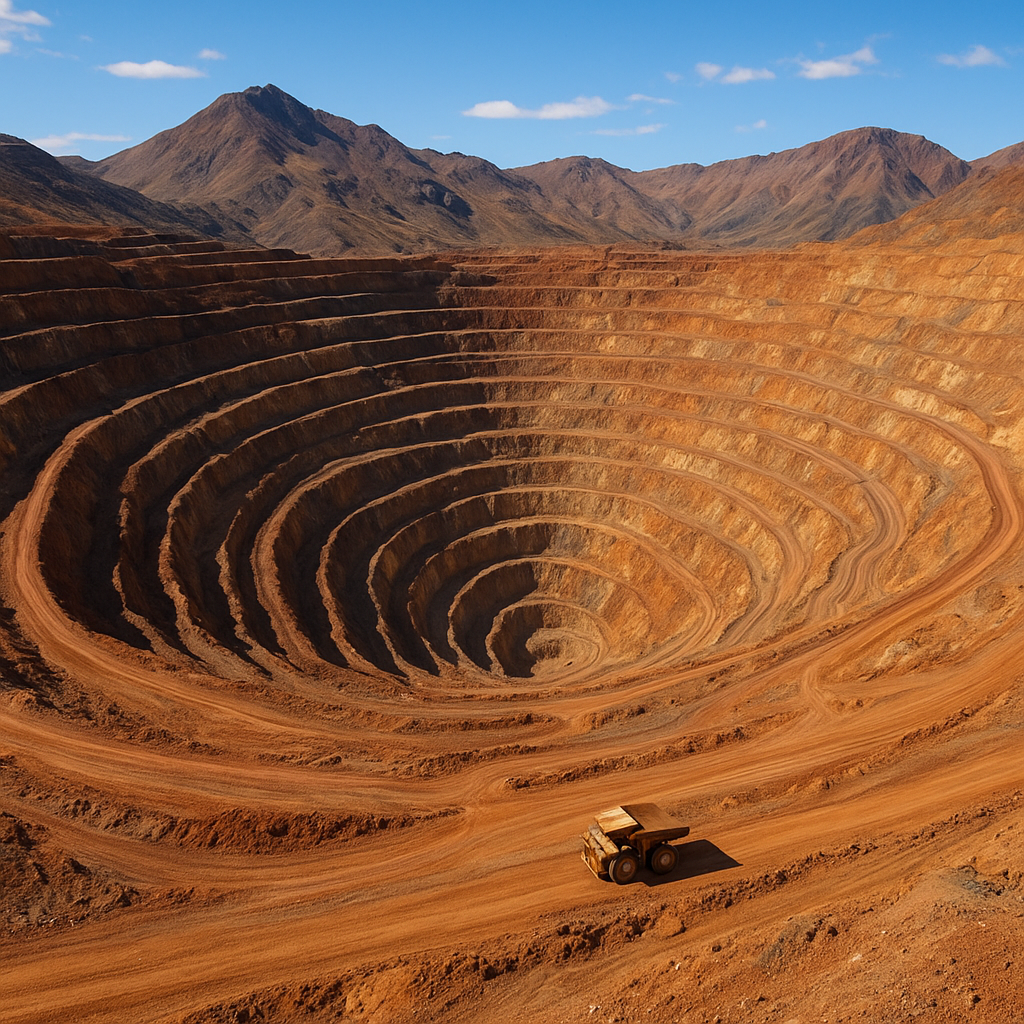
The Corocoro mine, set high on the Andean Altiplano, is one of Bolivia’s notable metal-producing localities. Known primarily for its copper-bearing ores, Corocoro has played roles in regional development, local employment and the broader mining history of the country. This article reviews the mine’s location, geological character, production and economic significance, environmental and social context, and some of the more intriguing details that make Corocoro an interesting case study in Andean mining.
Location and physical setting
The Corocoro deposit lies in the western highlands of Bolivia, within the La Paz Department on the Altiplano — the high plateau of the central Andes. It is associated with the town and municipality that carry the same name and is situated among other scattered historic mining centers. The site sits at a significant elevation typical of the Bolivian highlands, where thin air, large diurnal temperature swings and a sparsely vegetated landscape shape the practical aspects of mining operations.
Regional context
The mining district around Corocoro is part of a string of Andean metallogenic provinces rich in polymetallic mineralization. The broader region contains mineral belts that historically supplied Bolivia with vast quantities of silver, tin and a range of base metals. Corocoro’s copper-rich ores occur in this complex of volcanic, sedimentary and intrusive rocks that were affected by multiple phases of deformation and hydrothermal activity during Andean mountain building.
Access and infrastructure
Road access to the deposit has historically been limited by elevation and weather, but over time regional roads and local transport improvements have increased the mine’s connectivity to towns and processing centers. Infrastructure constraints — such as transport of concentrate, availability of water, and energy supply — continue to be important operational considerations. The mine’s proximity to highland communities links its logistical needs to local economies and services.
Geology and mineralization
Corocoro is best understood as a polymetallic copper-bearing deposit formed by hydrothermal processes common in orogenic and volcanic settings. The mineralization style shows characteristics of replacement and vein-hosted systems where hot fluids altered host rocks and deposited sulfide minerals.
- Host rocks: The deposit is hosted in a sequence of volcanic and sedimentary units typical of the Altiplano, intruded locally by felsic to intermediate igneous bodies that provided heat and metal-bearing fluids.
- Ore minerals: The principal commodity is copper, commonly present as chalcopyrite and associated sulfides. Secondary minerals and associated phases historically reported or expected in the zone include galena (lead), sphalerite (zinc), and various silver-bearing phases, indicating a polymetallic signature.
- Alteration: Hydrothermal alteration includes zones of silicification, sericitization and skarn-like replacement where calcium-rich rocks reacted with invading fluids, creating favourable sites for copper deposition.
Because mineralization at Corocoro is associated with several metal species, the economic focus has generally been on copper while recognizing the value of by-product metals such as silver, lead and zinc where recoverable.
Mining history and production
Mining activity at Corocoro spans decades and reflects the broader patterns of Bolivian mining: early exploitation, periods of increased industrial development, and cycles of investment and decline driven by metal prices and political-economic shifts.
Early and mid-20th century
Records and archival sources indicate that Corocoro was exploited intermittently during the 20th century with small- to medium-scale operations extracting copper-bearing ores for local smelters and concentrate markets. Throughout this period, the mine contributed to regional employment and incremental infrastructure improvements.
Modern era and production trends
In more recent decades, Corocoro has been part of the search for more diversified metal production in Bolivia beyond the country’s historic focus on tin and silver. Production at different times has focused on generating copper concentrates suitable for regional processing plants. Exact annual production figures vary by period and by operator; however, the deposit has been provincially important as a source of raw material and local livelihoods.
Economic significance
The economic impact of the Corocoro mine can be viewed at three scales: local, departmental and national.
- Local economy: Corocoro provides direct employment at the mine and in support services (transport, maintenance, commerce). Mining town economies are often dependent on seasonal rhythms of extraction and on the availability of contracts for drilling, hauling and processing.
- Regional development: Revenues and investment in infrastructure originating from mining activity have helped sustain roads, power lines and community services. Partnerships between operators and local authorities shape how mineral rents are distributed.
- National role: While Bolivia’s macro-economy is more heavily influenced by hydrocarbons and other minerals, copper from Corocoro contributes to export baskets and to domestic industrial supply chains. The mine’s copper output, when aggregated with other Bolivian sources, supports metal trade and processing sectors.
Taxes, royalties and direct wages paid by mining operations feed public budgets at multiple levels. For indigenous and rural communities surrounding Corocoro, mining is both an income source and a structural factor influencing migration and settlement patterns.
Environmental and social dimensions
Mining at high elevations introduces several environmental and social challenges. At Corocoro, as with many Andean mines, water management, tailings storage, dust control and impacts on pastures and traditional livelihoods are central concerns.
Water and hydrology
Water scarcity and the sensitive hydrology of the Altiplano make mine water use and discharge critical. Tailings management must prevent contamination of surface and groundwater used by communities and livestock. Improvements in water recycling and treatment have become priorities for responsible operations.
Tailings and waste rock
Properly engineered tailings storage facilities are essential to avoid acid drainage and heavy-metal migration. Legacy waste dumps from earlier phases of activity are frequently the subject of remediation efforts, requiring investment and technical planning.
Community relations
Local communities, often comprising indigenous Aymara and Quechua populations, have complex relationships with mining companies. Benefits such as jobs and infrastructure can be offset by concerns over environmental degradation, cultural impacts and fair distribution of benefits. Participatory consultation and benefit-sharing arrangements have become more common expectations in modern projects.
Current operations, ownership and governance
The Corocoro area has been operated by different entities over time, including local private firms and, at times, state or mixed-capital ventures. Mining governance in Bolivia is characterized by national regulations, departmental authority and community rights, with variable enforcement and contractual frameworks.
- Regulatory framework: Mining activity must comply with environmental permits, labour laws and royalty regimes set by national authorities. The mine’s economic viability depends on stable legal and tax conditions.
- Local participation: Contracts for supplies, local hiring targets and community investment programs influence how profits are distributed and how social license to operate is built.
Because ownership and operating arrangements can change with market cycles and policy shifts, Corocoro’s operations have periodically been restructured or renegotiated. Transparency in contracts and benefit-sharing is often requested by local stakeholders.
Exploration potential and future prospects
Prospects for Corocoro are shaped by geological potential, technological trends and market conditions for copper and associated metals.
Resource expansion
Geophysical surveys and modern drilling techniques may reveal extensions of known mineralization or previously unrecognized lenses at depth. Advances in exploration technology — including geochemistry, remote sensing and 3D modeling — improve the chances of delineating resources that were beyond reach in earlier decades.
Processing and value addition
Upgrading facilities to produce higher-grade concentrates or to process multiple metals can increase project value. Investment in local smelting or hydrometallurgical plants creates downstream jobs and reduces raw concentrate exports, but requires substantial capital and market certainty.
Market drivers
Global demand for copper is influenced by electrification, renewable energy technologies and infrastructure growth. Long-term copper demand trends support interest in exploring and developing mid-sized deposits like Corocoro, provided environmental and social conditions are satisfactorily managed.
Interesting and lesser-known aspects
Corocoro contains a number of features that make it noteworthy beyond production statistics:
- High-altitude mining culture: Working conditions at Corocoro exemplify the adaptations of Andean mining communities — from specialized health and safety practices to logistical solutions for living and working at altitude.
- Polymetallic opportunity: Although copper is the headline commodity, the coexistence of silver, lead and zinc in the deposit offers flexibility for operators to optimize revenue through integrated recovery techniques.
- Historical continuity: The area around Corocoro reflects centuries of mineral extraction and the interplay of indigenous mining know-how with modern industrial methods.
- Potential for modernization: Technologies such as improved flotation circuits, dry-stacking of tailings and renewable energy integration (solar and wind) are especially attractive at high, sunny altiplano sites and could lower environmental footprints while improving efficiency.
Challenges and opportunities for sustainable development
Balancing mining growth with environmental protection and community well-being frames Corocoro’s path forward. Opportunities exist to apply best-practice mining standards to reduce risks and to create meaningful local benefits:
- Adoption of modern tailings solutions and water recycling to protect fragile hydrological systems.
- Investment in local skills training and supply-chain development to increase local content of goods and services.
- Transparent benefit-sharing mechanisms and participatory decision-making to strengthen social license and reduce conflict.
- Exploration of downstream value capture, such as concentrate processing or metal refinement, to retain more value inside Bolivia’s economy.
When viewed in a broader national and global context, the future of Corocoro depends on geological potential, commodity markets and the commitment of stakeholders — government, industry and communities — to pursue a development path that is economically viable and environmentally responsible.
Further reading and research directions
For readers interested in deeper technical or policy analysis, relevant topics include Andean metallogeny, high-altitude mine engineering, Bolivian mining law and case studies of sustainable mining practice in similar settings. Academic papers, government geological surveys and reports from responsible mining initiatives provide useful primary material for researchers and practitioners alike.
Key words highlighted in the text: Corocoro, Bolivia, copper, Andes, Altiplano, tin, silver, mining, economy, sustainability.

