Proustite is a striking and historically significant mineral whose vivid red color has captivated mineralogists, gem cutters and collectors for nearly two centuries. While it is far too delicate and rare to serve as an everyday gemstone or industrial feedstock, proustite occupies an important place in the story of silver mining, mineral chemistry and the aesthetics of mineral specimens. Below you will find a detailed examination of its chemistry, physical characteristics, geological settings, classic localities, practical uses (and limits), and some lesser-known but intriguing aspects that make proustite a subject of ongoing interest in mineralogical research and collecting.
Chemical and physical properties
At the most basic level, proustite is a silver arsenic sulfosalt with the idealized formula Ag3AsS3. It belongs to the family of sulfosalts — complex sulfide minerals in which a semimetal (here arsenic) combines with sulfide and metal elements. Proustite is often compared and directly related to pyrargyrite (Ag3SbS3), the antimony analogue; the two form a compositional series in which arsenic and antimony may substitute for one another to varying degrees.
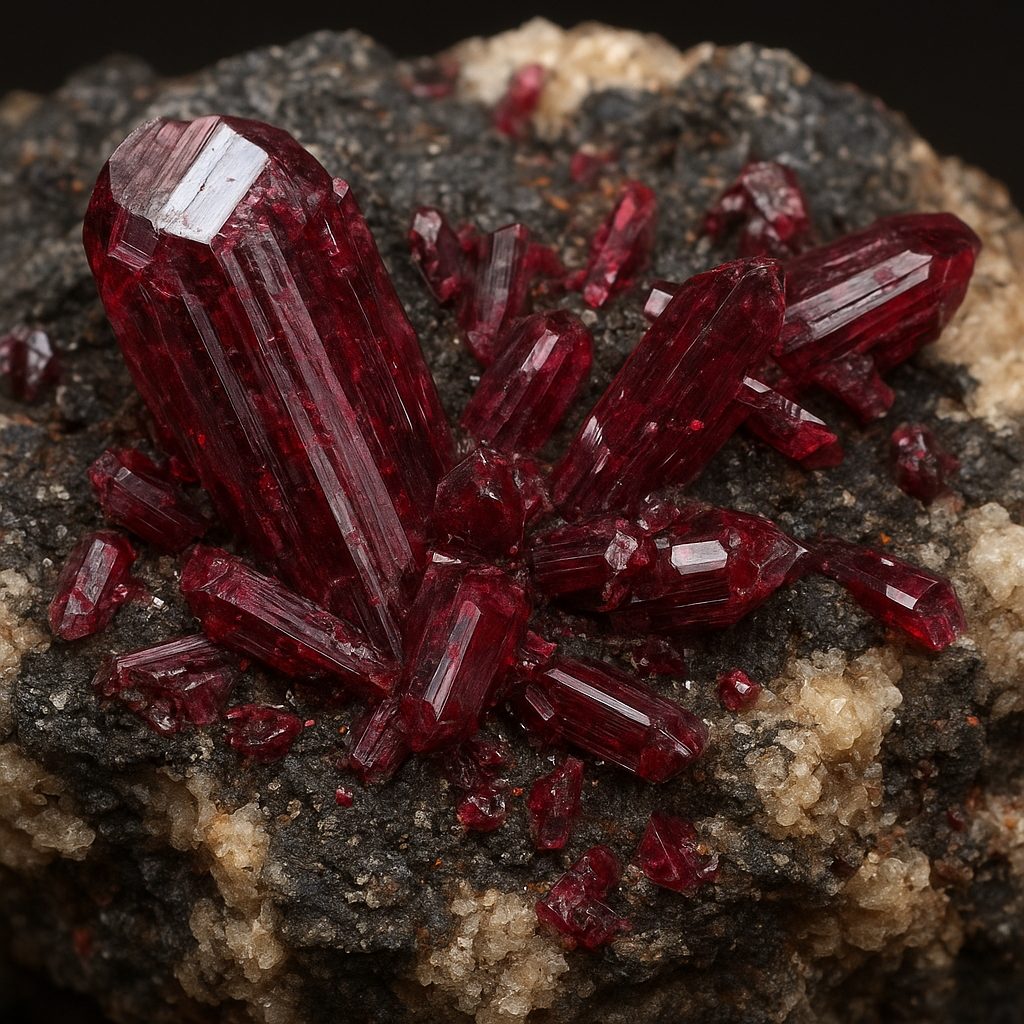
Optically and physically, proustite is prized for its deep, transparent to translucent blood-red to ruby-red color and high luster — which has earned it the popular name ruby silver. It commonly crystallizes in the trigonal system, producing well-formed prismatic or rhombohedral crystals that may be gemmy enough for faceting on rare occasions. Typical physical parameters include a low hardness (approximately 2.5–3 on the Mohs scale), a relatively high specific gravity (roughly 5.5–6.0), a red streak, and an adamantine to resinous luster when fresh.
One of the most important practical aspects of proustite is its marked sensitivity to light and to strong heat. Prolonged exposure to bright light or sunlight causes progressive darkening as the mineral partially decomposes and metallic silver forms on crystal surfaces or within the structure. For that reason proustite specimens must be handled and stored with care.
Geological occurrence and typical associations
Proustite is predominantly a mineral of silver-bearing hydrothermal veins. It forms in medium- to low-temperature hydrothermal environments where silver, sulfur and arsenic are available and may occur both in the primary hypogene zone and in some supergene environments where alteration is limited. It rarely occurs in large quantities; more often it appears as isolated crystals or small aggregates intimately associated with other silver minerals.
Mineralogical associations are important for recognizing potential proustite-bearing environments. Typical associated minerals include:
- Native silver and silver sulfides such as acanthite (Ag2S)
- Other sulfosalts: pyrargyrite, stephanite and tetrahedrite–tennantite group minerals
- Common gangue sulfides such as galena and sphalerite
- Calcite, quartz and other gangue minerals typical of hydrothermal veins
Recognition of these associations helps field geologists and collectors identify promising veins and evaluate whether a rich specimen might be a proustite crystal rather than a superficially similar red mineral.
Notable localities and historical mining
Although proustite is widely scattered and local in distribution, a number of classic localities have produced the finest and most famous specimens. Historically famous deposits are typically associated with silver mining districts where hydrothermal vein systems concentrated silver and associated sulfosalts.
Examples of notable localities include the historic silver districts of Europe — such as parts of the Erzgebirge (Saxony) and the old Joachimsthal (Jáchymov) area of central Europe — which yielded fine crystalline specimens during the great mining eras. South and Central America have also produced spectacular examples: Chilean mines at Chañarcillo and other Atacama-region localities are celebrated for richly colored proustite and pyrargyrite specimens. Mexico’s long history of silver mining (Guanajuato, Zacatecas and other districts) and various Peruvian silver districts have likewise produced notable finds.
Collectors’ catalogs and museum collections often showcase proustite crystals from these classical localities because the combination of saturated color, transparency, and well-formed crystal faces is most commonly obtained under the particular geological conditions present in these veins. Modern prospecting occasionally reveals new pockets, but large, gemmy crystals are rare and highly sought after.
Uses, historical significance and limitations
From a practical standpoint, the most straightforward use of proustite has been as a source of silver when found in economically significant concentrations. In the days before large-scale metallurgy and beneficiation, any rich silver sulfosalt could be exploited for its metal content. However, proustite is not an important ore mineral on a global scale because it is typically too scarce and occurs only in small pockets.
Proustite’s striking color brought it attention as a collector’s gem and occasional jewelry stone in the 19th and early 20th centuries. When transparent and stable enough, small cabochons and faceted stones were cut and marketed under the evocative name ruby silver. The principal constraints on broader gemological use are the mineral’s low hardness, brittleness and pronounced light-sensitive instability: faceted stones and gemstones made from proustite tend to darken and degrade with exposure, which makes them impractical for most wearable jewelry.
In modern contexts, proustite finds its chief value in the realms of mineralogical research and collecting. It serves as a classic example for studies in sulfosalt crystal chemistry and for understanding substitution between arsenic and antimony (the proustite–pyrargyrite solid-solution). Materials scientists and crystallographers sometimes study proustite to explore its structural relationships, bonding characteristics and photo-induced decomposition mechanisms.
Handling, safety and conservation
Because proustite contains arsenic and is chemically reactive to light, safety and conservation are key concerns for collectors, museums and anyone handling specimens. The mineral is not dangerously radioactive, but its arsenic content means that powdered or degraded material could present an exposure risk if inhaled or ingested. Practical precautions include:
- Store specimens away from direct light and strong artificial illumination — dark, UV-filtered display cases are ideal.
- Avoid prolonged handling and always wash hands after touching specimens; wear gloves if preparing or moving fragile samples.
- Do not attempt aggressive cleaning with chemicals, acids or ultrasonic baths; proustite’s softness and sensitivity will make such treatments destructive.
- Label specimens with provenance and any known stability issues; if a crystal has begun to darken or powder, isolate it to avoid contaminating other display pieces.
Museums often use controlled lighting, low relative humidity and minimal handling to preserve proustite specimens. For private collectors, keeping proustite in a closed, dark case and limiting exposure to daylight will significantly prolong the life and color of the mineral.
Scientific interest and current research topics
Although proustite is not a high-profile material in contemporary applied science, it continues to attract attention for several reasons. First, the mineral’s crystal chemistry is representative of complex sulfosalt behavior: understanding how silver and semimetals (arsenic, antimony) organize into ordered frameworks has implications for mineralogy and solid-state chemistry. Second, the photo-induced decomposition of proustite — where light exposure leads to partial reduction of Ag+ to metallic silver and a consequent darkening of the mineral — makes it a convenient case study for photochemical reactions in the solid state.
Researchers use modern techniques (X-ray diffraction, electron microprobe analysis, Raman and infrared spectroscopy, and synchrotron-based methods) to probe structural subtleties, substitution mechanisms and the exact pathways by which light, heat or atmosphere provoke decomposition. These studies help inform conservation strategies and expand fundamental knowledge of sulfosalt materials that are chemically and structurally complex.
Cultural and collecting perspectives
Collectors prize proustite for several interlinked reasons: rarity, aesthetic beauty, and evocative historical associations with the great silver mining districts. A well-preserved, transparent proustite crystal with intact faces and saturated color can command high interest and value on the mineral market. Institutional collections often include proustite as part of classic suites that illustrate sulfosalt diversity and the geology of silver deposits.
Because of its fragility, notable specimens are sometimes displayed sparingly and photographed extensively to reduce exposure to light. The storytelling around a named specimen — its mine of origin, the mining period and the conditions that produced the crystal — adds to a piece’s appeal. Proustite thus functions as both a scientific object and an aesthetic artifact linking geology, history and human imagination.
Curiosities and interesting facts
A few tidbits that tend to surprise people encountering proustite for the first time:
- It is named after the French chemist Joseph Louis Proust (1754–1826), known for early work on chemical composition and the law of definite proportions.
- Despite its gem-like appearance in some crystals, proustite is unsuitable for most jewelry applications — both because of physical softness and because of its tendency to darken under light exposure.
- The close chemical relationship between proustite and pyrargyrite (the arsenic vs. antimony end-members) makes many specimens interesting hybrid examples, with delicate color shifts reflecting composition.
- Collectors and curators often store proustite specimens in conditions optimized to limit photo-degradation: low light, UV filtering and minimal air exchange.
Proustite illustrates how a mineral can be scientifically important, historically significant and visually compelling, all while being fragile and elusive. Its allure endures among mineralogists and collectors because it sits at the confluence of chemistry, crystallography, mining history and aesthetic appreciation.