
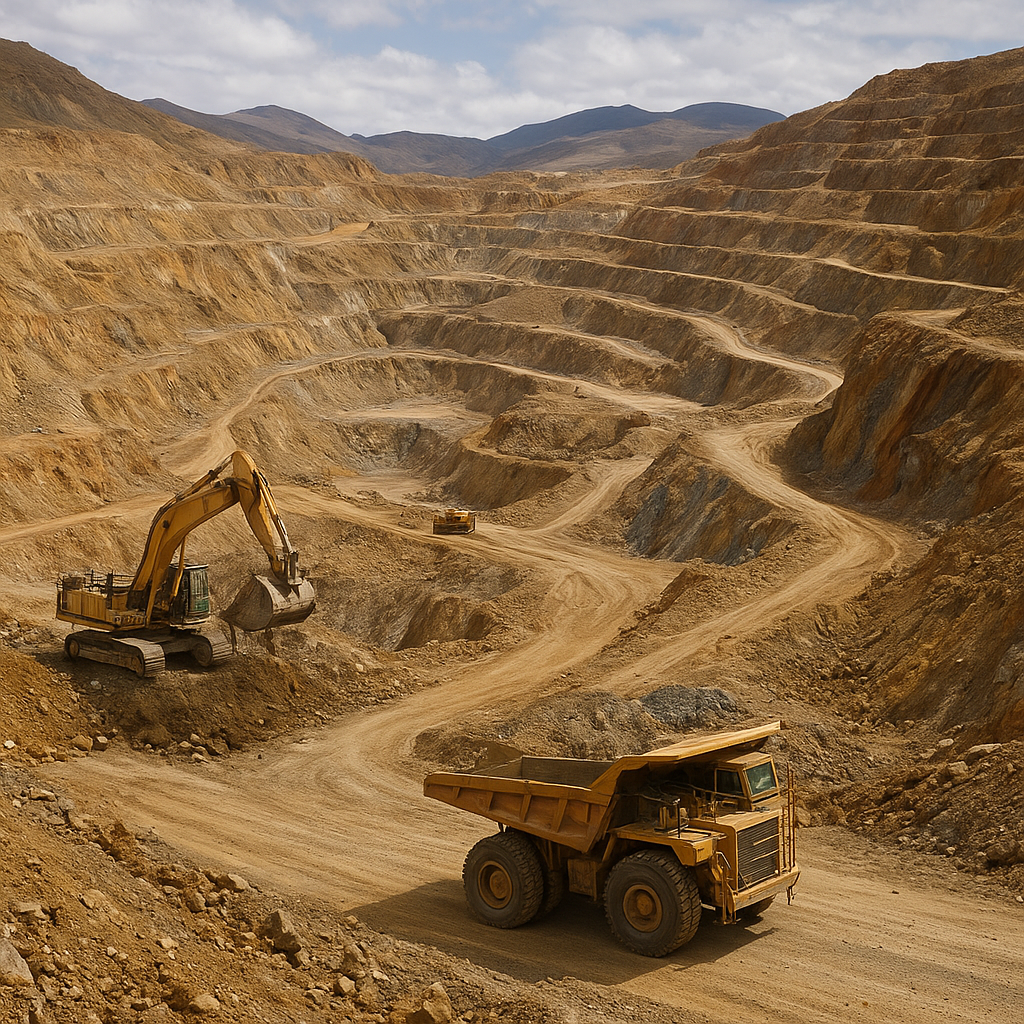
The Huanuni mine stands among the best-known mining centers in the high plateau of the Andes. Located in western Bolivia, it has shaped local life, regional industry and national mining policy for more than a century. This article examines the mine’s setting, the minerals produced, its economic role and a number of noteworthy aspects of its operation and legacy.
Location and geological setting
The Huanuni deposit sits in the central Andean highlands of the Oruro region of Bolivia, near the small town that shares its name. Perched on the Altiplano at high altitude, the mine is part of a wider district that hosts a range of polymetallic and tin-bearing deposits. The regional geology combines folded sedimentary sequences and volcanic-tectonic features that provided pathways for metal-rich hydrothermal fluids. Over geological time these fluids deposited veins and lenses of tin-rich minerals within fractured host rocks.
The most commercially important mineral at Huanuni is tin, typically occurring as the oxide mineral cassiterite in quartz and sulfide veins. Cassiterite commonly appears as dense, high-specific-gravity fragments that are amenable to gravity concentration, while associated sulfide minerals carry lead, zinc and traces of silver. The deposit’s style is characteristic of many Andean tin provinces: structurally controlled veins where hydrothermal circulation concentrated tin at various depths.
The high elevation and rugged terrain shape both access and the technical choices made by operators. Weather, steep topography and limited infrastructure historically made extraction more difficult and costly than in lowland settings, but they also concentrated mining communities that evolved around ore-processing plants, shafts and workshops.
Historical development and production
Interest in Huanuni began in the late 19th and early 20th centuries as prospecting across the Bolivian Andes intensified. Over subsequent decades the mine developed extensive underground workings, shafts and processing facilities. During the 20th century Huanuni rose to prominence among the country’s tin producers and became strategically important to Bolivia’s mining economy.
A major turning point in the mine’s institutional history came with the mid-20th-century political changes in Bolivia. The nationalization movement that followed the 1952 revolution brought many operations under state control and led to the formation of the national mining corporation. Under state management, Huanuni formed part of a broader program to stabilize employment, increase domestic processing and retain value within the country. In later decades, shifts in policy, economic pressures and the emergence of private and cooperative actors changed the structure of mining operations, but Huanuni remained a focal point for tin extraction.
Production at Huanuni has historically focused on the extraction of tin-bearing ore, with cassiterite as the primary commercial product. Mines in the district have produced tin concentrates that are either refined domestically to some extent or exported for smelting and further processing abroad. The mine’s output has experienced booms and downturns tied to global tin prices, domestic policy and operational factors such as investment in infrastructure and equipment.
Mining methods and site operations
Huanuni’s operations are dominated by underground mining methods. Extensive networks of tunnels, shafts, stopes and service drifts penetrate the mountain to reach vein systems. The term underground best captures the mode of extraction: miners advance headings, develop stopes and support openings with timber and modern support systems when possible. Mechanized drilling, controlled blasting and rock hauling co-exist with more manual methods in places where geometry or economics limit mechanization.
Ore processing traditionally emphasizes gravity concentration because cassiterite’s high density allows efficient separation from gangue by jigging, tabling and dense-media separation. In many operations, flotation circuits are used where tin occurs with sulfide minerals; these circuits allow recovery of associated metals and the production of cleaner concentrates. Tailings management and water recycling are routine concerns in processing schemes, particularly given the scarcity of water at altitude and the environmental sensitivities of highland watersheds.
The human side of operations is complex. A mix of technical staff, experienced miners, local laborers and contract crews run shifts that reflect both the continuous nature of underground production and the rhythms of a community-based workforce. Maintenance of shafts, hoists and ventilation systems is a constant necessity in a working mine, and logistical efforts connect Huanuni to regional supply lines for explosives, spare parts and processing reagents.
Economic significance at local and national levels
The economic imprint of Huanuni extends from the town’s streets to national balance-of-payments considerations. At the local level the mine is a major employer: direct jobs in extraction and processing support families and generate demand for services, transport and local commerce. Wages paid to mining employees circulate through the local community, supporting schools, markets and small businesses. Informal economies also develop around the mine, including trade in fuel, food and equipment.
Regionally and nationally, Huanuni contributes to Bolivia’s mineral export earnings and to the preservation of industrial skills. Tin itself remains an industrially important metal: it is used in soldering, plating, alloys and in several specialty applications. Revenue from tin sales, fiscal contributions from mining companies and royalties for mineral extraction form part of government income, which can be allocated to infrastructure, social programs and public services. Historically, Bolivia’s identity as a tin-producing country gave operations like Huanuni strategic importance in national economic planning.
Economic cycles at Huanuni mirror global tin markets. High tin prices incentivize investment, expansion and higher employment, while prolonged price weakness pressures operators to reduce costs, slow development and sometimes curtail production. Because many local households and small businesses depend on mining incomes, these cycles have real social consequences.
Social and cultural dimensions
Mining towns develop their own social fabric. In Huanuni, mining traditions influence family life, gender roles and local culture. Generations of families have worked underground, and mining identity often shapes local festivals, patron-saint celebrations and neighborhood solidarity. Trade unions and miners’ organizations have historically played an important role in negotiating labor conditions, wages and social services. These organizations are frequently central to local political life.
Health and safety remain persistent challenges. Underground work brings risks of rockfalls, gas accumulation, respiratory illnesses and accidents linked to heavy equipment and explosives. Over time, attention to occupational safety, training for emergency response and medical services has improved for many operations, but the realities of high-altitude mining and complex access mean that hazards persist.
Education and training programs tied to mining companies and government initiatives can provide a pathway for local youth into technical careers. Conversely, cycles of boom and bust can cause social stress, with migration to urban centers during downturns and rapid population growth during expansionary phases.
Environmental considerations and governance
Mining at Huanuni, as at many other highland sites, has environmental consequences that require careful management. Tailings — the crushed rock and processing residues left after concentration — pose long-term storage and stability challenges. If poorly managed, tailings can lead to contamination of surface waters, sedimentation of streams and risks to downstream agriculture and communities.
Water is both an operating resource and a limited local asset. Processing operations need water for concentration and flotation, while local communities depend on the same watershed for livestock and domestic use. Modern environmental governance emphasizes water-efficiency measures, recycling of process water and proper tailings basin containment to reduce environmental footprint.
Regulatory oversight is implemented by national and regional agencies, often with input from international norms and lenders when projects involve external financing. Environmental impact assessments, closure plans and remediation funding are increasingly considered essential components of a mine’s life cycle. Community participation and consultation are also emerging as central elements of responsible mining practice, with stakeholders seeking transparent commitments on land use, pollution control and post-closure land rehabilitation.
Challenges and opportunities
Huanuni faces the usual set of challenges for an aging, high-altitude mining district: the need to modernize equipment, to manage costs during price slumps and to reduce environmental risk while maintaining social stability. Investment in mechanization, ore-sorting technologies and more efficient processing can improve recovery and lower per-ton costs, but such investments require capital and stable governance.
At the same time, opportunities exist. Advances in mineral processing, digital monitoring of underground conditions and better tailings management offer ways to extend the productive life of deposits while reducing negative impacts. Value-addition through domestic refining and the development of local supply chains can increase the economic benefit retained in the region, provided that policy frameworks and market conditions support such development.
Interesting facts and lesser-known aspects
- Specimen collectors prize well-formed pieces of cassiterite and associated minerals that come from Huanuni; these specimens often illustrate the crystalline nature of tin oxide found in high-grade veins.
- The social organization of Huanuni reflects a long tradition of local mining cooperatives and worker-led initiatives that arose in response to structural changes in the mining industry. These cooperative models have influenced how labor, profits and decision-making are distributed at the site.
- Rich oral histories and local narratives link families in Huanuni to the mine across multiple generations; the mine is not just an economic asset but a living part of collective memory and identity in the region.
- The combination of altitude, thin air and hard physical labor has shaped unique health adaptations and occupational practices among the workforce. Local medical and safety programs often reflect the need to address altitude-related health risks together with conventional mining hazards.
- Huanuni’s geological setting provides educational opportunities for students and researchers studying Andean mineralization, vein formation and the interplay between tectonics and hydrothermal systems.
Technical innovation and future prospects
Continued exploration in the district can delineate new extensions of vein systems and upgrade inferred resources into mineable reserves where economic conditions permit. Innovations such as automated monitoring of ground stability, ore-sorting sensors that separate higher-grade material before milling and improved concentrator circuits can both increase metal recovery and reduce operating costs.
Sustainable development of Huanuni’s resources depends on coordinated action among operators, government agencies and local communities. Clear environmental safeguards, shared benefit programs and investments in local infrastructure — roads, healthcare and education — can help convert mineral wealth into durable social and economic improvements.
Final observations
The Huanuni mine is a complex and enduring feature of Bolivia’s mining landscape. As a long-lived source of tin and a center of working-class culture and technical know-how, it highlights both the potential and the responsibilities inherent in resource extraction. Efforts to maintain productive output while improving safety, environmental performance and community outcomes will shape the mine’s role in the coming decades. Whether through modernization of operations, stronger governance or community-driven initiatives, the trajectory of Huanuni will remain important for the broader economy of the region and for Bolivia’s mineral sector.

