
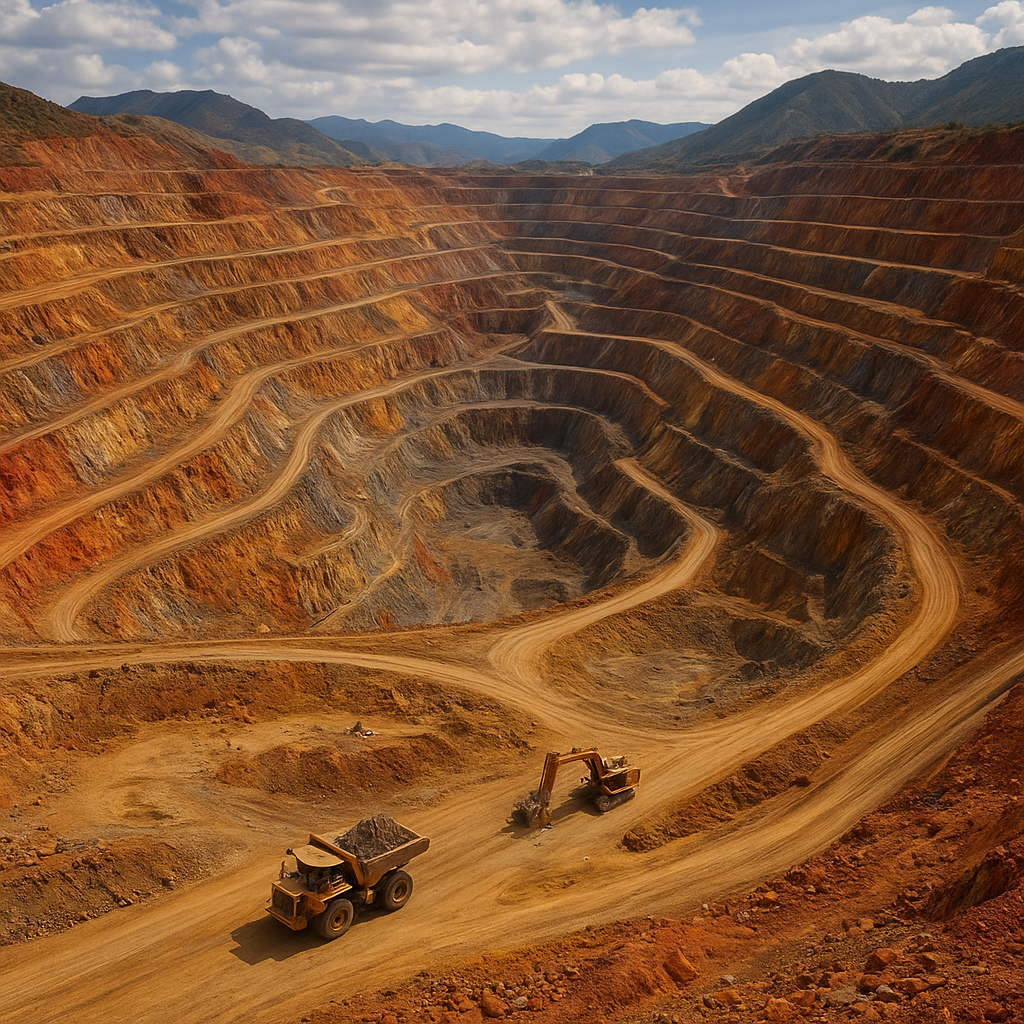
The vast mining complex known as Buenavista del Cobre stands among the most significant mineral operations in Mexico. Located in the northwestern state of Sonora, this mine has played a central role in the country’s extractive industry for decades. Beyond the extraction of **copper**, the site influences local economies, national exports and global metal markets. The following sections describe its location and geology, the minerals and methods of extraction, the economic footprint, environmental and social challenges, and several noteworthy historical and technical aspects.
Where it is and the geological setting
Buenavista del Cobre is situated in the state of Sonora, a region of Mexico characterized by its long history of mining and complex geology. The deposit belongs to a belt of mineralization associated with the volcanic and intrusive rocks of northwestern Mexico, where large porphyry-type systems are relatively common. These types of deposits are the primary sources of the world’s copper and typically form in association with large magmatic intrusions that alter and mineralize surrounding host rocks.
The geological model for Buenavista del Cobre conforms to the classic porphyry paradigm: disseminated sulphide minerals such as chalcopyrite and bornite are distributed through vast volumes of host rock, with higher-grade zones concentrated around intrusive centers. Hydrothermal fluids, driven by magmatic heat, precipitated copper and associated metals across a broad envelope, resulting in an orebody that is amenable to large-scale open excavation. The deposit’s scale and continuity allow cost-effective bulk mining techniques and centralized processing.
What is mined and how
The dominant product extracted at the complex is copper, recovered primarily as a copper concentrate. Typical recovery starts with large-scale open-pit mining, where benches are excavated and ore is hauled to a concentrator. At the concentrator, crushing and milling reduce rock to fine particle sizes, followed by flotation to produce a sulphide-rich concentrate that can be transported to smelters or exporting facilities.
- Primary product: copper concentrates (sulphide copper).
- Common byproducts: gold and silver entrained within the copper minerals; molybdenum is often recovered where mineralization warrants it.
- Final processing: concentrates may be smelted domestically or shipped abroad, depending on market and logistical considerations.
At mines of this type, modern processing integrates significant equipment and technology: high-capacity crushers, SAG and ball mills, cyclones for classification, and carefully designed flotation circuits. Water management, tailings deposition and reagent handling are essential parts of the operation. The mine also requires a sizable supporting infrastructure: haul roads, power lines, workshops, and accommodation for a considerable workforce.
Ownership, scale and production context
The operation is a prominent asset in the portfolio of one of Mexico’s largest mining companies. Grupo México has been a leading name in Mexican mining for decades, and Buenavista del Cobre figures prominently among its copper-producing units. While production figures vary over time because of market cycles, operational changes and investments, Buenavista has represented a substantial share of the country’s annual copper output and thus contributes to Mexico’s role in global metal markets.
Production at a complex of this size typically involves millions of tonnes of ore moved per year and concentrate shipments measured in tens to hundreds of thousands of tonnes. The mine’s output feeds domestic smelters and export channels and is directly tied to global copper demand, which in turn is driven by industrial activity, infrastructure investment and the expanding needs of electrification and renewable-energy technologies.
Economic significance: regional and national impacts
Buenavista del Cobre’s economic footprint extends well beyond the pit and processing plant. The mine is a major employer in the surrounding region, generating a mix of direct and indirect jobs. Direct employment includes miners, metallurgists, engineers, technicians and administrative staff. Indirect employment arises in local services, transport, equipment maintenance, construction, and supply chains that serve the mine.
- Local economies benefit from wages, procurement and taxes tied to the operation.
- State and federal revenues receive contributions through royalties, taxes and export receipts.
- Infrastructure such as roads, energy supply and sometimes community facilities often improves as a consequence of large-scale mining investment.
Export earnings from copper concentrates support the national balance of trade and attract foreign currency. For regions where alternatives are limited, a major mine can be a central pillar of the economy for generations. That said, dependence on a single industry also introduces vulnerability to commodity price swings and operational interruptions.
Environmental and social challenges
Large-scale mining inevitably poses environmental and social challenges, and Buenavista del Cobre has experienced its share. One of the most significant issues associated with porphyry copper operations is the management of tailings — the finely ground waste left after ore processing. Tailings require secure storage facilities engineered to contain solids and process water for many decades after active mining has ceased. Failures or leaks can impact surface water, groundwater and ecosystems downstream.
The operation has been involved in environmental incidents that prompted widespread attention and remediation efforts. Such events highlight the persistent concerns for communities and regulators: water contamination, impacts on agriculture and fisheries, and the burden of long-term environmental monitoring. In response, companies and authorities may implement a combination of engineering fixes, community compensation programs, and stricter monitoring regimes to restore trust and mitigate damage.
Socially, mining activities affect land use, traditional livelihoods and community dynamics. Effective community relations programs focus on transparent communication, investment in local development, vocational training and health services. The success of these programs varies, and in many cases the legacy of disputes persists alongside economic benefits.
Regulation, accountability and remediation
Regulatory frameworks in Mexico require permits for water use, waste disposal and environmental impact assessment. Major operations like Buenavista are subject to federal and state oversight as well as periodic reviews. Public scrutiny and civil-society campaigns have pushed for stronger enforcement and better corporate practices in recent decades.
When environmental incidents occur, remediation strategies typically include containment and treatment of contaminated water, rehabilitation of affected soils and ecosystems, and long-term monitoring campaigns. Financial assurance mechanisms such as bonds or trust funds are increasingly common to ensure that remediation obligations are met even if the operating company changes hands.
Historical and cultural context
The region surrounding the mine is steeped in mining history. Mining has shaped settlement patterns, infrastructure development and social movements for well over a century. Nearby towns have origins as mining camps and have grown with successive waves of investment. Historical events related to labor relations in the region contributed to broader national labor movements and political changes in the early 20th century.
Mining heritage can be both a point of pride and a source of tension: physical reminders such as old shafts, processing ruins and company towns coexist with narratives of boom-and-bust cycles, labor disputes and environmental impacts. Efforts to document and preserve historical sites sometimes intersect with contemporary development goals.
Technological and operational noteworthy aspects
Operations at Buenavista del Cobre reflect modern trends in large-scale copper mining: consolidation into larger complexes, deployment of high-capacity equipment, and an emphasis on cost control and process optimization. Automation, improved flotation reagents and digital monitoring systems are all part of the contemporary toolkit used to maximize recovery and minimize downtime.
- Processing improvements: advanced flotation and improved concentrate handling reduce losses and optimize metal recovery.
- Water management: recycling and treatment systems lower freshwater consumption and mitigate discharge impacts.
- Safety and health: modern mines invest in occupational safety programs, medical services and training to reduce workplace risks.
As copper demand is projected to rise with global decarbonization efforts — electrification, renewable energy installations and the growth of electric vehicles — the strategic importance of large copper deposits is likely to increase. This places pressure on operators and regulators to reconcile the need for more metal with higher environmental and social standards.
Interesting facts and broader significance
Several noteworthy aspects make Buenavista del Cobre more than a simple mining site:
- Scale and visibility: operations of this size are visible economic engines in their regions, drawing attention from investors, governments and communities alike.
- Integration into global markets: concentrates produced at the site are part of international metallurgical supply chains that feed smelters and refineries worldwide, contributing to global industrial activity and export revenues for Mexico.
- Technological evolution: the site illustrates how modern mining combines large-scale earthmoving, mineral processing and environmental engineering.
- Societal impact: the balance between job creation and environmental stewardship is often debated in towns and municipalities that host the mine.
Buenavista del Cobre embodies many of the themes common to major extractive projects: valuable resources, large capital investments, technical complexity and strong social implications. It also represents how a single mining complex can influence regional development, national trade balances and the global flow of a metal that is critical to modern infrastructure and technology. For observers interested in resource economics, environmental policy or industrial history, the mine provides a concentrated case study of the opportunities and challenges of contemporary mining.

