
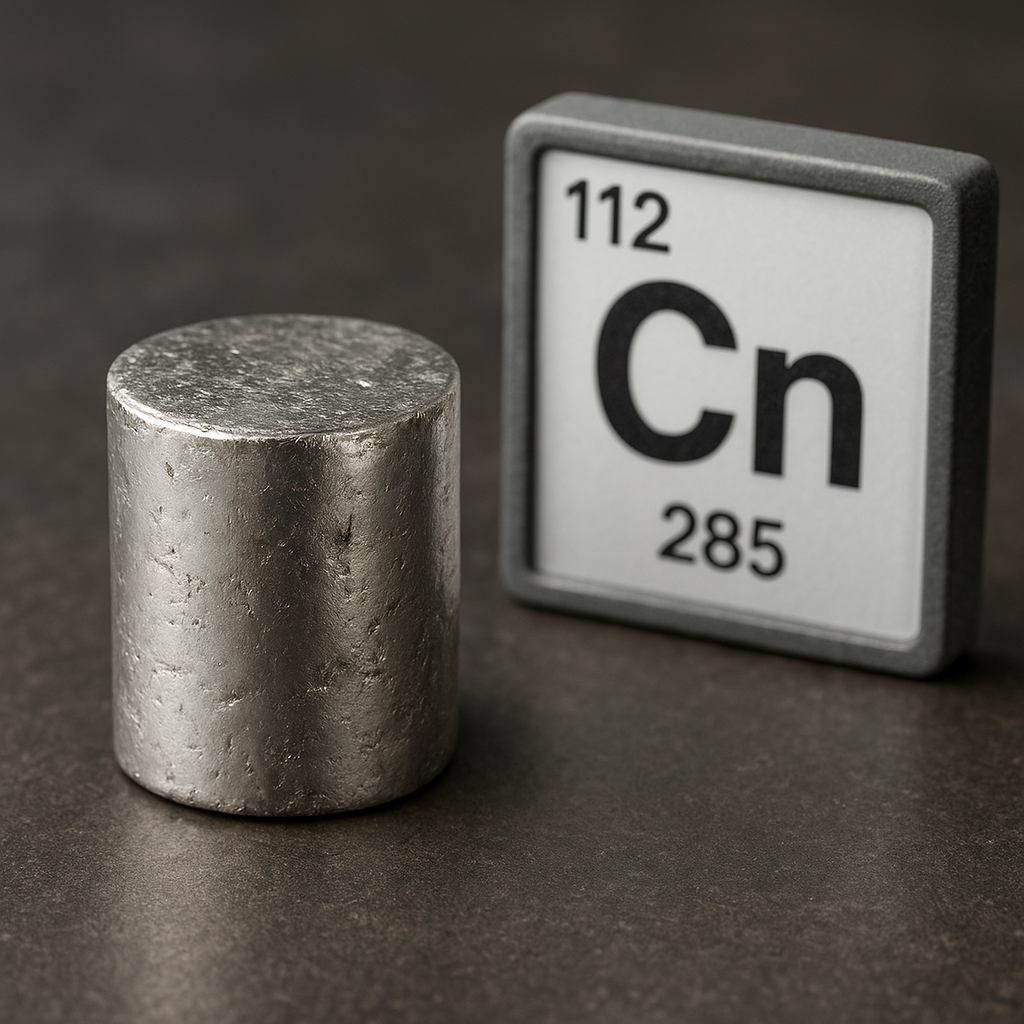
Copernicium is a compelling and exotic member of the periodic table, occupying a place among the heaviest known elements. Synthesized in minute quantities in particle accelerators, this element captures the imagination of physicists and chemists alike because it confronts the limits of nuclear stability and challenges our understanding of chemical behavior under extreme relativistic effects. The following sections explore where Copernicium is produced and why it does not exist naturally, summarize experimental evidence about its properties, describe its (currently limited) applications, and highlight related scientific themes such as the island of stability and advanced detection techniques.
Discovery and basic identity
Copernicium is identified by the atomic number element 112, and its systematic temporary name was previously ununbium (Uub) until an official name was adopted. The element was first synthesized at the GSI Helmholtz Centre for Heavy Ion Research in Darmstadt, Germany, in 1996. Teams of experimental nuclear physicists produced Copernicium nuclei by fusing heavy-ion projectiles with lead or bismuth target nuclei under carefully optimized energy conditions. The discovery produced a brief sequence of decay events that allowed researchers to assign atomic number 112 to the new atom.
The name Copernicium honors the Renaissance astronomer Nicolaus Copernicus; the IUPAC officially approved the name in 2010. Like all elements beyond uranium, Copernicium is properly classed as an artificial and synthetic element: it is created deliberately in laboratories and does not occur in appreciable quantities in the natural environment.
Where Copernicium occurs and how it is produced
Natural occurrence: Copernicium is essentially absent from nature. Its isotopes are extremely short-lived, and any atoms that might have been produced by natural radioactive processes long ago have decayed away. No naturally occurring geological or biological reservoir contains measurable amounts of this element.
Production methods
- Fusion reactions: The primary production method involves heavy-ion fusion reactions in accelerators. A light but neutron-rich nucleus (for example, zinc-70) is accelerated and made to strike a heavy target (such as lead-208). If fusion succeeds, a compound nucleus temporarily forms and then cools by evaporating a few neutrons, leaving a Copernicium isotope.
- Cold fusion vs hot fusion: Two broad strategies exist. Cold fusion uses near-barrier energies and heavy targets with closed shells (like lead), producing products with relatively low excitation energy and favoring the evaporation of one or two neutrons. Hot fusion uses actinide targets (like curium or californium) and higher energies, often producing more neutron-rich products but with higher excitation and usually higher neutron evaporation.
- Recoil separators: After production, reaction products (recoiling nuclei) are separated from the beam and unwanted byproducts using magnetic and electrostatic separators, such as SHIP (Separator for Heavy Ion reaction Products) at GSI or similar devices at other laboratories. The separated nuclei are transported to detection stations where they are implanted and observed via their decay.
Production rates are extremely low: often only a few atoms (sometimes a single atom) are detected in experiments that run for days or weeks. Because of this scarcity, each event is precious for understanding the element’s properties.
Chemical and physical properties
Copernicium sits in group 12 of the periodic table, below zinc, cadmium, and mercury. Based on its position, one might expect some similarities to mercury, but theoretical calculations predict significant departures from simple extrapolation because of relativistic effects on the electrons of superheavy elements.
Electronic structure and relativistic effects
As atomic number increases, inner-shell electrons move at a significant fraction of the speed of light. Their effective mass increases and orbital energies shift, leading to contraction of s orbitals and expansion or destabilization of others. For Copernicium, these relativistic effects make the 7s electrons particularly stabilized and alter bonding tendencies relative to lighter group-12 elements. As a result, Copernicium is predicted to exhibit atypical oxidation states and enhanced inertness in some chemical contexts.
Observed chemical behavior
Direct chemical characterization of Copernicium has been limited but informative. Gas-phase chromatography experiments have been used to probe volatility and adsorption characteristics by allowing single Copernicium atoms to interact with surfaces (often gold) at low pressures and cryogenic temperatures. These experiments suggest that Copernicium might be unusually volatile compared with mercury and may even behave like a noble metal in certain respects—exhibiting weak interaction with surfaces and a high degree of chemical inertness in some conditions.
Given experimental constraints, scientists typically describe Copernicium’s chemical properties cautiously: theoretical models and scant experimental data point to a very volatile, weakly interacting metal with strong relativistic stabilization of valence electrons.
Isotopes, decay, and nuclear properties
All known isotopes of Copernicium are radioactive and have short half-lives, typically ranging from milliseconds to seconds. Because they decay rapidly, long-term chemical or physical applications are not feasible. Experimental detection relies on identifying characteristic alpha-decay chains or spontaneous fission events that link newly produced nuclei to better-known daughter nuclides. These decay chains are key to confirming the creation of Copernicium atoms and to assigning their mass numbers.
- Decay modes: alpha decay is the most common mode observed for Copernicium isotopes; spontaneous fission is another pathway for some neutron-deficient isotopes.
- Half-lives: measured half-lives vary considerably by isotope. The available data indicate lifetimes spanning many orders of magnitude, but even the longest-lived isotopes decay far too rapidly for practical handling outside specialized experimental setups.
Applications and scientific significance
There are no practical applications for Copernicium outside of fundamental research. Its chief value is intellectual and experimental: producing and studying Copernicium advances our knowledge of nuclear physics, atomic physics, and relativistic quantum chemistry.
Research-driven applications
- Testing nuclear models: The creation and measured properties of Copernicium isotopes provide crucial data points for models of nuclear structure and stability, especially near the limits of the periodic table.
- Exploring the island of stability: The search for relatively longer-lived superheavy nuclei—the so-called island of stability—is a central motivation for synthesizing elements like Copernicium. Observations inform strategies to reach nuclei with more favorable neutron-to-proton ratios.
- Relativistic chemistry: Copernicium offers a real-world test of theoretical predictions about how extreme nuclear charge affects electronic structure and chemical behavior. Comparing experimental adsorption data and predicted properties refines computational methods used across chemistry and materials science.
- Instrumentation and methods: The challenges of creating and detecting single atoms push the development of high-sensitivity detectors, fast electronics, improved separators, and innovative chemical techniques that may have broader experimental applications.
Experimental techniques and detection
Producing Copernicium requires a suite of advanced technologies: heavy-ion accelerators, thin high-purity targets, precise beam control, recoil separators, and decay-detection arrays. Typical detection schemes implant recoiling nuclei into semiconductor detectors (e.g., silicon) that record alpha particles, conversion electrons, and fission fragments with microsecond to millisecond timing.
Gas-phase chemistry and adsorption studies
To probe chemical behavior, researchers use on-line gas-phase chromatography: a carrier gas transports freshly produced atoms through a temperature-gradient column coated with a surface material (often gold), and detectors record where atoms stick or pass through. Because experiments involve single-atom events, statistical analysis and repeated trials are necessary to build confidence in measured adsorption enthalpies and to compare them with theoretical predictions.
Safety, handling, and legal status
Copernicium’s practical hazards are governed primarily by its radioactivity, but the quantities produced are so small (often individual atoms) that normal chemical safety concerns are minimal. Nevertheless, experiments are conducted in shielded facilities under strict radiological controls. Handling protocols focus on protecting personnel from beam-related radiation and possible daughter nuclide activity rather than bulk material hazards.
Legally, Copernicium is treated like any other synthetic radionuclide: its production and handling are regulated according to national and international guidelines for ionizing radiation and radioactive materials. Institutions that synthesize it operate under licenses and oversight that ensure compliance with safety standards.
Related themes and interesting facts
The study of Copernicium touches on several broader scientific themes and intriguing ideas that extend beyond the element itself:
- Transactinide chemistry: Copernicium is part of the transactinide series—elements beyond the actinides—where chemistry is increasingly influenced by relativistic and quantum electrodynamic effects.
- Periodic table limits: Research on superheavy elements like Copernicium helps define the practical and theoretical boundaries of the periodic table and challenges our notions of periodicity under extreme conditions.
- Island of stability: The concept that certain combinations of protons and neutrons might yield superheavy nuclei with relatively long half-lives remains a major motivation; Copernicium experiments contribute important clues about how to reach these potentially more stable nuclides.
- Interdisciplinary collaboration: Experiments require collaboration among nuclear physicists, chemists, engineers, and materials scientists; progress depends on innovations in target fabrication, beam delivery, detection electronics, and theoretical interpretation.
- Naming history: Before its formal naming, element 112 carried the temporary systematic name ununbium (Uub). Its eventual naming after Copernicus reflects a tradition of honoring scientists and explorers.
- Educational impact: Even though Copernicium has no everyday applications, its discovery and study are valuable pedagogical tools illustrating nuclear reactions, decay processes, and modern experimental physics.
Challenges and future directions
Understanding Copernicium remains experimentally demanding. Future directions include synthesizing more neutron-rich isotopes (which may exhibit longer half-lives), refining gas-phase chemical measurements, and integrating experimental results with ever-more-accurate theoretical models that incorporate relativity and electron correlation. International cooperation, upgraded facilities, and advances in detector sensitivity will all play roles in deepening our understanding of Copernicium and neighboring superheavy elements.
Potential breakthroughs
- Enhanced production techniques that increase yield per experiment, allowing more extensive chemical studies.
- Discovery of isotopes with half-lives long enough to permit more detailed spectroscopy, which would illuminate electronic structure directly.
- Better theoretical models that predict chemical bonding and volatility with higher precision, validated by single-atom experiments.
Although Copernicium is a brief visitor to our laboratories, it opens windows onto the extremes of matter. The element’s creation and study probe the limits of nuclear existence and test the foundations of chemical theory when classical intuition gives way to relativistic reality. For researchers, every detected atom is both a technical triumph and a source of insight into how the periodic table behaves at its frontiers.