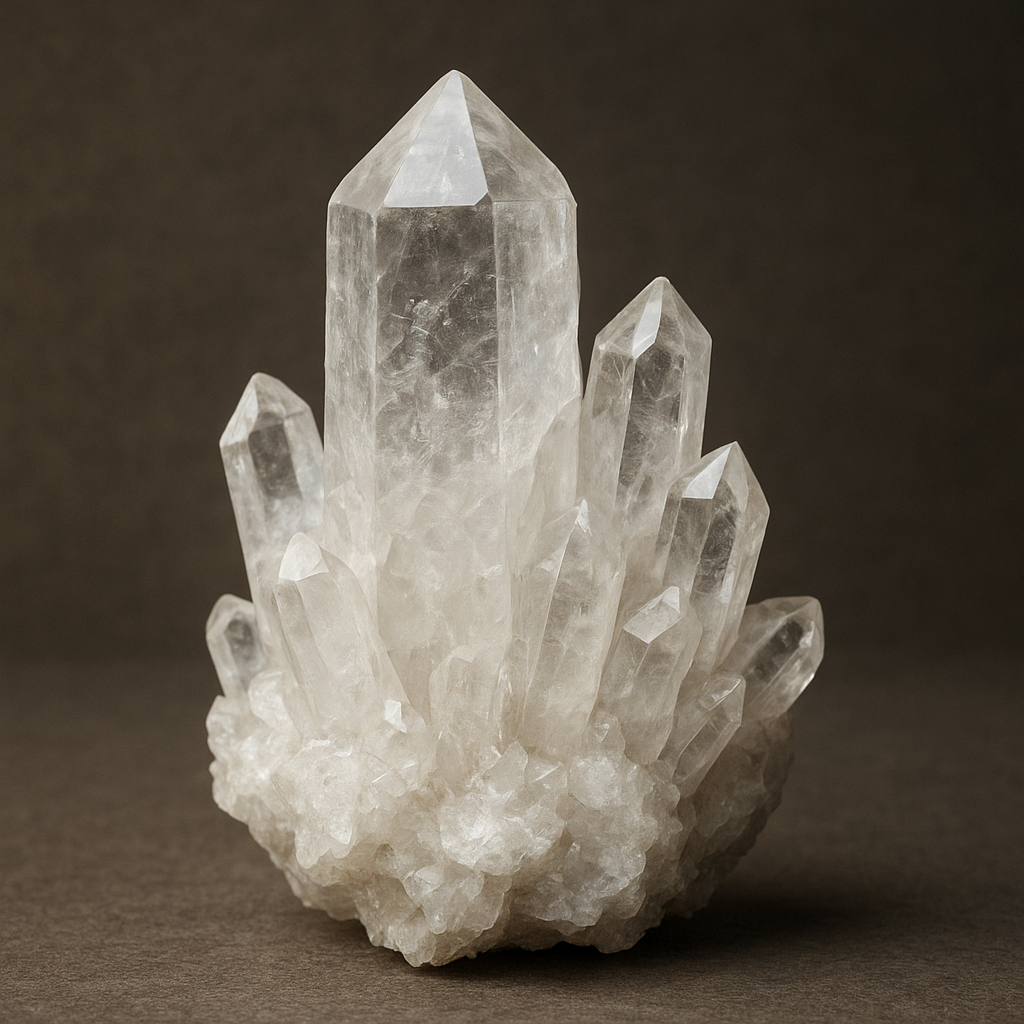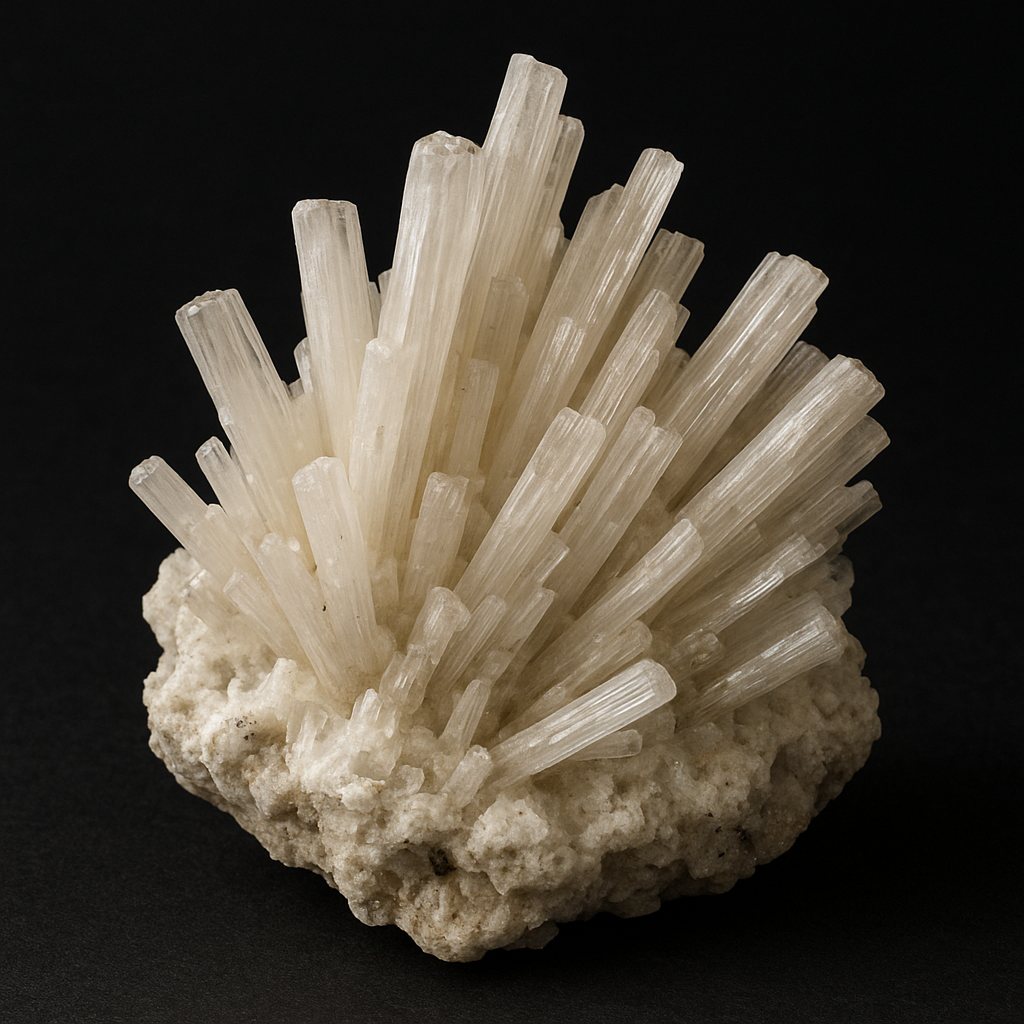
Pectolite is a fascinating but often overlooked mineral that bridges the worlds of mineralogy, gemology and cultural history. Known for its delicate fibrous crystals and the rare, enchanting blue variety called Larimar, pectolite appears in the cavities of volcanic rocks and has intrigued collectors, lapidaries and scientists alike. This article explores the mineral’s composition, global occurrences, practical uses, and several lesser-known facets that make pectolite worth closer attention.
Mineralogy, Chemistry and Formation Processes
Pectolite is a hydrous sodium-calcium silicate whose idealized chemical formula is NaCa2Si3O8(OH). The name comes from the Greek root pekto- (to congeal or become dense), a reference to its common compact or radiating habit. It typically crystallizes in thin, needle-like or fibrous aggregates that can form radiating sprays, balls, or compact masses. These hairlike crystals give pectolite a characteristic silky to vitreous luster and often a delicate texture under the loupe.
The mineral commonly forms in the cavities and vesicles of basaltic volcanic rocks where low-temperature hydrothermal fluids circulate. In such settings silica-rich solutions carrying sodium and calcium precipitate pectolite along with a suite of secondary minerals. These fluids often deposit pectolite in open voids, lining vugs and forming stellate or radiating groups. Because of this genesis, pectolite is frequently found in association with members of the zeolites and with calcite, prehnite, chalcedony and apophyllite.
Crystallography and physical traits
- Pectolite generally crystallizes in the triclinic system and displays acicular, fibrous habits; the term acicular is commonly used to describe its needle-like crystals.
- Mohs hardness lies in the mid-range (around 4.5–5), making the mineral softer than many classic gemstones but suitable for careful lapidary work.
- Specific gravity is moderate (approximately 2.6–2.9), depending on porosity and associated minerals.
- Optically it is typically translucent to opaque, and its fracture is uneven to splintery because of the fibrous habit.
These physical traits influence both how specimens are handled by collectors and how the mineral is used in jewelry: the fibrous structure can produce a silky sheen in polished pieces but also makes pectolite relatively fragile compared to tougher gem materials.
Where Pectolite Is Found
Pectolite occurrences are globally distributed, but they are most common in volcanic terrains where silica-bearing hydrothermal fluids have had access to open cavities. Notable localities are often prized for fine specimens or unusual color varieties.
- Dominican Republic — The most famous and commercially significant occurrences are those that produce the blue variety known as Larimar. This stone is found in a limited mountainous region of the southwestern Dominican Republic, where small-scale artisanal mining yields the striking blue material prized for jewelry.
- Canada — Mont-Saint-Hilaire in Quebec is renowned for diverse and well-crystallized mineral specimens, including attractive pectolite aggregates sought by collectors.
- United States — Several basaltic and trap-rock localities in states such as New Jersey and Michigan (and other states with volcanic or hydrothermal history) have produced pectolite specimens, often associated with typical zeolite suites.
- Iceland and Greenland — basaltic terrains with abundant cavities regularly yield pectolite among other secondary minerals.
- Various localities across Europe, Mexico and other volcanic provinces — pectolite shows up where suitable conditions (open cavities, silica-rich fluids, the right cations) converge.
Although pectolite is more widely distributed than some gem minerals, high-quality, richly colored specimens are rare—which is why the Dominican blue material commands attention and higher prices in the gem market.
Larimar: The Blue Variety and Its Story
The blue, green-blue and blue-white patterned variety of pectolite called Larimar is one of the most evocative and marketable forms of the mineral. Its colors range from pale sky-blue and aqua to deep turquoise-blue, often with striking white marbling or darker inclusions. The blue tones and patterns recall Caribbean seas, which helped inspire the stone’s popular name.
The modern story of larimar involves local discovery and a brief burst of international interest. In the early 20th century small amounts were known, but the variety did not become widely recognized until the 1970s when Dominican miners and a visiting foreigner helped publicize and market the material. The name larimar reportedly fuses a local miner’s daughter’s name, Larissa, with the Spanish word mar (sea), capturing the gem’s maritime hues.
Why larimar is special
- Its rare and vibrant blue colors set it apart from ordinary pectolite specimens.
- Large, well-colored pieces suitable for cutting and cabochons are uncommon, hence high-quality larimar commands premium prices.
- The mining is often small-scale and artisanal, giving larimar jewelry a connection to local crafts and communities.
Color in larimar arises from trace elements and subtle variations in chemistry and structure. Unlike turquoise or sapphire, the precise chromophore chemistry is complex; trace impurities and microinclusions are thought to influence the shades and intensity.
Uses, Lapidary Work and Market Considerations
Pectolite’s primary uses are as a collector mineral and as a gemstone when the material is attractive enough. The blue larimar variety has achieved particular popularity in jewelry, especially in cabochons, beads and small carvings.
Lapidary tips
- Because of the fibrous internal structure, pectolite must be cut and polished with care. Its moderate hardness makes it easy to shape, but edges can chip and very thin settings are risky.
- Polishing brings out a silky or vitreous sheen; many artisans favor cabochons to show the color and pattern while minimizing stress on the stone.
- Avoid harsh chemical cleaners and ultrasonic cleaners for porous or fractured pieces; gentle washing with mild soap and warm water is recommended.
Market value hinges on color saturation, pattern, size and the presence of matrix. Deep, uniform blues with attractive veining or cloud-like patterns typically fetch the highest prices among collectors and jewelry designers. Lesser-colored or heavily veined pieces are more affordable and popular for casual or artisan jewelry.
Scientific and Educational Roles
Beyond ornamentals and collectors, pectolite plays useful scientific roles. Because it commonly forms in low-temperature hydrothermal settings, it records conditions of late-stage alteration in volcanic systems. Researchers studying fluid-rock interaction, secondary mineral paragenesis and zeolite-bearing assemblages often examine pectolite-bearing vugs to infer the chemistry and temperature of formation.
Well-crystallized specimens are valuable in teaching crystallography and mineral identification. The acicular habit, silky luster and characteristic associations with zeolites and calcite make pectolite an instructive specimen for geology and mineralogy students.
Conservation, Trade Ethics and Imitations
The concentrated mining of larimar in specific zones produces social and environmental questions typical of small-scale mining operations: landscape disturbance, informal labor practices, and supply limitations. Supporting ethically sourced material and local communities is important for collectors and buyers. Many artisans and dealers work directly with Dominican miners to ensure fair trade and responsible practices.
Because larimar’s attractive blue color is commercially desirable, it is sometimes imitated. Common substitutes include dyed magnesite or howlite and other white minerals that take dye readily. Caution and basic testing help: color that penetrates deeply (versus only surface color), characteristic weight, and the presence of natural patterns and matrix are indicators of authenticity. Experienced gemologists can use microscopic inspection and more advanced tests to identify imitations.
Buying advice
- Buy from reputable dealers who can document locality and provide realistic assessments of color and treatment.
- Learn the common signs of dyed imitations: overly uniform color, dye concentration in fractures, or an unrealistically intense hue for a given price.
- When in doubt, have the piece examined by a gemological laboratory or an experienced lapidary.
Interesting Facts and Cultural Connections
Pectolite’s cultural footprint is disproportionately large compared to its modest physical presence. Larimar has become a symbol of Dominican craft and identity, appearing in souvenir markets and high-end jewelry alike. The stone’s oceanic colors fuel romantic and spiritual associations; in modern metaphysical circles, larimar is often attributed calming or soothing properties, though these claims are outside the realm of empirical science.
From a mineralogical perspective, pectolite is intriguing because it exemplifies how small changes in geochemistry produce striking visual differences. A relatively common mineral in basalt cavities can, when enriched in certain trace components and formed in the right conditions, yield the rare blue rows of larimar that are instantly recognizable.
Collectors also prize large, well-preserved radiating sprays of pectolite that showcase the mineral’s acicular habit. In museum displays pectolite and larimar specimens often attract attention for both aesthetic qualities and for the stories they tell about regional geology and human interaction with mineral resources.
Practical Care and Long-Term Preservation
To conserve pectolite specimens or jewelry:
- Store separately from harder gems to avoid abrasion.
- Keep in a dry environment to reduce risk of alteration where porous specimens have surface weathering.
- Use conservative cleaning—mild soap and warm water with a soft brush—rather than aggressive chemicals or prolonged ultrasonic exposure.
- When used in jewelry, protect pectolite from hard knocks and avoid exposure to solvents or extreme heat that could damage matrix or cause crazing.
For high-value larimar jewels, periodic professional inspection ensures settings remain secure and the stone retains its polish without suffering edge fractures.
Final Notes on Appreciation and Study
Pectolite occupies an interesting middle ground: it is a common secondary mineral in terms of geology, yet some of its varieties (notably Larimar) have achieved niche gem status and cultural visibility. Whether appreciated purely for aesthetic reasons, collected as specimens for scientific curiosity, or worn as jewelry, pectolite rewards a closer look. Its formation tells a story of volcanic activity and hydrothermal chemistry, and its market illustrates the intersection of geology, local economies and global taste.