
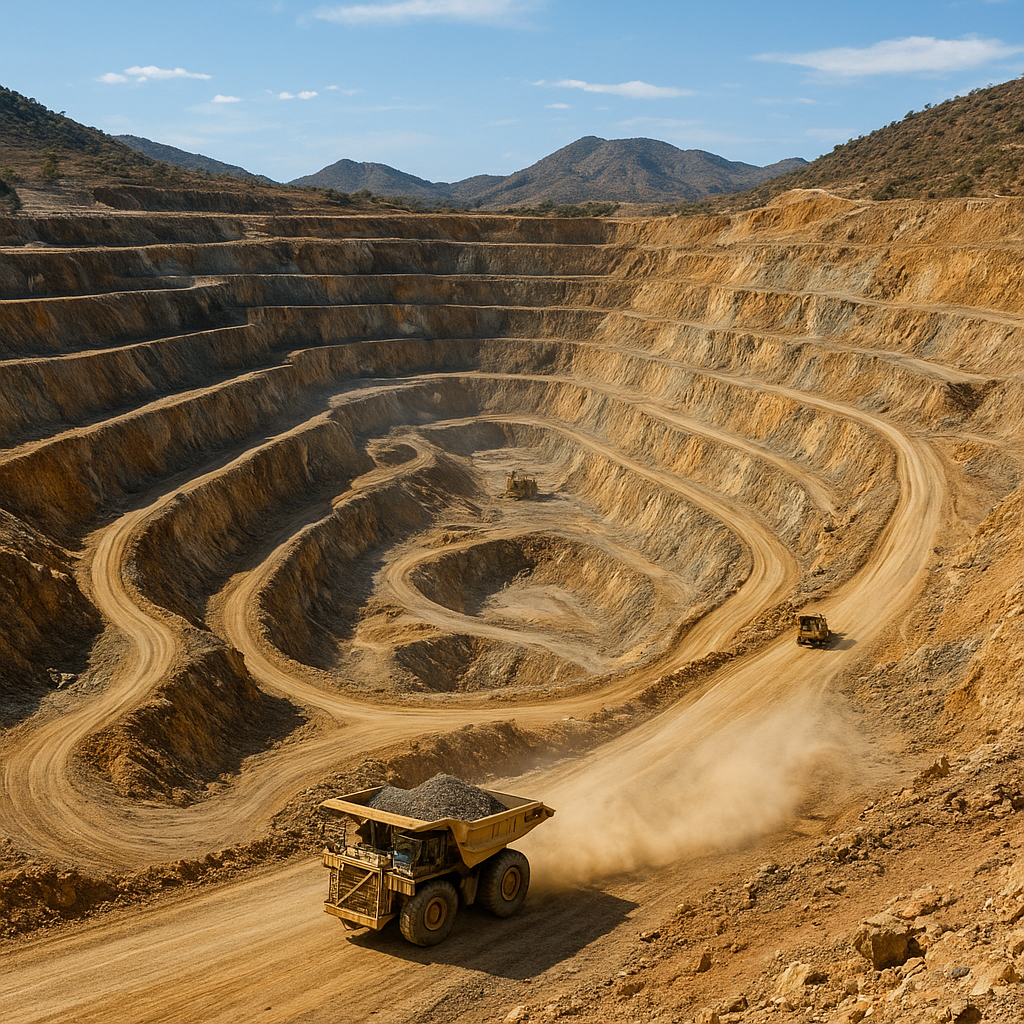
The Pinos Altos mining district, centered around the community of Pinos Altos in the state of Chihuahua, Mexico, is a long-established centre of mineral extraction in the northern Sierra Madre. Known primarily for its gold and silver resources, the area combines a rich mining history with active modern operations, complex geology, and a role that extends beyond mere commodity production into regional economic development and community life. This article examines where the mine is located, what is extracted there, its economic importance, and several interesting geological, historical, and social aspects that make Pinos Altos notable.
Location and Regional Setting
Pinos Altos lies in the rugged Sierra Madre Occidental mountain range of northern Mexico, within the municipality surrounding the small town that shares the district’s name. The district is accessible from the city of Chihuahua and other regional centres by a network of paved and unpaved roads that climb into the highlands. The topography is characterized by steep ridges, forested slopes, and valleys, an environment that has hosted mineral exploration and mining since colonial times.
The mine’s placement within the broader geological belt of northern Mexico situates it among numerous other precious- and base-metal deposits. This belt has attracted explorers and miners for centuries because of its widespread mineralization. The local community of Pinos Altos historically depended on mining as a primary source of income, and modern operations continue to influence population movement, infrastructure development, and the pattern of local services.
Mineralogy and Geology
The mineralization at Pinos Altos is typical of many productive districts in the Sierra Madre: structurally controlled veins and breccias hosting precious metals. The deposits are often described as epithermal-style mineralization, formed from hydrothermal fluids moving through faults and fractures in volcanic and volcaniclastic host rocks. In such systems, gold often occurs together with silver and a suite of sulfide minerals.
Host Rocks and Structural Controls
Local geology includes volcanic sequences—rhyolites, andesites, and tuffs—interrupted by intrusive bodies and fault zones that provided pathways for mineral-bearing fluids. The distribution of mineralization is controlled by fault intersections, dilation zones, and lithologic contacts. These structural controls create concentrated shoots of higher-grade material that underground miners target and, where conditions permit, can be expanded into open pits.
Typical Mineral Assemblage
In addition to native gold and electrum, deposits commonly include silver in various mineral forms, along with sulfides such as pyrite, sphalerite, and chalcopyrite. Gangue minerals—silica, quartz, and carbonate phases—are also common. The coexistence of gold and silver makes the ore amenable to metallurgical processing that recovers both metals, enhancing the economic value of the resource.
Mining Methods and Processing
Because the deposit geometry at Pinos Altos often features discrete veins and pockets of higher-grade ore, mining methods have historically included underground development—drifts, stopes, and vein mining. In areas where mineralization is more extensive and closer to surface, open-pit methods have been employed to exploit bulk zones of lower- to medium-grade ore. Contemporary operations tend to optimize a mix of methods to balance ore access and cost efficiency.
Extraction Techniques
- Underground mining: development of ramps, crosscuts, and stope systems to follow vein structures and extract high-grade material with selective mining.
- Open-pit mining: terraces and benches to remove overburden and extract oxidized or disseminated ore bodies where economic.
- Blasting, hauling, and crushing systems adapted to the local terrain and ore hardness.
Processing and Metallurgy
Processing of Pinos Altos ore typically focuses on recovering both gold and silver. Common metallurgical steps include crushing and grinding, followed by gravity recovery for coarse free gold where present, and chemical extraction such as cyanidation or flotation followed by leaching. Carbon-in-leach and other adsorption-desorption-electrowinning techniques are widely used in the industry to maximize recovery rates. Tailings management and water recycling are important components of modern processing facilities, addressing both environmental and operational efficiency concerns.
Economic Importance
Pinos Altos has been an important economic engine for its region. Mining activity contributes through direct employment in the mine and processing plant, contract work for local service providers, purchase of supplies, and the development of transport and energy infrastructure. The presence of a mine stimulates secondary economic activity such as retail, hospitality, and non-mining services that cater to workers and families.
Jobs and Local Development
Mining operations provide skilled and unskilled jobs that often pay above average local wages, leading to improved household incomes in host communities. Employment spans a spectrum from geologists, engineers, and technical operators to truck drivers, equipment mechanics, and administrative staff. Indirectly, jobs are created in suppliers, catering, and other service sectors.
Revenue, Royalties and Taxes
At the municipal and state levels, mining contributes through taxes, royalties, and permit fees. These revenues can be channeled into public services such as schools, roads, health clinics, and municipal projects. For smaller towns like Pinos Altos, even modest injections of capital from mining-related payments can have outsized impacts on infrastructure and public amenities.
Regional and National Role
On a regional and national scale, productive gold-silver mines such as Pinos Altos add to Mexico’s standing as one of the world’s leading producers of silver and a significant gold producer. Export earnings from precious metals contribute to trade balances and help attract further investment in exploration and mining technology across Mexico.
Social and Environmental Considerations
Mining in mountainous regions like Pinos Altos brings both benefits and challenges. Social impacts include changes in community demographics, shifts in local economies, and cultural effects related to the influx of workers and capital. Environmental aspects include land disturbance, water use, and the management of mine waste such as tailings and waste rock.
Community Relations and Social Responsibility
Companies active in regions such as Pinos Altos commonly engage in community relations programs to build trust and support. These can include local hiring policies, training programs, support for schools and clinics, and investments in local infrastructure. Transparent dialogue with indigenous groups and long-standing local residents is crucial to avoiding conflict and ensuring that benefits are shared.
Water, Tailings, and Waste Management
Water is a critical resource for mineral processing and local communities alike, so modern operations focus on efficiency and reuse to reduce freshwater withdrawals. Tailings management—designing safe storage facilities and monitoring seepage and stability—is central to environmental stewardship. Regulatory frameworks and best-practice engineering are intended to minimize risks of contamination and structural failure.
Reclamation and Closure Planning
Sustainable mines plan for eventual closure from day one. Reclamation strategies include reshaping disturbed land, replacing topsoil, revegetation with native species, and monitoring for residual contamination. Closure planning also addresses economic transition for local communities, such as retraining programs and legacy land-use planning to enable productive use of rehabilitated land after mining ends.
Historical Context and Evolution
Pinos Altos’ mining history stretches back centuries, with colonial miners exploiting visible veins and surface oxidized material long before modern exploration techniques. Over time, advances in geology, drilling technology, and processing allowed deeper and lower-grade resources to be economically extracted. The evolution from artisanal and small-scale mining to industrial operations mirrors broader trends in the mining industry across northern Mexico.
From Early Prospects to Modern Operations
Early miners focused on easily accessible high-grade veins and placer deposits. As surface and near-surface resources were depleted, exploration methodologies—geologic mapping, geochemical sampling, and drilling—identified larger targets suitable for mechanized extraction. Infrastructure improvements, including roads and power lines, made it feasible to run mills and process facilities on-site.
Interesting Facts and Lesser-Known Aspects
- Pinos Altos is not just a mine but a whole district with a tapestry of old workings, tailings areas, and historic camps that reflect centuries of human interaction with the earth.
- The interplay of volcanic geology and structural tectonics in the Sierra Madre creates crisp, localized mineral shoots—an intriguing natural laboratory for geologists studying epithermal systems.
- Many mining districts in the region exhibit multi-metal deposits; at Pinos Altos, gold often occurs with silver and other metals, making metallurgical flexibility an advantage.
- Remnants of colonial and early industrial mining—such as adits, stamp mills, and tailings—can still be observed in and around Pinos Altos, offering cultural and historical interest for visitors and researchers.
- Investment in infrastructure around productive mines typically leaves a lasting legacy: improved roads, electrical networks, and sometimes enhanced water and health services that continue to benefit communities after mining activity declines.
Challenges and Future Prospects
The future of mining at Pinos Altos depends on several variables: the size and grade of remaining resources, commodity prices, technological advances in exploration and processing, and evolving environmental and social regulations. Continued exploration may extend the mine’s life if new zones are identified. Innovations—such as improved ore-sorting technologies, more efficient water use, and stronger community engagement models—can make operations more sustainable.
Economic viability also hinges on global market conditions for gold and silver, as well as the cost of energy and inputs. Mines that adapt to changing expectations about environmental performance and social license tend to fare better in the long run. For local communities, diversification of the economy beyond mining—through tourism, forestry, or small manufacturing—can provide resilience once mining winds down.
Final Observations
Pinos Altos stands as a representative example of a productive Mexican mining district where geology, history, and modern industry intersect. Its contributions to local livelihoods, regional infrastructure, and national mineral output are clear, while the technical challenges and environmental responsibilities of running a modern mine underscore the complexity of converting subterranean resources into enduring human benefits. For geologists, historians, and economists alike, Pinos Altos offers layers of interest—from the formation of epithermal veins to the social dynamics of mining communities and the engineering solutions used to extract and process precious metals.

