
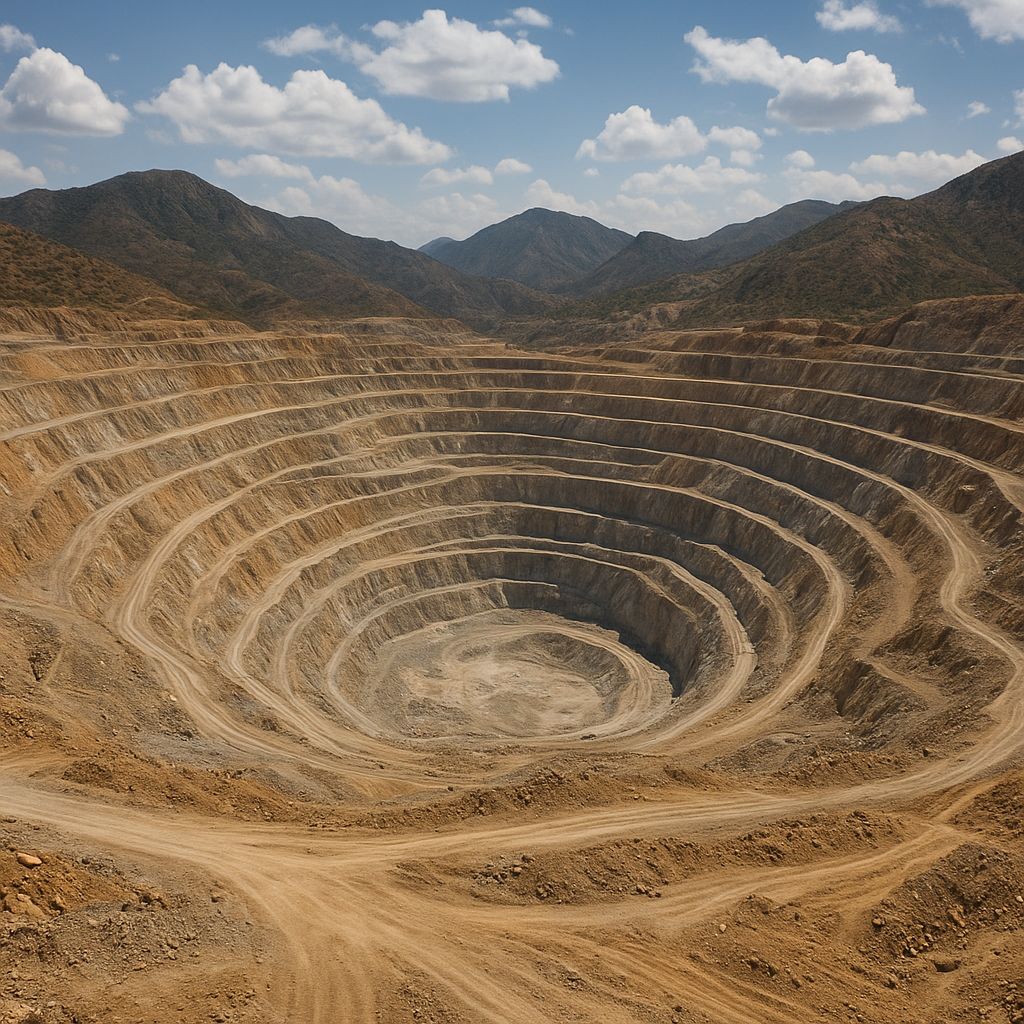
The La Parrilla mining district in northern Mexico stands as one of the country’s historically important silver producers. Situated in the state of Durango, the district encompasses a cluster of mines and processing facilities that have extracted and processed silver-rich ore for more than a century. This article explores La Parrilla’s location and geology, the nature and scale of its mineralization, its economic importance, and a number of noteworthy facts that help explain its place in regional and global mining history.
Location and geological setting
La Parrilla lies within the Sierra Madre Occidental geological province, a region known for extensive mineralization related to Tertiary magmatism and associated hydrothermal systems. The deposit is located near the town of Vicente Guerrero in the municipality of Nombre de Dios, Durango state, and is accessible by regionally connected roads that link the site to larger transportation networks serving northern Mexico. The district’s landscape is characterized by rugged hills and valleys with outcrops of volcanic and sedimentary rocks altered by hydrothermal activity.
Geologically, La Parrilla is typical of many Mexican silver deposits in that it reflects multiple episodes of mineral-bearing hydrothermal fluid flow. The host rocks include andesitic to rhyolitic volcanic sequences and associated volcaniclastic sediments. Mineralization commonly occurs in structurally controlled veins, stockwork zones and breccias, often localized along faults and contacts. Sulfide mineral assemblages dominated by argentiferous galena, sphalerite and lesser amounts of pyrite and chalcopyrite are common; these are frequently accompanied by silver sulfosalts and native silver in higher-grade portions.
Mineralization, reserves and mining methods
The La Parrilla district features classic epithermal to mesothermal vein-style mineralization. High-grade shoots of silver occur in quartz-carbonate vein systems and in replacement bodies where hydrothermal fluids interacted with more reactive host lithologies. Individual veins may range from a few centimeters to several meters in width and can extend for hundreds of meters along strike, though continuity of high-grade zones is variable.
Ore types and gangue
- Primary ore minerals: argentiferous galena, sphalerite, tetrahedrite-tennantite series (silver-bearing), and occasional native silver.
- Gangue minerals: quartz, carbonate (calcite and dolomite), barite, and various clay alteration minerals.
- Secondary minerals: oxide and supergene assemblages where near-surface oxidation has modified sulfide zones, producing cerussite, anglesite and other lead-silver carbonates and sulfates in parts of the deposit.
The deposit’s reserves have fluctuated over time due to periods of exploitation, advances in metallurgy and economic shifts in metal prices. Historically, La Parrilla supported significant small- and medium-scale underground mining activities. Modern operations in the district have used a combination of room-and-pillar, cut-and-fill and longhole stoping methods depending on vein geometry and ground conditions. Processing has typically involved crushing, grinding, gravity concentration and flotation to produce lead-silver and zinc concentrates which are then shipped to smelters and refineries.
History of exploitation and ownership
Mining in the La Parrilla area dates back to colonial times and intensified during the 19th and early 20th centuries when silver prices and demand were strong. Over the decades, ownership has changed hands among local mine operators, Mexican corporations and international exploration and mining companies. These shifts reflect both the cyclical nature of the metals markets—particularly silver—and evolving technologies that allowed previously uneconomic ore to be processed profitably.
In the 20th century, La Parrilla saw a pattern familiar to many Mexican districts: a combination of artisanal mining carried out by local miners and more mechanized operations under company management. The latter introduced mechanized underground workings, basic crushing and milling plants, and later flotation circuits and tailings management systems that increased recovery rates and throughput.
Production, processing and metallurgy
Production at La Parrilla historically focused on generation of concentrates rather than direct bullion production on site. Typical processing flows included primary crushing, secondary and tertiary crushing and grinding to liberation size, followed by gravity concentration to recover coarse native silver and heavy galena-silver particles. Flotation circuits recovered lead, silver and zinc in separate concentrates. The overall metallurgy emphasized recovery of silver either as a by-product of lead concentrates or within complex silver sulfosalt-bearing concentrates requiring specialized refining.
Recovery rates have varied depending on ore type and the sophistication of the processing plant. In favourable conditions, recoveries for silver to concentrates could reach solid percentages, while zinc and lead recoveries also contributed materially to the overall economic return. Advances in metallurgical techniques—such as improved flotation reagents, regrinding and more effective desliming—have incrementally increased the efficiency of recovery over time.
Economic significance and regional impact
The economic importance of La Parrilla is multifaceted. On a local scale, mining operations have been a significant employer in a principally rural part of Durango. Direct employment in mines, processing plants and ancillary services—transport, supply, maintenance—has provided livelihoods for local families for generations. On a regional level, the mine contributed taxes, royalties and procurement spending that supported municipal infrastructure and local businesses.
From a national viewpoint, La Parrilla formed part of Mexico’s broader silver-producing base, supporting the country’s role as one of the world’s leading silver suppliers. Silver extracted from districts such as La Parrilla feeds into global markets where it supplies industrial demand (photovoltaics, electronics, chemical applications), jewellery and investment markets. The presence of mining operations also attracted related services and technical expertise to the area, strengthening local capacity in geology, metallurgy and mine engineering.
Revenue streams and economic multipliers
- Direct metal sales: concentrates sold to smelters; in some historical periods, local or regional smelters produced bullion.
- By-products: lead and zinc concentrates provided important additional revenue streams, stabilizing income during periods of low silver prices.
- Local procurement: spending on supplies, fuel and contracting services created indirect economic effects and supported small businesses.
The cyclical nature of metal prices, particularly silver, has meant that La Parrilla’s economic impact waxed and waned with commodity cycles. During silver booms, investment and employment surged; during downturns, some operations scaled back or paused. Nonetheless, cumulative contribution over decades has been sizable.
Community, environment and regulation
Like any mining district, La Parrilla presents both opportunities and environmental challenges. The benefits—jobs, infrastructure and local economic development—are balanced by the need to manage water use, tailings, acid rock drainage potential and dust. Many of the historical operations predate modern environmental standards, leading to legacy issues that later operations and regulators had to address.
In the contemporary regulatory environment, Mexican mining operations must comply with federal and state environmental regulations, obtain environmental impact statements and implement social programs to maintain their social license to operate. Measures commonly adopted by responsible operators in La Parrilla and similar districts include:
- Constructing lined tailings storage facilities and implementing progressive rehabilitation.
- Water management plans and treatment systems for process-affected water.
- Air quality controls to reduce dust and particulate emissions from crushing and transport.
- Community engagement programs focused on local employment, procurement and infrastructure support.
Community relations have been crucial in La Parrilla’s longevity. Local expectations for jobs and economic benefits have at times clashed with environmental concerns or shifts in operational scale. Operators often negotiate benefit-sharing arrangements and local hiring commitments, while governments monitor compliance with environmental and labor regulations.
Interesting aspects and technical highlights
There are several features of La Parrilla that make it particularly interesting to geologists, mining engineers and historians of the industry:
- Complex silver mineralogy: La Parrilla hosts a mix of argentiferous galena and silver-bearing sulfosalts, providing intriguing mineralogical challenges for metallurgists aiming to optimize recoveries.
- Vertical and lateral continuity: High-grade shoots can be relatively narrow but sometimes persist for significant distances, demanding careful underground targeting and selective stoping strategies.
- Historic and modern juxtaposition: The district’s long mining history creates a layered record of technological evolution—from simple ore extraction and amalgamation techniques to complex modern flotation and hydrometallurgy.
- By-product economics: The importance of lead and zinc by-products exemplifies how polymetallic deposits can remain viable despite silver price volatility.
- Exploration potential: Unexploited or under-explored peripheral veins and deeper targets continue to attract exploration interest; modern geophysical and geochemical methods may reveal extensions of known mineralization or entirely new shoots.
From a technical standpoint, recovery of complex silver sulfosalts remains a focus of metallurgical research. Achieving high silver recoveries while producing saleable concentrates requires careful control of grind size, reagent schemes and flotation kinetics. At times, supplemental hydrometallurgical processing—such as pressure oxidation or selective leaching—has been evaluated to extract silver more effectively from refractory concentrates.
Investment, risks and future outlook
For investors and mining companies, La Parrilla presents a typical combination of opportunity and risk. Upside arises from:
- Potential for discovering additional high-grade zones through systematic exploration and modern targeting methods.
- Technological improvements that could enhance recoveries or lower processing costs.
- Positive commodity price trends, particularly for silver, lead and zinc, which improve project economics.
Key risks include:
- Volatility of metal prices, which can quickly alter project feasibility and operational scale.
- Environmental liabilities from historical operations that may require remediation and capital expenditure.
- Regulatory changes or permitting delays that can constrain development timelines.
- Social license issues if community expectations are not met or environmental impacts are perceived to be mishandled.
In many ways, the future of La Parrilla depends on the balance of exploration success, metallurgical innovation and attentive environmental and social management. Given Mexico‘s supportive mining framework and the global demand for silver, there is continued interest from both junior explorers and established mining firms in evaluating La Parrilla-type deposits. Well-run projects that combine solid technical planning with meaningful community engagement and environmental stewardship are the most likely to attract capital and sustain operations.
Broader significance within Mexico and global markets
La Parrilla exemplifies the role of medium-sized Mexican silver districts in the global supply chain. While not a single giant producer, clusters of districts like La Parrilla cumulatively make Mexico one of the top silver-producing countries. This production supports a variety of downstream industries—from electronics that require high-purity silver to the burgeoning photovoltaic sector where silver paste remains a key material in solar cell manufacture.
Moreover, La Parrilla illustrates the classic Mexican mining narrative of blending centuries-old mining traditions with modern techniques and capital. The district’s evolution reflects technological, economic and social transformations that are mirrored across many mining communities in Latin America.
Concluding observations
The La Parrilla mining district in Durango, Mexico is notable for its long history of silver production, its diverse and complex mineralization, and its role in local and regional economies. Continued exploration, improvements in metallurgy, and responsible environmental and community practices will largely determine whether La Parrilla continues to contribute meaningfully to metal supply and local development. The district remains a point of interest for geologists and mine developers because of its geological complexity, its metallurgical challenges, and the human stories embedded in decades of mining activity.

