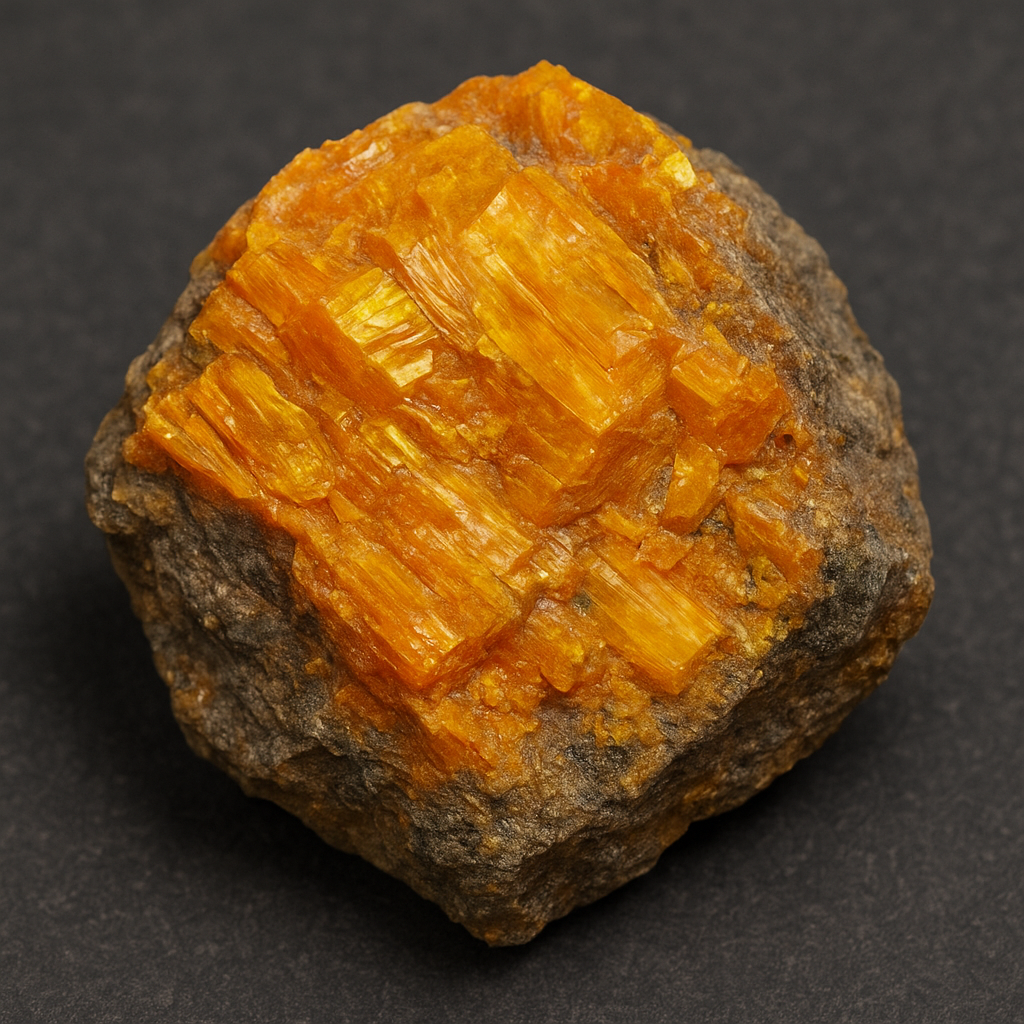
Orpiment is one of the most visually striking and scientifically intriguing sulphide minerals known to collectors, historians and materials scientists alike. Its vivid golden‑yellow to orange hues and distinctive texture have made it a subject of artistic fascination and technical interest for millennia. Beyond its appearance, orpiment embodies a complex story that links geology, toxicology, cultural history and modern photonics. This article explores where orpiment forms in nature, how it was used historically and artistically, its role in contemporary technologies, and the safety and conservation issues that accompany this unmistakable yellow mineral.
Where Orpiment Occurs: Geological Settings and Associations
Orpiment is chemically arsenic trisulfide, with the formula As2S3. It is most commonly produced in low‑temperature geological environments where arsenic and sulphur are available together. Typical natural settings include:
- Low‑temperature hydrothermal veins and replacement deposits, where hot fluids deposit arsenic‑rich minerals in fractures and porous rocks.
- Fumarolic and volcanic sublimation zones, where vapours from fumaroles cool and condense to form bright yellow crystalline aggregates.
- Hot spring and geothermal areas, where boiling or evaporative processes precipitate arsenic sulphides from solution.
- Evaporitic and sedimentary contexts where diagenetic mobility of arsenic leads to sulfide precipitation under reducing conditions.
Orpiment is frequently found together with a characteristic suite of other minerals. Common associates include realgar (arsenic sulphide with different stoichiometry and color), arsenopyrite (FeAsS), cinnabar (HgS), stibnite (Sb2S3), galena (PbS), and various barites and carbonates. These associations reflect the complex geochemical behavior of arsenic, which can partition into sulphide species under reducing conditions and into oxides or soluble complexes under oxidizing environments.
Notable occurrences appear in regions with historical mining activity and abundant geothermal or volcanic systems. Many historic deposits were exploited for their arsenic content or simply valued for the cosmetically attractive pigment orpiment provided. Modern geological surveys continue to document orpiment in varied tectonic environments, particularly in areas with active or recent hydrothermal systems.
Physical and Chemical Properties: What Makes Orpiment Distinctive
Orpiment’s striking color is its most obvious characteristic, but several physical and chemical properties are important for identification and understanding its behavior:
- Color and luster: Bright yellow to deep orange, often with a resinous to pearly luster on cleavage surfaces.
- Crystal system and habit: Orpiment crystallizes in the monoclinic system, commonly forming foliated masses, thin laminae, and needlelike crystals. It is often found as crystalline crusts or compact aggregates rather than as large, well‑formed euhedral crystals.
- Hardness and tenacity: It is relatively soft (Mohs hardness ≈ 1.5–2) and has a sectile to brittle tenacity, easily cut or crumbled.
- Specific gravity: Moderate, typically around 3.4–3.5.
- Chemical behavior: Orpiment is chemically reactive; it can oxidize on exposure to air and light to produce arsenic oxides (e.g., arsenolite, As2O3) and other alteration products. In contact with strong acids or oxidants it will release arsenic species into solution.
- Optical and electronic features: As a chalcogenide compound, crystalline and glassy As2S3 have interesting optical properties, including a relatively wide transparency window into the infrared and non‑linear optical responses that have modern technological uses.
The layered structure of As2S3, with covalent bonds within sheets and weaker interactions between them, is part of what gives orpiment its cleavage and softness. These structural features also influence how the substance behaves when it is heated, illuminated, or chemically treated — important factors in both historic pigment use and modern material processing.
Historical and Artistic Uses: Pigment, Poison, and Alchemy
For at least two thousand years orpiment has been recognized and used by many cultures. Its brilliant colour made it an object of artistic interest, while its arsenic content led to uses and reputations ranging from medicine to poison.
As a pigment
Orpiment was ground and used as a yellow pigment in manuscripts, wall paintings, lacquerware and occasional easel paintings. It provided one of the few bright, warm yellows available to artists before the synthetic era. In East Asia, particularly China and parts of Southeast Asia, orpiment and its cousin realgar were employed in lacquer work and manuscript illumination. In medieval and Renaissance Europe, artists and illuminators sometimes used orpiment for intense yellow details, although its reactivity and cost limited widespread adoption in easel painting.
Several practical issues complicated its use as a pigment:
- Orpiment’s reactivity meant it could chemically interact with other pigments or lead white to form darkened or altered compounds.
- Exposure to light and environmental oxidants can alter its color and surface, producing dulling or the formation of white arsenic oxides.
- Its toxicity made handling hazardous; artisans historically sometimes suffered from arsenic exposure during pigment preparation.
Medicinal, cosmetic and ritual uses
In a number of traditional medicinal systems, powdered orpiment appeared in small quantities as a component of remedies or topical treatments, despite the obvious risks. In some ritual and decorative contexts, orpiment’s vivid color carried symbolic meanings. Historical alchemists prized bright and unusual minerals like orpiment for both practical and symbolic reasons; arsenic itself featured in many pre‑modern chemical experiments.
Mining and industrial history
Arsenic extracted from orpiment and other arsenical minerals played a role in earlier industries. Arsenic compounds were used as pigments, in early pesticides and rodenticides, and in metal processing to produce alloys or assist in refining. The hazardous nature of arsenic gave rise to occupational diseases in past mining communities; arsenic poisoning from mine tailings and roasting operations created long‑term environmental legacies in some districts.
Modern Applications: From Glass to Photonics
While ground orpiment as a pigment has largely been superseded by safer and more stable synthetic yellows, the chemical family to which orpiment belongs — the chalcogenides — has found a new lease on life in modern technology. Glassy and crystalline forms of As2S3 and other chalcogenide compounds have properties that are useful in optics, electronics and materials science.
- Infrared optics: Chalcogenide glass made from arsenic sulfide is transparent in the mid‑infrared range, where conventional silicate glass is opaque. This makes such glasses valuable for infrared lenses, sensors and thermal imaging components.
- Nonlinear and photonic devices: As2S3 exhibits nonlinear optical behavior that can be harnessed in devices for frequency conversion, optical switching and integrated photonic circuits. These properties support research into all‑optical signal processing and telecommunications applications.
- Photo‑sensing and optical storage: Photoinduced structural changes in arsenic sulfide glasses lend themselves to rewritable holographic storage, photoresists and chalcogenide‑based phase‑change materials. The ability to change optical properties with light exposure allows for novel recording technologies.
- Semiconductors and thin films: Thin films derived from chalcogenides are studied for their electronic, photoconductive and memory properties. Research into resistive switching and neuromorphic devices sometimes explores arsenic sulfide compositions as elements in emerging memory architectures.
These modern applications typically use carefully processed, high purity materials under controlled conditions to avoid the hazards of free arsenic and to ensure predictable performance. Commercial and laboratory chalcogenide glasses are engineered to meet specific optical and thermal requirements rather than relying on raw mineral specimens.
Toxicity, Safe Handling, and Conservation Issues
The same chemical composition that gives orpiment its vivid color also makes it dangerously toxic. Its arsenic content means it can pose acute and chronic health risks if inhaled, ingested, or absorbed through skin wounds. Important considerations for handling and long‑term care include:
- Personal protection: When handling raw mineral specimens or historical pigments, use gloves, avoid breathing dust, and wash hands thoroughly. Museum professionals follow strict protocols when conserving objects containing arsenic minerals.
- Environmental risks: Weathering, grinding, or heating arsenic minerals can mobilize arsenic into soils, waterways and the atmosphere. Mining and processing of arsenic‑bearing ores has historically led to localized contamination that can persist for decades.
- Conservation conflicts: Orpiment in artworks presents dilemmas. Conservators must balance the desire to preserve color and original material against the risk of continuing chemical changes and the danger posed to handlers. In many cases, orpiment layers may flake, fade or convert to arsenic oxide, creating white crusts that alter the appearance of a work.
- Legal and disposal concerns: Waste containing arsenic demands regulated handling and disposal to prevent environmental release. Museums and laboratories follow hazardous waste procedures for materials that contain orpiment.
Because of these issues, orpiment is typically avoided in new consumer applications unless it is bound into a stable, contained matrix and appropriate safety measures are in place. In cultural heritage contexts, documentation and, when possible, stabilization are preferred to aggressive restoration that could exacerbate arsenic release.
Analytical Identification and Laboratory Notes
Identification of orpiment in the lab and in the field employs a mix of classical mineralogy and modern instrumental techniques. Useful approaches include:
- Visual inspection: Color, habit and cleavage give initial clues, but the risk of mixing up yellow minerals (e.g., sulfur, jarosite, some oxides) requires caution.
- Simple physical tests: A streak test, specific gravity measurement and hardness test can help narrow possibilities, though destructive testing is undesirable for museum samples.
- Instrumental methods: X‑ray diffraction (XRD) confirms crystal structure; scanning electron microscopy with energy dispersive X‑ray spectroscopy (SEM‑EDS) provides elemental composition; Raman spectroscopy and Fourier transform infrared spectroscopy (FTIR) detect molecular and bonding signatures; X‑ray fluorescence (XRF) offers non‑destructive elemental analysis.
- Caution with heating: Heating arsenic sulfides can release toxic volatiles; experiments that vaporize or decompose orpiment must be executed in proper fume containment and with suitable scrubbing of emissions.
In conservation science, non‑destructive optical and spectroscopic methods are preferred, allowing identification and mapping of orpiment in paint layers or substrates without exposing technicians or degrading the artifact.
Cultural and Curious Notes: Stories Around a Golden Mineral
Orpiment’s vivid color and toxic nature have given rise to many anecdotes and cultural traces. A few particularly interesting points:
- Symbolism and status: Bright yellows were historically prized and sometimes associated with wealth, divinity or alchemical transformation. The rarity and hazard of orpiment made it a material imbued with mystique.
- Artistic choices: Painters sometimes used orpiment selectively — for illuminated manuscripts, ceramics glazes, or small decorative zones — accepting the risks for the radiance it provided. In icon painting and lacquerwork, orpiment’s color could be particularly effective.
- Colors of technology: The move from natural mineral pigments like orpiment to synthetic azo and cadmium yellows in the 19th and 20th centuries reflects broader shifts in chemistry, industry and a rising awareness of toxicity.
- Scientific legacy: Research into chalcogenide materials that began with the study of minerals such as orpiment now supports advanced optical technologies, showing how a substance once valued chiefly for color can inspire future engineering.
Finally, orpiment serves as a reminder that beauty and hazard often coexist in natural materials. Its golden appearance can captivate collectors and scholars, but respect for its chemical properties and careful handling are essential. Whether encountered in a geological outcrop, a museum drawer, or a materials research laboratory, orpiment continues to fascinate across disciplines — geology, art history, conservation and modern photonics — connecting ancient practices with contemporary science.
Key terms highlighted in this text emphasize central concepts: orpiment, arsenic, As2S3, pigment, hydrothermal, toxicity, chalcogenide, infrared, glass, and mineral.