
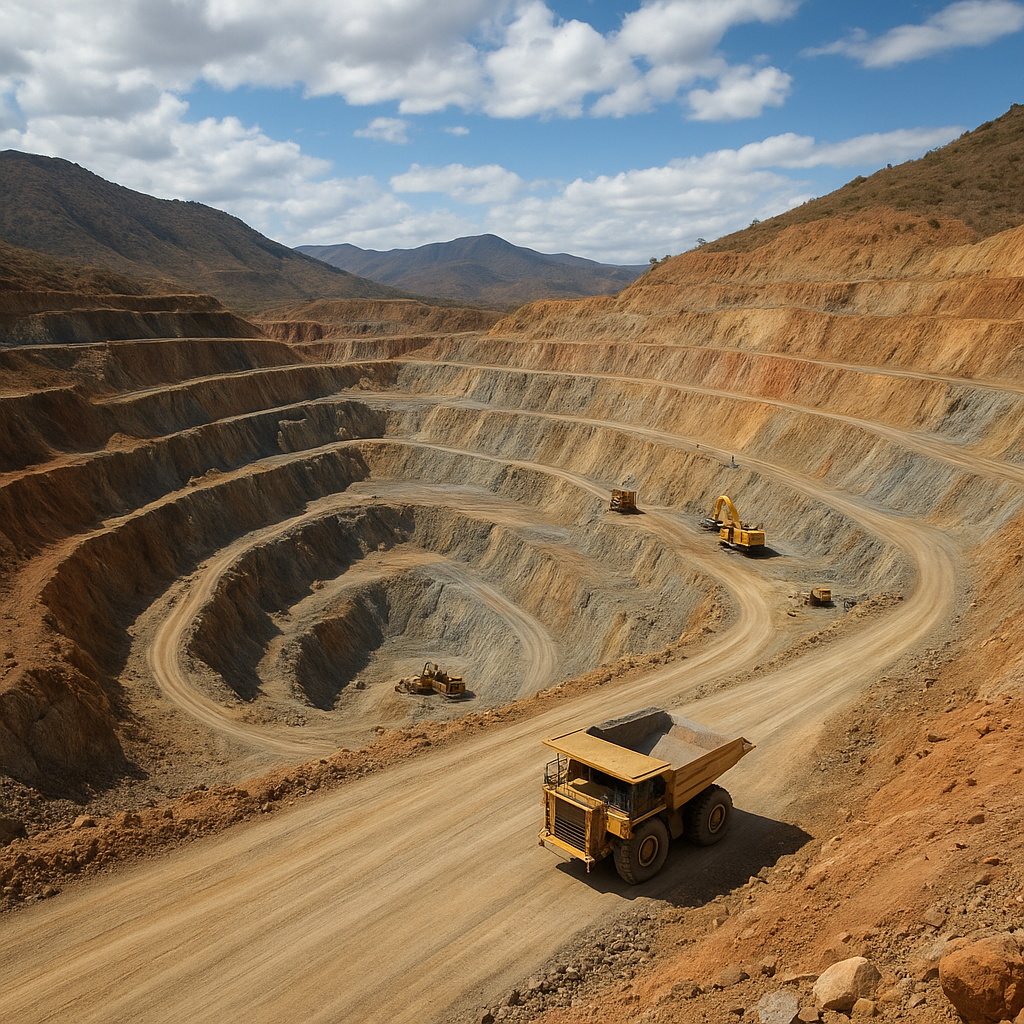
The Dolores mine is one of the best-known precious metals operations in northern Mexico, notable for producing both gold and silver from a large open-pit complex. Located in the rugged highlands of the Sierra Madre, the site plays an important role in the regional economy, provides direct and indirect employment to local communities, and attracts sustained investment from the mining sector. This article describes where Dolores is found, what is extracted and how, its economic significance, and a number of interesting technical, social and historical aspects that make the project noteworthy.
Location and geological setting
The Dolores operation sits in the state of Chihuahua, in northern Mexico, within the broader mountain chain of the Sierra Madre Occidental. The region is characterized by rugged terrain, semi-arid climate and a long history of mineralization that has made northern Mexico a global center for precious metals mining. The mine is accessed by a network of paved and unpaved roads that traverse canyons and mesas, connecting the site to nearby towns and to regional transport corridors.
Geology in brief
Dolores exploits epithermal-style mineralization, which is a common host for both gold and silver in Mexico. Epithermal systems form from hydrothermal fluids that circulate through fractures and near-surface rock units, depositing veins and stockworks of quartz with disseminated precious metals. These deposits are often amenable to open-pit mining when they are near surface and laterally extensive. The scenic slopes and outcrops around Dolores show vein systems, breccias and alteration halos typical of these deposits.
Access and infrastructure
- The mine requires significant on-site infrastructure: conveyor systems, crushing and grinding circuits, cyanide and leach processing facilities, and tailings storage.
- Power is typically supplied via regional electricity grids supplemented by on-site diesel generation for redundancy; water is sourced from local catchments and wells and carefully managed because of the semi-arid environment.
- Logistics include ore transport, concentrate and doré shipment routes, and roads that support heavy-haul truck traffic.
What is produced and how
At its core, Dolores is a precious metals producer focused on gold and silver, often recovered from oxide and transitional ore zones. The typical processing flows combine crushing, milling, and chemical leaching to extract the precious metals, producing bullion or concentrate for refining.
Mining method
The dominant method at Dolores is large-scale open-pit mining. Open-pit mining enables the operation of massive fleets of haul trucks, shovels and loaders, and is chosen when ore bodies are near surface and extensive. Overburden and waste rock are removed systematically to expose mineralized zones; blasting and fragmentation strategies are optimized to control dilution and dilution minimization is critical to maintain ore grade.
Ore processing and metallurgy
Processing plants at operations like Dolores commonly use a combination of crushing, grinding, and leaching:
- Crushing and milling to liberate mineral grains.
- Cyanide leach or carbon-in-pulp/carbon-in-leach (CIP/CIL) circuits to recover gold and silver from the slurry.
- Recovery circuits producing doré bars or concentrates, followed by transport to refineries for final refining.
Environmental controls are integral to these processes: cyanide detoxification, tailings management, dust suppression and water recycling systems are all part of modern plant engineering.
Economic significance
The Dolores mine provides multiple layers of economic impact at a local, regional and national level. While specific figures change over time, the structural effects of a medium-to-large mining operation are consistent across similarly sized projects in Mexico.
Direct and indirect employment
- Direct employment includes miners, technicians, engineers, metallurgists, environmental specialists, security personnel and administrative staff.
- Indirect employment extends to contractors, local suppliers, transport operators, hospitality and services that support the workforce and their families.
- A single mine like Dolores can sustain hundreds to thousands of jobs depending on scale and the stage of operation (ramp-up vs steady-state).
Local and regional development
Revenue from payroll, procurement and community programs can stimulate local economies. Mines invest in access roads, power improvements, water infrastructure and sometimes clinics and schools as part of corporate social responsibility programs or community development agreements. The presence of a large employer reduces migration pressures by providing stable incomes, although dependency on a single industry can create economic exposure if production slows.
Government revenue and trade
Mining contributes to public finances through royalties, taxes, and permit fees. Precious metals are an important export product for Mexico; production from mines like Dolores contributes foreign exchange inflows and strengthens the mining sector’s role in the national economy. In addition, mining projects often bring ancillary investment—service companies, exploration firms and supply chains—that broaden the economic footprint beyond the mine itself.
Environmental and social aspects
Large-scale mining operations carry environmental responsibilities and social expectations. Dolores, like other modern mines, operates within a regulatory framework that governs permits, water use, tailings management and reclamation obligations.
Water and tailings management
In semi-arid areas water is a sensitive resource. Modern operations prioritize water recycling and reuse, and implement engineered tailings storage facilities with monitoring programs. Cyanide use in leach circuits is strictly controlled according to international best practices, including detoxification before discharge and robust secondary containment systems to prevent accidental releases.
Community relations and social license
Maintaining a social license to operate is central. Engaging with local communities, addressing concerns about dust, noise, road traffic and employment, and ensuring transparent grievance mechanisms underpin long-term project viability. Companies often support education, health care and local procurement to foster positive relations.
Security and regional challenges
Security can be an operational concern in parts of northern Mexico. Mining firms invest in risk assessment and collaborate with local authorities and communities to ensure safe operations. Effective engagement and conflict resolution strategies are crucial to mitigate disruptions.
Interesting technical and historical points
Beyond the operational basics, several technical and historical elements make the Dolores operation an intriguing case study in modern mining.
1) Evolution from discovery to operation
Like many mines in Mexico, Dolores evolved from early discovery work—mapping, trenching, drilling—to feasibility studies and mine construction. The transition from exploration camp to full production involves dozens of technical disciplines working in concert: geological modeling, pit design, metallurgy testing, infrastructure engineering and environmental permitting.
2) Technology and optimization
Large open-pit operations adopt continuous improvement measures to lower unit costs and reduce environmental footprint. Fleet optimization, grade control using drill-in-blast programs, and metallurgical test work to improve recoveries are typical. Increasingly, automation and remote monitoring systems are deployed in pit operations and processing plants to increase safety and efficiency.
3) Mineralization style and research
Epithermal deposits like those at Dolores remain the subject of academic and industry research—especially regarding controls on precious metal distribution, the role of host rock chemistry and the structural pathways that localize high-grade shoots. These studies not only improve mine planning but also guide future exploration in the broader region.
4) Role in Mexico’s mining landscape
Dolores exemplifies the modern Mexican precious metals mine: integrating international investment, local workforce development and export-oriented production. Mines of this style helped establish Mexico as one of the world’s top silver producers and a significant gold producer.
5) Reclamation and legacy planning
Contemporary mining practice emphasizes planning for the end of mine life from day one. Progressive reclamation—reshaping waste dumps, re-vegetation with native species, and post-closure water management—reduces long-term liabilities and helps communities transition beyond mining dependence.
Operational challenges and future prospects
Mines like Dolores face a mix of cyclical and structural challenges as they operate and plan for the future. Commodity price volatility, permitting timelines, local social expectations, and technical issues such as deeper or lower-grade ore all shape decisions about mine life extension and exploration.
Exploration potential
Exploration around established mining centers can be highly productive because known mineral systems may extend beyond the currently defined pit. Step-out drilling, geophysical surveys and reinterpretation of historical data are common approaches used to identify satellite deposits and extensions that can sustain operations.
Economic resilience
Precious metals often serve as a hedge during periods of economic uncertainty; therefore continued demand supports margins for producers. However, operational excellence—cost control, process improvements and community relations—remains the most reliable path to long-term resilience.
Quick facts and notable features
- Dolores is located in northern Mexico and exploits epithermal gold-silver mineralization.
- The operation is principally an open-pit mine with a processing plant geared to precious metals recovery.
- Major economic impacts include job creation, local procurement and government revenues.
- Environmental management—water, tailings and chemical handling—is a significant operational focus.
- Exploration potential around the mine offers opportunities to extend the life of the project.
Final note: The Dolores mine is a representative example of how modern precious metals operations integrate geology, engineering, economic strategy and community relationships. Its significance extends beyond the metal recovered: it is a focal point for local livelihoods, regional infrastructure and the continuing story of Mexico’s mining industry.

