Nuummite is a striking and enigmatic natural material prized by collectors, jewelers, and geologists alike. Rare and visually arresting, it is known for deep, lustrous black backgrounds interrupted by flashes of color that seem to move beneath the surface. Beyond its aesthetic appeal, nuummite has a story that spans billions of years of Earth history and crosses disciplines from petrology to lapidary art. This article explores its origins, physical and optical properties, occurrences in the world, practical uses, and cultural associations, as well as tips for collectors and researchers who want to recognize and care for specimens of this remarkable stone.
Origin and Geology: How Nuummite Formed
At its core, nuummite is a product of intense geological processes. The material most widely recognized as nuummite formed in the region around Nuuk, the capital of Greenland, and derives its name from that locality. The rock originated during the deep past — the geology of the area indicates Archean-age events, so much of the nuummite is among the oldest metamorphic terrains on Earth, with parts estimated to be roughly two and a half to three billion years old.
Nuummite is not a single mineral but a metamorphic rock made up predominantly of amphibole-group minerals, especially the elongated, fibrous species commonly identified as anthophyllite and gedrite. These amphiboles form as the original igneous or sedimentary protoliths were subjected to high temperatures and pressures deep in the crust. During regional metamorphism, crystal growth and alignment of amphibole fibers produced the rock’s characteristic internal structures. Subsequent deformation, recrystallization, and retrograde metamorphism further enhanced the intergrowth textures that give nuummite its visual complexity.
The most famous optical phenomenon seen in nuummite — the metallic, shimmering flashes that catch the eye — arises from the arrangement and orientation of those amphibole fibers and associated inclusions. Light reflecting and refracting off of many tiny, closely spaced mineral surfaces creates a play of color and sheen often described as a sort of schiller or iridescence, though the exact optical mechanisms differ from those in feldspar-based labradorite or moonstone. The aligned fibrous structure also accounts for the pronounced cleavage and fracture behavior of the material, which is important to lapidaries and collectors.
Physical and Optical Properties
Understanding the physical and optical properties helps gemologists, lapidaries, and hobbyists identify and work with nuummite.
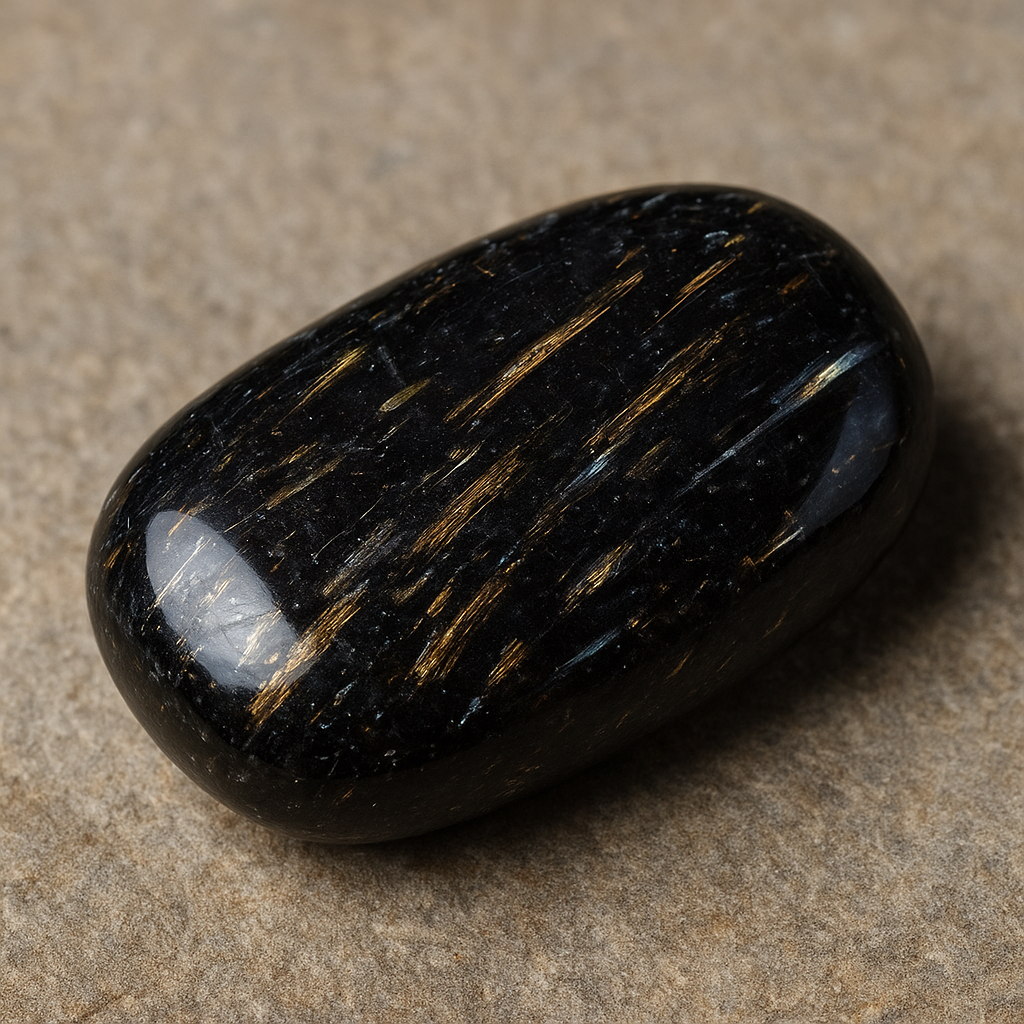
- Appearance: Most specimens display a deep, near-black matrix with flashes of metallic color — commonly gold, blue, green, and sometimes deep red. The sheen can appear as veins, flecks, or broader patches that shift with viewing angle.
- Composition: Dominated by amphiboles, particularly anthophyllite and gedrite, often intergrown with accessory minerals such as pyrite, magnetite, or other sulfides that may enhance metallic reflections.
- Hardness: On the Mohs scale, nuummite typically falls in the mid-range (roughly 5–6), making it softer than many traditional gemstones and thus demanding careful handling when crafted into jewelry.
- Density: Specific gravity values vary with composition and accessory minerals, but many nuummite specimens feel relatively heavy for their size because of the presence of dense amphiboles and iron-bearing minerals.
- Optical Effects: The hallmark is a layered or fibrous reflectivity sometimes described as a “flash” or “schiller.” Although similar in visual impact to labradorescence, the cause in nuummite is microstructural alignment of amphibole fibers and minute reflective inclusions rather than lamellar twinning in feldspars.
Where Nuummite Occurs Today
The classical and most significant deposits of nuummite are in western Greenland near the Nuuk region. These occurrences are closely tied to ancient metamorphic belts where Archean crustal rocks were metamorphosed and deformed. Because the stone is regionally named and intimately associated with that terrain, Greenland remains the primary source supplying high-quality material to collectors and lapidaries.
Outside Greenland, smaller or less well-documented occurrences have been reported from other parts of the world. Occurrences described in the literature and by trade sources sometimes include regions with ancient metamorphic terranes such as parts of Canada, Mauritania, and other shield areas, but these sources tend to produce material that can differ in composition and appearance from Greenland nuummite. In many cases the mineralogical makeup is comparable (amphibole-rich), but the color, flash, and overall character may vary depending on local geological history.
Because the stone is relatively rare and often mined in limited quantities, high-quality specimens — especially large pieces with dramatic color play — command attention in the gem and mineral markets. Accessibility to deposits in Greenland is affected by remote locations, climate, and local regulations, making commercial mining an intermittent activity rather than a large-scale operation.
Uses and Applications
Nuummite has a range of uses that span decorative, scientific, and metaphysical spheres. Its rich visual qualities make it attractive to artisans, while its geological distinctiveness draws academic interest.
Jewelry and Lapidary Work
- Cut into cabochons and polished stones, nuummite is used in pendants, brooches, and statement pieces. Its tendency to fracture and its moderate hardness mean jewelers typically favor protective settings or larger, hand-polished pieces rather than delicate faceting.
- Carvings and beadwork are also common, though skilled lapidaries must account for cleavage directions to avoid splitting during work.
Collecting and Display
- Specimens with vivid metallic flashes are highly sought after by collectors. Museum displays often feature nuummite as part of exhibits on ancient metamorphic rocks or the geology of Greenland.
Scientific Study
- Petrologists and geochemists study nuummite to understand amphibole formation, Archean metamorphic processes, and crustal evolution in ancient terranes. Trace-element analyses and microstructural studies provide insights into the pressure-temperature conditions of formation.
Metaphysical and Cultural Uses
- In contemporary crystal and metaphysical communities, nuummite is frequently promoted as a potent grounding and protective stone. Practitioners value it for supposed properties related to inner transformation and dealing with shadow aspects of the psyche.
- While these uses lack scientific basis, they form an important part of the stone’s modern cultural identity and market demand.
Cultural, Historical, and Metaphysical Associations
Although nuummite’s formal discovery and naming are tied to the Nuuk area, documented historical uses by indigenous communities are not as extensively chronicled as for some other gemstones. Nevertheless, modern narratives around nuummite blend geological wonder with symbolic meaning.
In metaphysical circles, nuummite is often attributed qualities such as deep grounding, psychic protection, and assistance with emotional or spiritual shadow work. Many writers and practitioners suggest that the stone helps reveal hidden patterns or strengthen intuitive perception. Because these claims are spiritual rather than scientific, they are best treated as part of the cultural life of the material rather than empirical fact.
Beyond metaphysics, nuummite plays a part in modern artisanal identity. Craftspeople who work with the material often emphasize ethical sourcing, given the stone’s limited supply and the logistical challenges of Greenland. This ethical discourse reflects broader trends in the gem trade toward provenance transparency and environmentally conscious practices.
Collecting, Care, and How to Identify Nuummite
Collectors and buyers should be informed to appreciate and preserve nuummite properly.
Identification Tips
- Look for the characteristic dark matrix with metallic, shifting flashes that change with angle — this visual effect is one of the most reliable field indicators.
- Under magnification, you can often observe elongated or fibrous textures and fine lamellar reflections consistent with amphibole intergrowths. This distinguishes genuine nuummite from imitations like polished glass or dyed stones.
- Testing hardness (around 5–6 Mohs) and specific gravity, when feasible, can support identification. Laboratory techniques such as X-ray diffraction or electron microprobe analysis will confirm amphibole-dominated mineralogy.
Care and Maintenance
- Avoid ultrasonic cleaners and harsh chemical treatments; these can damage the stone or alter its surface luster.
- Store nuummite away from harder gemstones that might scratch it, and use protective settings for jewelry to minimize the risk of fracture.
- Clean gently with a soft cloth and mild soapy water, rinse thoroughly, and dry immediately.
Imitations, Look-Alikes, and Market Considerations
As with many attractive minerals, the market for nuummite includes imitations and misleadingly labeled materials. Buyers should be alert to:
- Polished basalt or other black rocks with applied or natural metallic specks that may be sold as nuummite.
- Dyed stones or glass with surface treatments intended to mimic the flash effect. These will not show fibrous internal structures under magnification.
- Alternative amphibole-rich materials from other localities marketed as nuummite; provenance matters if buyers seek the classic Greenland material.
Working with reputable dealers who provide clear provenance and return policies is advisable. For high-value specimens, request or pursue laboratory confirmation of mineralogy and origin.
Related Minerals and Comparative Context
Understanding nuummite benefits from comparisons to other iridescent or amphibole-bearing materials:
- Labradorite and spectrolite: feldspar minerals that also show striking plays of color (labradorescence). The optical physics differ, but the visual impact can be analogous.
- Amphibole-rich rocks: nuummite sits within a broader family of metamorphic rocks where amphiboles occur; petrologists compare textures and chemistries across such rocks to infer geological conditions.
- Obsidian and glassy materials: superficially similar in dark appearance, but lacking the structured internal reflections and mineralogy of nuummite.
Scientific and Economic Importance
From a scientific perspective, nuummite offers windows into the deep past. Studying its mineral assemblages, isotopic signatures, and microstructures contributes to reconstructions of Archean metamorphism, crustal stabilization, and the metamorphic evolution of greenstone belts. Nuummite-bearing rocks thus become proxies for understanding ancient tectonic environments.
Economically, nuummite is a niche material. Its rarity, coupled with visual appeal, creates a boutique market for collectors and artisans. The price of specimens varies widely: polished pieces and jewelry-grade cabochons fetch higher prices, while raw material and small beads are more accessible. Market dynamics are influenced by supply constraints from remote localities, ethical sourcing campaigns, and the growing interest among collectors for unusual and ancient materials.
Interesting Facts and Lesser-Known Details
- Nuummite is often described as one of the oldest marketed stones because of its Archean origin, giving it an appealing “ancient” narrative in the gem trade.
- Despite the dramatic visual effects, nuummite rarely takes a high-gloss faceted cut. It is primarily a cabochon and ornamental material because of cleavage and toughness factors.
- Small inclusions of iron sulfides or magnetite in some specimens can produce magnetic anomalies and contribute to the metallic flashes, linking physical and optical properties in an intriguing way.
- The word nuummite connects a global market to a specific locality, reminding collectors that many outstanding geological treasures are localized and tied to unique tectonic histories.
Final Notes for Enthusiasts and Professionals
Whether your interest is scientific, aesthetic, or spiritual, nuummite rewards careful attention. Its combination of ancient origin, complex mineralogy, and striking visual effects makes it a subject of ongoing fascination. For those acquiring nuummite, prioritize verified provenance, consider the practical aspects of care and setting, and appreciate the stone both as an object of beauty and as a record of deep Earth processes. From the remote terrains of Greenland to the hands of modern artisans and collectors, nuummite remains a rare and compelling window into the planet’s distant past, its features shaped by the slow, powerful forces of metamorphism and time.