Monazite is a distinctive and economically important phosphate mineral that hosts a suite of heavy rare-earth and radioactive elements. Found in a range of geological settings from ancient continental shields to coastal placers, it has played a key role in the development of modern technologies and in geological science. This article explores where monazite occurs, what it contains, how it is used, and why it continues to attract attention from miners, geologists, and environmental scientists.
Occurrence and geological settings
Monazite typically occurs as small, dense, accessory crystals within a variety of rock types and in secondary sedimentary concentrations. It is commonly associated with granitic rocks, pegmatites, high-grade metamorphic rocks (such as gneisses and schists), and in heavy-mineral placer deposits formed by weathering and sedimentary concentration.
- Placer deposits — Coastal and riverine placer sands often concentrate monazite because of its high density and resistance to weathering. Classic examples are the beach sands of parts of India (Kerala and Tamil Nadu), Sri Lanka, Brazil (notably some coastal regions), and Madagascar.
- Pegmatites and granites — Monazite is commonly an accessory phase in felsic intrusions and pegmatites where rare-earth elements become concentrated during late-stage crystallization.
- Metamorphic terranes — In high-temperature, high-pressure environments, monazite can form or recrystallize, recording metamorphic events and fluid interactions within continental crust.
- Carbonatites and alkaline complexes — Some rare-earth deposits are associated with carbonatite intrusions and related hydrothermal systems where phosphate minerals including monazite may form.
Geographically, monazite-bearing deposits are widespread. Notable regions include southern Asia (India, Sri Lanka), parts of South America (Brazil), Africa (Madagascar, South Africa), Australia, and certain localities in North America and Europe. The distribution of monazite broadly follows regions with a history of intrusive felsic magmatism or long-lived weathering and sedimentary concentration.
Chemistry, structure and physical properties
Monazite is a family of rare-earth phosphate minerals with a general formula often written as (Ce,La,Nd,Th)PO4. The variable occupancy of the rare-earth sites means compositions vary from specimen to specimen, but cerium usually dominates. Monazite commonly contains measurable amounts of thorium and occasionally uranium, which confer mild radioactivity to many samples.
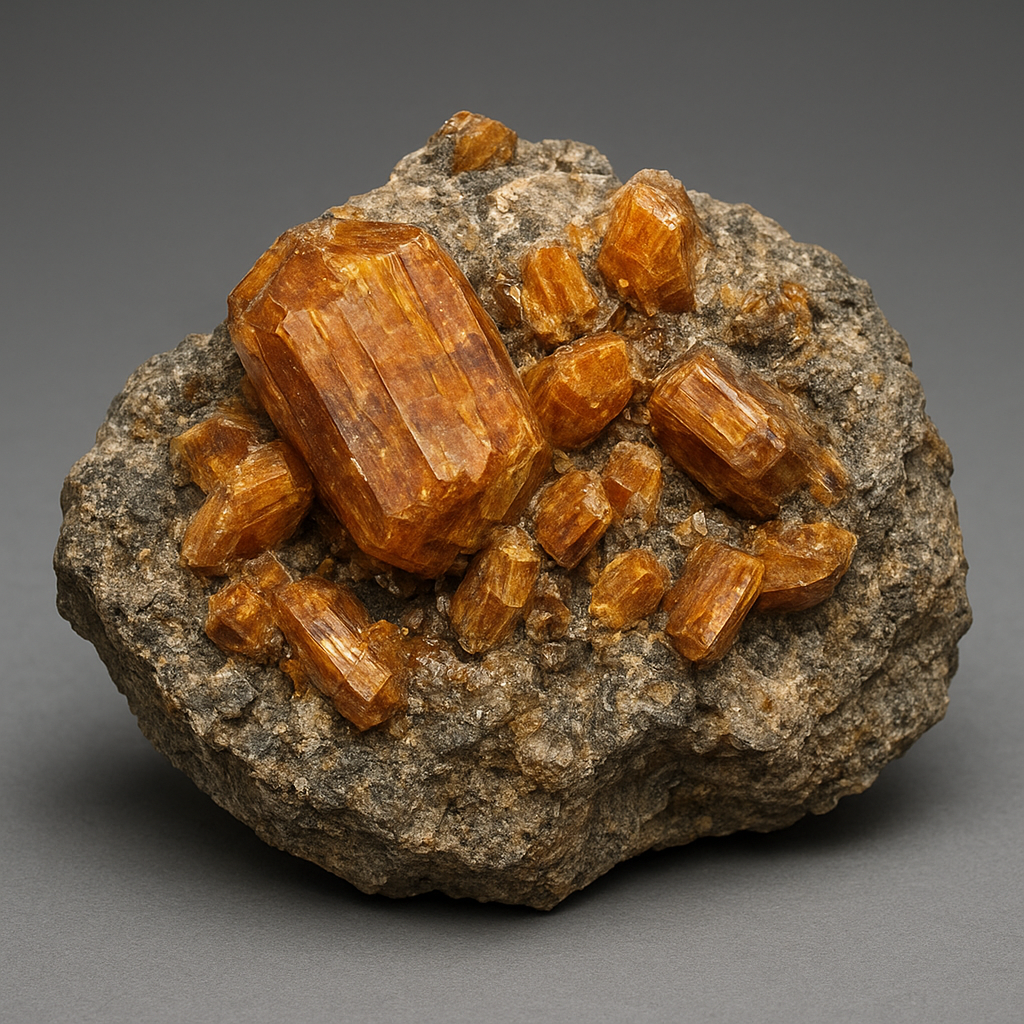
- Crystal system and habit — Monazite typically crystallizes in the monoclinic system and forms prismatic to granular crystals, often exhibiting a distinctive adamantine to resinous luster.
- Color and appearance — Colors can range from pale yellow, brown, reddish-brown to gray; weathered grains may appear dull. Fresh crystals are commonly translucent to opaque.
- Density and hardness — It is relatively dense (higher than many silicates) and moderately hard, which contributes to its concentration in placer deposits as lighter minerals are winnowed away.
- Compositional variability — The mineral accommodates a wide range of lanthanides (the lanthanides or rare-earth series) and tetravalent thorium, with chemical substitution being a primary control on physical properties.
The presence of thorium and uranium in monazite leads to radiogenic production of lead as decay products accumulate. This property underpins monazite’s role in geochronology (see below) and also has implications for handling and environmental management.
Industrial uses and economic importance
Monazite has long been an important source of several commercially valuable elements. Historically and today its economic value is tied primarily to the rare-earth elements (REEs), especially cerium, lanthanum, neodymium, and others, and to thorium as a radiogenic element of interest.
- Sources of rare-earth elements — Monazite can be processed as one of several ores to obtain individual rare-earth elements that are critical for modern technologies: permanent magnets, catalysts, phosphors, polishing powders, glass additives, and many electronic components. Demand for REEs has increased with the growth of electric vehicles, wind turbines, and advanced electronics.
- Thorium potential — Monazite’s thorium content has prompted interest in thorium as a potential nuclear fuel. While thorium itself is not fissile, it can be part of fuel cycles under specific reactor designs. This has led to regulatory and strategic attention in some countries, though large-scale thorium power has not become mainstream.
- Minor uses — In the early 20th century thorium oxide from monazite was used for incandescent mantles. Monazite has also been studied for potential applications in ceramics and refractory materials because of its phosphate structure and thermal stability.
It is important to note that monazite is not the only source of REEs; other minerals like bastnäsite, xenotime, and ion-adsorption clays also contribute significantly to global supplies. The choice of ore for commercial recovery depends on grade, ease of processing, regulatory factors related to radioactivity, and market demand for particular REEs.
Monazite in geochronology and scientific research
One of monazite’s most valuable scientific applications is as a chronometer. The incorporation of uranium and thorium into monazite crystals allows geoscientists to date geological events by measuring radiogenic lead isotopes. Monazite U-Th-Pb geochronology has become a cornerstone technique in metamorphic geology.
- Recording metamorphic history — Monazite commonly forms or recrystallizes during metamorphism, capturing the timing of pressure-temperature events in the rock record. Its resistance to later alteration often preserves information about ancient tectonic episodes.
- Provenance studies — Monazite grains in sedimentary deposits retain chemical signatures that can be tied to source rocks, aiding in reconstructing erosion, sediment transport, and basin evolution.
- Isotopic tracers — Beyond U-Th-Pb dating, monazite’s rare-earth chemistry and isotopic systems contribute to broader studies of crustal evolution, melt generation, and element partitioning during magmatic and metamorphic processes.
Modern analytical tools such as electron microprobe analysis, laser-ablation inductively coupled plasma mass spectrometry (LA-ICP-MS), and sensitive ion probes allow single-grain or even intra-grain dating of monazite. These techniques reveal complex growth histories, protracted metamorphic episodes, and high-resolution tectonic timelines without needing to dissolve whole-rock samples.
Environmental, regulatory and safety considerations
Because monazite often contains significant thorium (and occasionally uranium), mining and processing raise specific environmental and health concerns that must be managed. The radioactivity of monazite is typically low to moderate, but concentrated ore processing can increase radiological hazards if not controlled.
- Occupational safety — Workers involved in mining, processing, or handling monazite-bearing materials require monitoring and controls to limit exposure to dust and gamma/alpha radiation. Appropriate industrial hygiene, dust suppression, and monitoring are standard regulatory practices in jurisdictions with monazite mining.
- Tailings and waste management — Processing monazite for REEs or thorium produces residues that may retain radionuclides. Proper tailings design, containment, and long-term stewardship are critical to prevent leaching or dispersion into the environment.
- Regulatory frameworks — Many countries classify monazite-containing ores under radiation protection laws, requiring licensing, environmental assessment, and community engagement before large-scale extraction or processing occurs.
- Remediation and legacy issues — Historical monazite mining and processing sites sometimes require remediation to address contamination or to manage legacy tailings. Modern operations are subject to stricter standards, focusing on minimizing environmental footprint and ensuring long-term stability of waste facilities.
From a public policy perspective, balancing the strategic need for REEs with environmental protection and community health is a prominent issue. This balance influences national resource strategies and can drive investment in recycling of rare-earth-containing products to reduce reliance on primary extraction.
Interesting historical, cultural and technological notes
Monazite’s story intersects with history, culture, and the evolution of technology. The mineral’s name derives from the Greek monazein, meaning “to be solitary,” referring to the isolated crystal habit often observed. Over the past two centuries monazite has shifted from a geological curiosity to a strategic resource.
- Early industrial uses — In the late 19th and early 20th centuries, thorium from monazite was used in incandescent mantles and certain high-temperature materials. Those applications declined as alternatives emerged and regulatory frameworks for radioactivity strengthened.
- Role in modern technology — Rare-earth elements derived from monazite and other minerals are essential for high-performance permanent magnets (used in electric motors and wind turbines), catalysts in petroleum refining, and phosphors for lighting and displays.
- Cultural and gemological aspects — Transparent, well-formed monazite crystals are occasionally used as collector’s gemstones. In some mineralogical collections, monazite specimens are prized for color, crystal habit, and radioactive glow under certain detection methods.
- Strategic considerations — As nations seek secure sources of critical minerals, monazite-bearing deposits have attracted strategic interest because they can contribute to domestic REE supplies. However, the radioactive component complicates straightforward development in some jurisdictions.
Research frontiers and emerging topics
Several active research areas concern monazite. These include refining high-resolution geochronological techniques to unravel complex tectonic histories; developing improved, environmentally responsible methods for REE recovery that minimize radioactive waste; and assessing the lifecycle of REEs in technology, including recycling routes.
Geoscientists also study monazite to understand crustal evolution and the behavior of incompatible elements during melting and metamorphism. The combination of practical resource value and scientific utility ensures monazite will remain a subject of interest across disciplines.
Practical considerations for collectors and educators
For mineral collectors, monazite specimens are attractive but require awareness of radioactivity. Simple field precautions—such as storing specimens in labeled containers, minimizing dust generation, and avoiding prolonged close contact—are sensible. Museums and educational institutions that display monazite adhere to regulatory guidance for radioactive exhibits, ensuring public safety while allowing scientific and educational use.
For educators, monazite offers a compelling case study linking mineralogy, geochemistry, resource economics, and environmental stewardship. Its dual role as a source of high-tech elements and as a recorder of geologic time makes it a powerful tool to illustrate interdisciplinary connections in Earth science.
Concluding remarks on relevance and future outlook
Monazite remains important both as a natural archive of geological events and as a potential contributor to the supply of rare-earth elements critical for modern technologies. Its association with radioactive elements adds complexity to mining and processing, calling for careful management and regulation. Continued advances in analytical methods, responsible resource development, and materials recycling will shape how monazite contributes to science, industry, and society in the coming decades.