
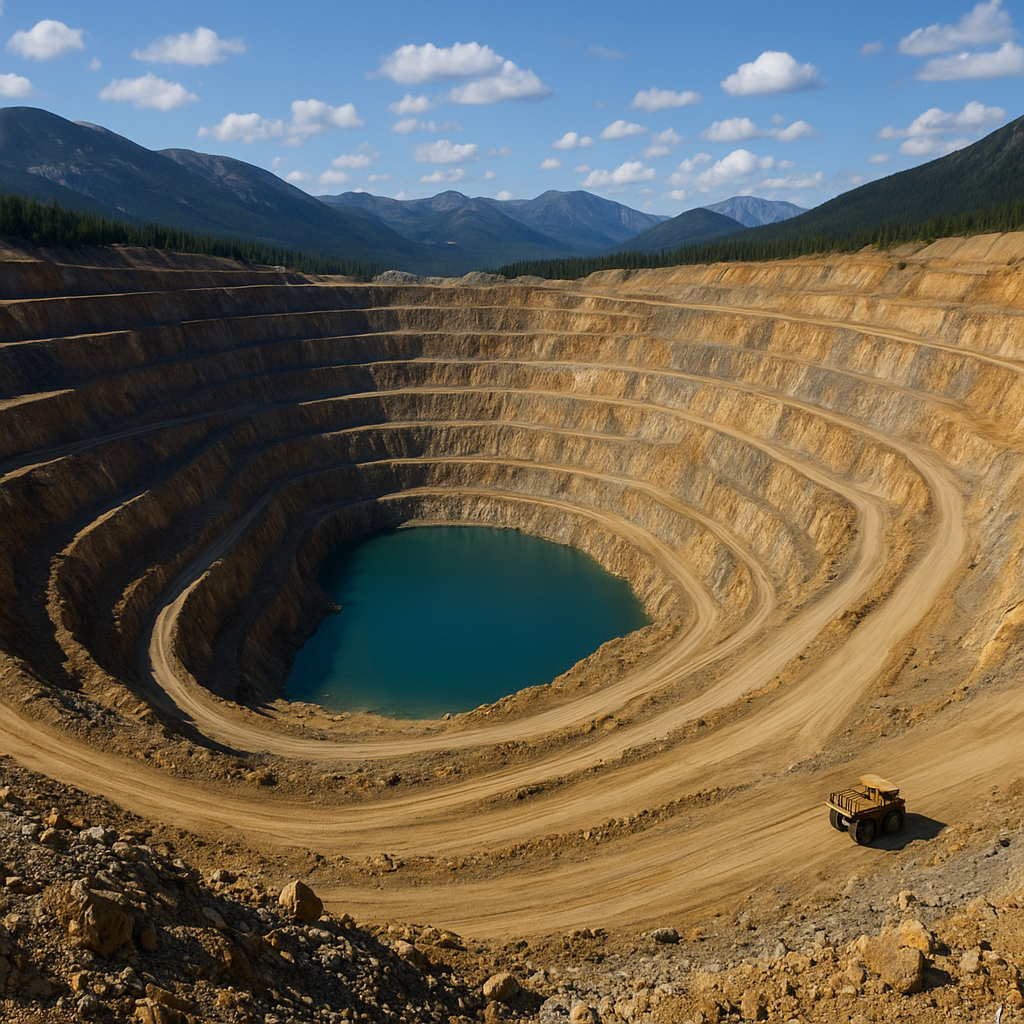
The Eleonore Mine is one of Canada’s most notable gold projects, located in the remote expanses of northern Quebec. This article explores its setting, the nature of the deposit and the mining methods used, its role in regional and national economies, and a collection of striking and lesser-known facts that make Eleonore a fascinating case study in modern mining. The mine’s profile touches geology, logistics, Indigenous relations, environmental management and technological innovation, reflecting how a remote mineral deposit can have broad significance.
Location, Setting and Accessibility
Eleonore sits in the vast territory of northern Quebec, within the administrative region commonly referred to as Nord-du-Québec and in the broader cultural landscape of Eeyou Istchee / James Bay. The site is remote by southern Canadian standards: it is nestled well north of the populated belt that includes cities like Val-d’Or and Rouyn-Noranda, and it is accessible primarily by air and by seasonal roads rather than by highway.
Because of its remote location, the Eleonore operation functions as a self-contained industrial community during production shifts. The mine maintains on-site camps, an airstrip for regular charter flights, and the supporting infrastructure needed to sustain a workforce operating in a subarctic environment. This physical isolation has shaped nearly every aspect of the project—from construction and logistics to workforce management and cost structure.
Geographic and Climatic Context
The region experiences long, cold winters, a short summer season, and significant variations in daylight depending on the season. Seasonal changes affect access: some equipment and heavy materials are delivered via winter ice roads when frozen lakes and muskeg permit heavier loads, while other supplies arrive year-round by air. The climate and permafrost conditions also influence tailings design, water management and reclamation planning, making environmental engineering a central consideration in the mine’s lifecycle.
Transport and Infrastructure
- Primary access is by chartered aircraft for personnel; an on-site airstrip supports regular flights.
- Heavy freight and fuel may be transported by winter ice roads or barged and stored when possible, reducing dependence on costly air freight.
- The operation typically includes power generation on site—often diesel with supplemental systems or connections to regional grids where feasible—and water treatment facilities necessary for regulatory compliance.
Geology and What Is Mined
The role of geology is central to Eleonore’s significance. The mine exploits a high-grade gold-bearing system hosted in Archean-age rocks, characteristic of many important Canadian gold districts. Eleonore’s deposit type is typically described as structurally controlled gold mineralization associated with steeply dipping, sulphide-rich veins and shear zones, which lends itself to underground mining methods.
The primary commodity extracted at Eleonore is gold. Although gold is the economic driver, mining operations also encounter associated minerals such as sulphides and other trace metals; however, these are generally of secondary economic importance compared to the value of the gold recovered. Ore is processed on-site in a dedicated mill, where it undergoes crushing, grinding, concentration and gold recovery via conventional metallurgical routes tailored to the mineralogy of the orebody.
Mining Methods and Processing
- Eleonore operates predominantly as an underground mine. Underground mining minimizes surface footprint relative to large open pits and is suited to high-grade, vertically oriented veins.
- Common techniques include long-hole stoping and cut-and-fill methods; backfill (often engineered paste or cemented fill) is used to support mined-out zones and improve ground stability.
- Ore is typically milled on-site using crushing and grinding circuits followed by gravity concentration and carbon-in-pulp or carbon-in-leach circuits for gold recovery. Tailings are managed in engineered storage facilities designed for cold-climate conditions.
Modern mineral processing at Eleonore emphasizes high recovery, operational efficiency and stringent environmental controls. Metallurgical testing and adaptive circuit design allow operators to optimize gold extraction from the particular mineral assemblage present in the deposit.
Production, Reserves and Economic Contribution
Eleonore is considered a high-value asset because the deposit’s grade and continuity support economically viable underground extraction despite the remote location. The mine contributes at multiple scales:
- Direct economic activity through employment of technical, trades and administrative personnel on site and in nearby service centers;
- Indirect benefits through suppliers, contractors and logistics providers that support the mine’s operations;
- Government revenue in the form of taxes, mineral royalties and permitting fees that flow to provincial and federal budgets;
- Local and regional economic development, including infrastructure improvements and community investment programs often negotiated with Indigenous governments and local municipalities.
While commodity price volatility affects annual revenue and profitability, high-grade gold operations like Eleonore typically retain economic resilience compared with lower-grade operations because less material must be mined and processed per ounce of recovered gold. This can translate to relatively lower operating costs per ounce when operations are optimized.
Employment and Local Benefits
The mine’s workforce model often follows a fly-in/fly-out rotation pattern common in remote Canadian projects. This structure allows a broad recruitment base while presenting unique workforce challenges, such as ensuring community engagement, providing effective training, and managing employee health and well-being in an isolated environment.
Agreements with Indigenous communities and local governments are frequently central to the project’s social license to operate. These can include provisions for employment and training, business procurement preferences for local firms, and long-term community development funds. Such arrangements ensure that a share of the economic benefits remain in the region and support local priorities like education, health services and cultural projects.
Environmental Management and Social Responsibility
Operating in a sensitive northern ecosystem places the onus on mine operators to implement robust environmental management practices. Water quality protection, reclamation planning and greenhouse gas management are core elements of day-to-day decision-making. The mine’s permitting and environmental assessment processes are typically rigorous, with detailed monitoring and reporting obligations to regulators and stakeholders.
Water and Tailings
Tailings storage and water treatment are especially important in colder climates. Designs must prevent contaminant migration, withstand freeze-thaw cycles, and ensure long-term stability. Operators often employ multi-barrier containment systems, continuous water treatment, and progressive reclamation to reduce the long-term environmental footprint.
Partnerships with Indigenous Communities
Indigenous engagement is not only an ethical responsibility but a practical necessity in northern Quebec. Collaborative approaches may include impact-benefit agreements, joint monitoring programs, and cultural heritage management plans. These partnerships help integrate traditional knowledge into environmental stewardship and ensure that Indigenous perspectives shape operational decisions.
Interesting Facts and Notable Features
The Eleonore Mine combines geological intrigue with logistical complexity and social dimensions that make it a compelling subject. Below are selected points that highlight aspects readers often find most interesting.
- High-grade geology: Eleonore’s gold-rich veins produce ore grades that are relatively high compared to many bulk-tonnage deposits, enabling profitable underground mining even in remote settings.
- Remote operations as a micro-economy: The mine effectively functions as a small, self-contained community—complete with housing camps, recreation facilities and on-site services—during shift rotations.
- Advanced hoisting and ventilation: To access deep high-grade zones safely and efficiently, modern underground mining uses sophisticated hoisting, rock support and ventilation systems, technology that dramatically improves productivity and worker safety.
- Logistics ingenuity: Winter ice roads and seasonal marine lift strategies reduce costs for heavy components by enabling bulk transport that would be prohibitively expensive if shipped by air.
- Environmental innovation: Cold-climate tailings solutions and adaptive water treatment systems are engineered to minimize long-term environmental liabilities under stringent provincial and federal regulations.
- Community-driven workforce development: Training programs and supplier development efforts create enduring capacity in nearby communities, including skills transferable beyond the life of the mine.
- Exploration potential: High-grade systems like Eleonore often host multiple mineralized zones; exploration around known orebodies has the potential to extend mine life, boost reserves, and justify additional infrastructure investment.
- Economic leverage: Gold mines in remote regions typically generate disproportionate economic impact locally, providing a stable tax base and opportunities for regional economic diversification.
Technical Challenges and Innovations
Operating an underground gold mine in a northern setting presents technical hurdles that have driven innovation. Geotechnical management of deep stopes, tailings governance in permafrost areas, and connecting remote operations to reliable energy sources are engineering problems that have seen creative solutions.
Automation and Remote Monitoring
Many modern mines, including those in northern Canada, adopt automation for drilling, hauling and monitoring activities. These technologies increase productivity and safety by reducing personnel exposure to hazardous underground conditions. Remote sensing and data analytics permit predictive maintenance and operational optimization, which is especially valuable when response times are extended due to remote location.
Energy Management
Fuel logistics and energy efficiency matter more the further a site is from major transmission infrastructure. As a result, mining operations experiment with hybrid power systems, waste heat recovery, and on-site fuel storage strategies. In some regions, partnerships are pursued to bring renewable power or improved energy interconnections to reduce both costs and greenhouse gas emissions over time.
Regional and National Importance
At the provincial level, Eleonore contributes to Quebec’s reputation as a major mineral-producing jurisdiction and supports government goals for responsible resource development. For Canada, mines like Eleonore reinforce the country’s role as a stable supplier of precious metals and a place where mining must balance economic returns with environmental stewardship and Indigenous rights.
The broader economic significance extends beyond direct gold sales: the mine stimulates engineering and construction firms, creates demand for specialized equipment and services, and contributes to a pool of technical expertise that underpins future exploration and mining projects across Canada.
Long-Term Considerations
Long-term value for host communities and governments depends on careful planning for mine closure and post-mining land use. Well-funded reclamation plans, ongoing monitoring, and skills-transfer initiatives can help ensure that the transition after mine closure leaves a durable legacy—both environmental and socio-economic.
Final Observations and Why Eleonore Matters
Eleonore is more than a gold mine: it is a concentrated example of how modern mining must integrate geology, engineering, community relationships and environmental science. The challenges of operating in a northern environment have stimulated innovations in logistics, infrastructure and social partnerships. As global demand for precious metals continues to evolve, the economic and technical lessons from operations like Eleonore will inform how future deposits are developed responsibly in Canada and beyond.
Whether considered from the perspective of mineral economics, regional development, or environmental management, Eleonore exemplifies how a single resource project can have amplified effects across supply chains, communities and governance systems. Its legacy will be shaped by how well today’s operators and stakeholders balance the imperative to mine valuable resources with the equally important goals of environmental protection and community prosperity.

