
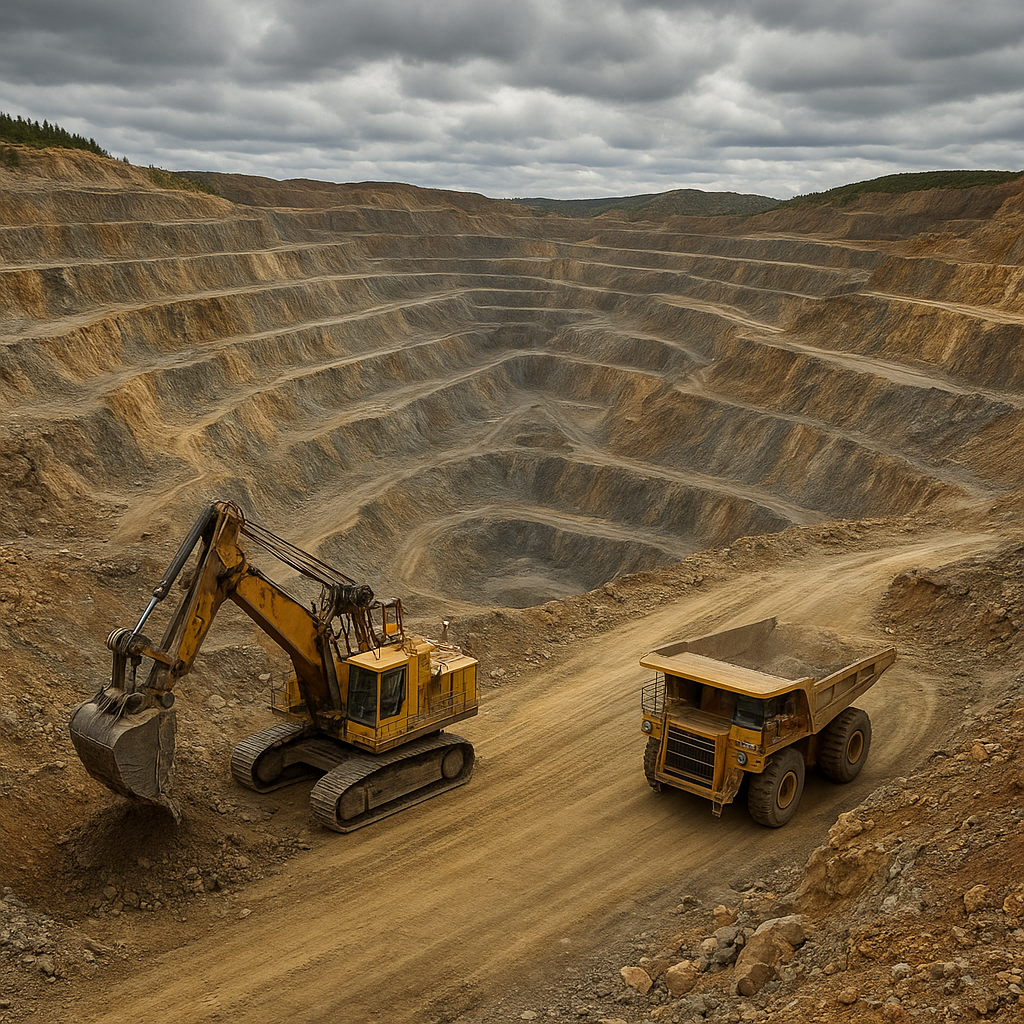
The Casa Berardi mine is one of the notable gold-producing operations in the Canadian province of Quebec. Located within a long-lived mining region, it illustrates how modern underground mining, focused exploration, and evolving processing technologies can sustain and extend the life of a mineral project for decades. This article explores where Casa Berardi is found, what is produced there, why it matters economically for the region and beyond, and several technical and historical details that make the operation interesting.
Location and geological setting
The Casa Berardi mine sits in the western part of the province of Quebec, within the Canadian Shield and the broad greenstone belts that host many of Canada’s most productive gold deposits. The mine is part of a mineralized corridor within the larger Abitibi-style orogenic terranes. These geological environments are characterized by folded volcanic and sedimentary sequences, intruded by mafic to felsic rocks and transected by shear zones where gold tends to concentrate.
Geologically, Casa Berardi is typical of an orogenic gold deposit: mineralization is commonly found in quartz veins and associated sulfide-bearing zones that have been emplaced along structural discontinuities such as faults and shear zones. Such deposits form during regional metamorphism and deformation, when gold-bearing hydrothermal fluids migrate and precipitate gold under the right pressure-temperature conditions.
How the geology controls mining
The distribution of ore at Casa Berardi reflects a complex interplay of lithology and structure. Narrow, high-grade shoots are commonly hosted in favorable lithological units and are cut by several generations of faulting and veining. Successful extraction requires careful geological mapping, detailed core logging, and targeted drilling to define ore continuity. Because of the structural complexity, the mine relies on high-density drilling and modern 3D geological modelling to guide development and production.
What is produced and how it is processed
The primary product from Casa Berardi is gold, recovered from underground-extracted ore. In most underground gold operations of this style, ore is crushed, milled and processed using a combination of gravity concentration to recover coarse gold and chemical leaching such as carbon-in-leach (CIL) or carbon-in-pulp (CIP) to recover finer gold. The concentrate or dore is then refined off-site into marketable gold bars. Tailings management and water treatment are integrated into the processing circuit to meet environmental standards.
- Mining method: Underground techniques tailored to the geometry of the ore bodies — commonly a mix of longhole stoping, cut-and-fill, and drift-and-fill where ground conditions or ore shapes demand it.
- Milling: Crushing and grinding to liberate gold-bearing minerals followed by gravity recovery and cyanide leaching circuits.
- Recovery: Carbon adsorption, stripping and electrowinning produce a final gold product that is sent to refineries.
Given the sometimes narrow but high-grade nature of the veins, selective mining and grade control are critical. Real-time ore-waste decisions underground, combined with quick assay turnarounds, help optimize mill feed and overall recovery.
Economic significance
Casa Berardi plays multiple economic roles at local, regional and national scales. At the local level the operation is a significant employer and supplier of contracts to service companies, from drilling and blasting to maintenance and catering. At a regional level the mine contributes to business activity in supporting towns and transport networks, and it helps sustain a skilled workforce that rotates through other mines in Quebec and nearby provinces.
Direct and indirect economic impacts
- Employment: The mine creates direct mining jobs (engineering, geoscience, operations, maintenance) and a broader set of indirect jobs in logistics, equipment supply, and professional services.
- Local procurement: A steady demand for goods and services — from local contractors to regional suppliers — helps diversify local economies and funds small businesses.
- Government revenue: Taxes, royalties, and permit fees provide public revenue that supports infrastructure, healthcare and education in the province.
- Export earnings: Gold produced contributes to Canada’s export profile; gold is a globally traded commodity with a role in reserves and international markets.
Beyond direct economic flows, mines like Casa Berardi act as hubs for technical expertise and training. Apprenticeships and on-site training programs develop a pool of skilled miners, electricians, mill operators and geologists who are then able to work throughout the mining industry in Canada and internationally.
Social, environmental and governance aspects
Modern mines in Canada operate within strict environmental and social governance frameworks. Casa Berardi is subject to provincial environmental regulations, community consultation processes and workplace safety requirements. Environmental management focuses on reducing water use, controlling runoff, stabilizing tailings, and progressively reclaiming disturbed land. Social responsibilities include engagement with nearby communities and First Nations to address employment opportunities, cultural concerns and benefit-sharing.
Mitigation and sustainability measures
- Water treatment: Effluent is treated to meet regulatory standards for metals and other constituents.
- Tailings: Modern tailings management techniques, sometimes including thickened tailings or filtered tailings, reduce environmental risk.
- Energy: Efficiency measures and, increasingly, electrification of underground equipment help reduce the carbon footprint of operations.
- Community programs: Investment in local infrastructure, scholarships and local procurement commitments supports long-term community resilience.
Worker safety is another priority: underground operations emphasize ventilation, rock mechanics monitoring, and emergency response training. Technological improvements such as remote-controlled equipment, better communication systems and digital monitoring improve both safety and productivity.
Operational challenges and innovations
Operating an underground gold mine in the Canadian Shield presents technical challenges — cold climate logistics, deep ore bodies, and complex geology. Innovations that have been applied to sites like Casa Berardi include advanced ore-sorting, higher-resolution geophysical imaging, and more sophisticated mine planning software.
Automation and electrification are transforming how underground mines operate. Battery-electric vehicles reduce diesel particulate emissions in tunnels and lower ventilation demands. Remote drilling and autonomous equipment can increase productivity in difficult headings and reduce exposure of personnel to hazardous work faces.
Exploration and resource extension
A recurring theme for long-lived mines is the constant search for extensions to known ore bodies and the discovery of satellite deposits. Focused exploration — intensive drilling campaigns guided by 3D models and structural interpretation — often converts previously uneconomic zones into new mineable areas. The ability to extend mine life through step-out drilling and by discovering deeper continuations of vein systems is critical to maintaining regional employment and preserving existing processing infrastructure.
Interesting facts and lesser-known details
- Mining heritage: The greenstone belts of Quebec have a mining history that stretches back more than a century. Mines such as Casa Berardi form part of that long heritage, carrying forward techniques while adopting modern technology.
- Selective high-grade mining: Operations in structurally complex deposits often produce higher-grade ore than large open-pit mines, making them economically resilient during fluctuating gold prices.
- Adaptive engineering: Adjustments in ground support, stope design and backfill methods are made continuously to handle geological variability and to keep the workforce safe.
- Research partnerships: Mines often partner with universities and technology companies to trial new metallurgical processes or digital tools that later benefit the wider industry.
- Mine-life strategy: Many underground mines maintain a portfolio approach — combining production from mature workings with ongoing exploration and small-scale development projects to keep mill throughput steady.
The broader context: gold’s role and Casa Berardi’s contribution
Gold remains a strategic commodity: it is a store of value, an industrial material with niche uses, and a key component of jewelry and electronics. Mines such as Casa Berardi contribute to the stable supply of gold that supports markets worldwide. Their role is not just the physical production of metal but also the development of regional economies, technical skills and supply chains that underpin the mining sector.
Even as global attention turns toward battery metals and critical minerals, gold operations retain strong economic importance in mining jurisdictions. The investment in responsible mining practice, community engagement and technological innovation at operations like Casa Berardi demonstrates how a mature industry can evolve to meet 21st-century expectations for environmental stewardship and social responsibility.

