
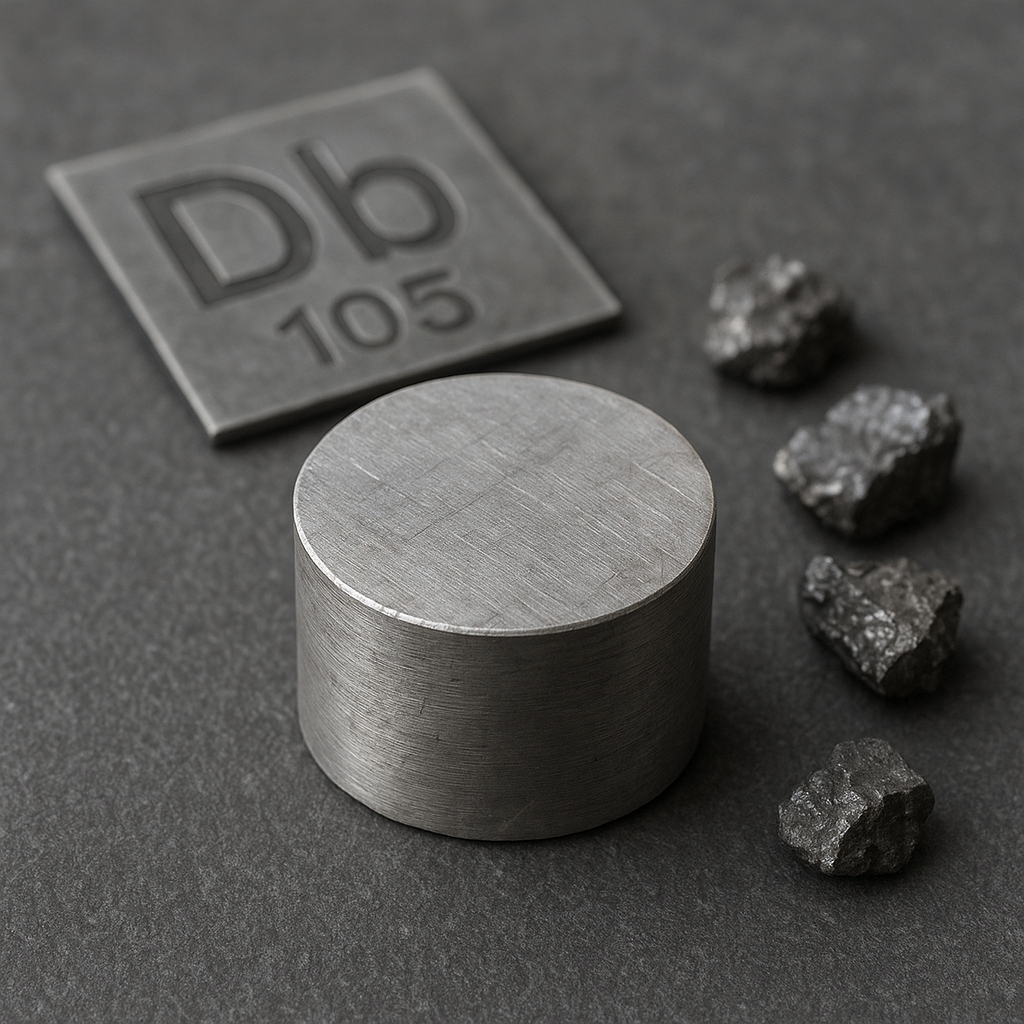
Dubnium is a synthetic, highly radioactive element in the periodic table whose story weaves together experimental ingenuity, international rivalry, and modern theoretical chemistry. Assigned the atomic number element 105 and the chemical symbol Db, dubnium sits among the early members of the heavy transactinide elements. Because it is produced only in minute amounts and decays rapidly, it has no commercial role, but its production and study illuminate the limits of matter, the behavior of electrons under extreme relativistic effects, and the structure of atomic nuclei.
History and discovery
The discovery of dubnium occurred in the context of intense scientific activity in the 1960s and 1970s, when laboratories around the world sought to extend the periodic table beyond the actinides. Two teams played central roles: researchers at the Joint Institute for Nuclear Research (JINR) in Dubna, Russia, and groups at Lawrence Berkeley National Laboratory (LBNL), California, USA. Each group produced experimental evidence for element 105 using different synthesis approaches and detection techniques. Controversy followed over priority and naming rights, a dispute that persisted for decades.
Early reports described production of isotopes that decayed by alpha emission and spontaneous fission, providing the first glimpses into the properties of this new heavy nucleus. Over time, additional experiments refined the identification of isotopes, decay chains, and chemical behavior. The question of a formal name was contentious: Berkeley scientists proposed the name “hahnium” in honor of Otto Hahn, while the Dubna team used a name derived from their home research institute. After extended review, the International Union of Pure and Applied Chemistry (IUPAC) accepted the name dubnium in 1997, acknowledging the important contributions of the Dubna laboratory to the element’s discovery.
Occurrence and production
Dubnium does not occur naturally on Earth in any significant amount. Its isotopes are exclusively synthetic, created in the laboratory through nuclear reactions that fuse lighter nuclei to form heavier ones. Production is technically demanding and expensive: accelerators that produce beams of ions, highly radioactive target materials, and state-of-the-art detection equipment are required. Facilities that have contributed to dubnium production and study include JINR (Dubna), Lawrence Berkeley National Laboratory, the GSI Helmholtz Centre for Heavy Ion Research in Germany, and other specialized heavy-ion research centers.
How dubnium is made
Researchers produce dubnium by accelerating ions of a lighter element and colliding them with an actinide target. When a collision results in fusion, a transient compound nucleus may form; if it survives long enough to shed excess energy (often by emitting neutrons), a dubnium isotope can remain. Because the cross sections (probabilities) for producing such heavy nuclei are extremely small, experiments must run for long periods while sensitive instruments search for characteristic decay signatures—typically sequences of alpha decays followed by spontaneous fission.
Isotopes and lifetimes
A range of isotopes of dubnium has been identified, spanning a variety of mass numbers. Isotopes are inherently radioactive and vary widely in stability: many decay within milliseconds or seconds, while a few have half-lives on the order of minutes to hours. Experimentalists focus on the more long-lived isotopes because these permit chemical studies and deeper characterization. The fleeting nature of all known dubnium isotopes means the element is studied in tiny, atom-by-atom experiments rather than macroscopic samples.
Chemical and physical properties
Dubnium is a member of group 5 of the periodic table, placing it beneath niobium and tantalum. Based on periodic trends and experimental results, dubnium is expected to display a dominant oxidation state of +5 and to form compounds analogous to those of niobium and tantalum. However, at such high atomic number, relativistic effects—the influence of special relativity on electron motion—alter orbital energies and can shift chemical behavior away from simple extrapolation of lighter congeners.
Chemistry in tiny quantities
Performing chemistry with dubnium requires handling atoms one or a few at a time. Two broad strategies have been used:
- Liquid-phase chemistry, where short-lived isotopes are transported and allowed to react in solution, with chromatographic techniques used to separate and identify products.
- Gas-phase techniques, in which volatile compounds or adsorption behavior on surfaces are studied to infer chemical properties.
Because experiments produce only a handful of atoms, the instruments must detect single-atom chemical events and distinguish them from background. Results from these experiments indicate that dubnium behaves like a typical group 5 element in many respects—for example, showing strong tendency for the +5 state and forming oxyanions and halides comparable to tantalum and niobium. Nevertheless, subtle deviations attributable to relativistic stabilization of certain electron orbitals and screening effects have been suggested by both experiment and theory.
Known and proposed compounds
Investigations have targeted derivatives analogous to common group 5 compounds. Studies suggest the formation of pentahalides, oxides, and complex ions consistent with a +5 oxidation state. Because experimental yields are tiny, many of these identifications rely on indirect tracers—volatility, adsorption/desorption temperatures, and characteristic decay signatures following chemical manipulations. The chemical experiments are complemented by high-level theoretical calculations, which predict molecular structures, bond strengths, and spectroscopic features taking into account relativistic quantum mechanics.
Applications and uses
There are no practical or commercial applications for dubnium. Its synthesis requires sophisticated infrastructure and produces only a very small number of atoms, each short-lived and highly radioactive. Nevertheless, the element plays a crucial role in fundamental science:
- Research into nuclear structure: Isotopes of dubnium and neighboring elements help physicists probe the shell structure of superheavy nuclei, test models of nuclear stability, and search for signatures of the predicted island of stability—a region of heavier nuclei that might exhibit comparatively longer half-lives.
- Testing theoretical chemistry: Dubnium provides an extreme case for studying how relativistic effects influence chemical bonding and periodic trends, offering benchmarks for advanced computational methods.
- Development of experimental techniques: The demands of dubnium research drive improvements in accelerator technology, detection systems, automated chemistry setups, and single-atom measurement methodologies that have broader applications in nuclear and materials science.
Research methods and detection
Detecting individual atoms of dubnium is a technological challenge. Several key techniques and instruments are essential:
- Heavy-ion accelerators to produce energetic ion beams.
- Actinide targets and specialized targetry to withstand intense bombardment.
- Recoil separators that isolate reaction products from the primary beam and transport them to detector arrays.
- Alpha and gamma spectroscopy systems that record decay energies and times, enabling reconstruction of decay chains.
- Chemical separation systems, often automated and miniaturized, that perform rapid transport and reaction steps within the short lifetimes of produced atoms.
These capabilities allow scientists not only to identify new isotopes but also to test chemical behavior by observing how the atoms interact with surfaces and reagents under controlled conditions.
Challenges and innovations
Because production rates are often a few atoms per day or less, maximizing detection efficiency and minimizing background noise are central concerns. Innovations include improved recoil separators, faster and more selective chemical separation approaches, and advanced detectors with excellent energy resolution and timing. Collaborative experiments across facilities, the sharing of target materials, and long-duration campaigns are common tactics to obtain statistically meaningful data.
Safety, handling, and practical considerations
Dubnium isotopes are highly radioactive, but practical safety concerns are mitigated by the extremely small quantities produced—typically only a few atoms at a time. Experimental work is carried out remotely, with shielded equipment, automated handling systems, and multiple layers of containment and monitoring. Radiation safety protocols ensure that researchers are not exposed to significant doses, and waste is managed according to strict regulatory standards. From a practical standpoint, the scarcity and short lifetimes of dubnium atoms make any large-scale use impossible.
Why dubnium matters: scientific and cultural perspectives
Although dubnium has no everyday application, it matters for several reasons. Scientifically, each new synthetic element extends our understanding of how protons and neutrons pack into a nucleus and how electrons arrange themselves in the extreme potential of very heavy atoms. Studies of dubnium help:
- Test predictions from nuclear models and the limits of nuclear stability;
- Illuminate the role of relativistic quantum mechanics in chemistry;
- Provide data that guide the search for even heavier, more long-lived superheavy elements.
Culturally, the history of dubnium highlights the international and sometimes competitive nature of big-science efforts. The dispute over discovery and naming underscored the need for clear standards and led to more systematic approaches by international governing bodies. The element’s name itself commemorates a place—Dubna—that has long been a center for nuclear physics research.
Future directions and open questions
Research on dubnium continues in several directions:
- Refining measurements of nuclear decay properties and identifying new isotopes that lie closer to predicted regions of enhanced stability.
- Expanding chemical studies to probe bonding preferences, oxidation states beyond +5 in exotic environments, and the influence of relativistic effects on ligand interactions.
- Improving production techniques and separator efficiencies to increase yields and enable more detailed investigations.
- Applying insights from dubnium experiments to the broader quest for synthesizing and characterizing elements at the far edge of the periodic table.
This ongoing work bridges nuclear physics, quantum chemistry, and instrumentation development, making dubnium studies an engine of broader scientific progress.
Notable anecdotes and curiosities
The story of dubnium includes a few memorable points:
- The naming controversy between research groups contributed to changes in how discoveries are credited and how element names are decided.
- Because experiments are performed atom-by-atom, dubnium research is an extreme example of single-atom chemistry and detection.
- Dubnium’s placement in the periodic table helped validate that the classic organization of elements remains useful even at very high atomic numbers, while also highlighting the need to incorporate relativistic and quantum effects into chemical predictions.
These aspects make dubnium both a scientific curiosity and a case study in the evolution of modern chemistry and physics.