Magnetite is one of the most intriguing and practically important minerals on Earth. Known for its distinctive black color and strong magnetic properties, it has played roles across geology, industry, biology, and advanced technology. This article explores what magnetite is, where it forms and is found, how it is used today, and several related topics that reveal why this mineral continues to attract scientific and commercial interest.
What magnetite is: composition, structure and physical properties
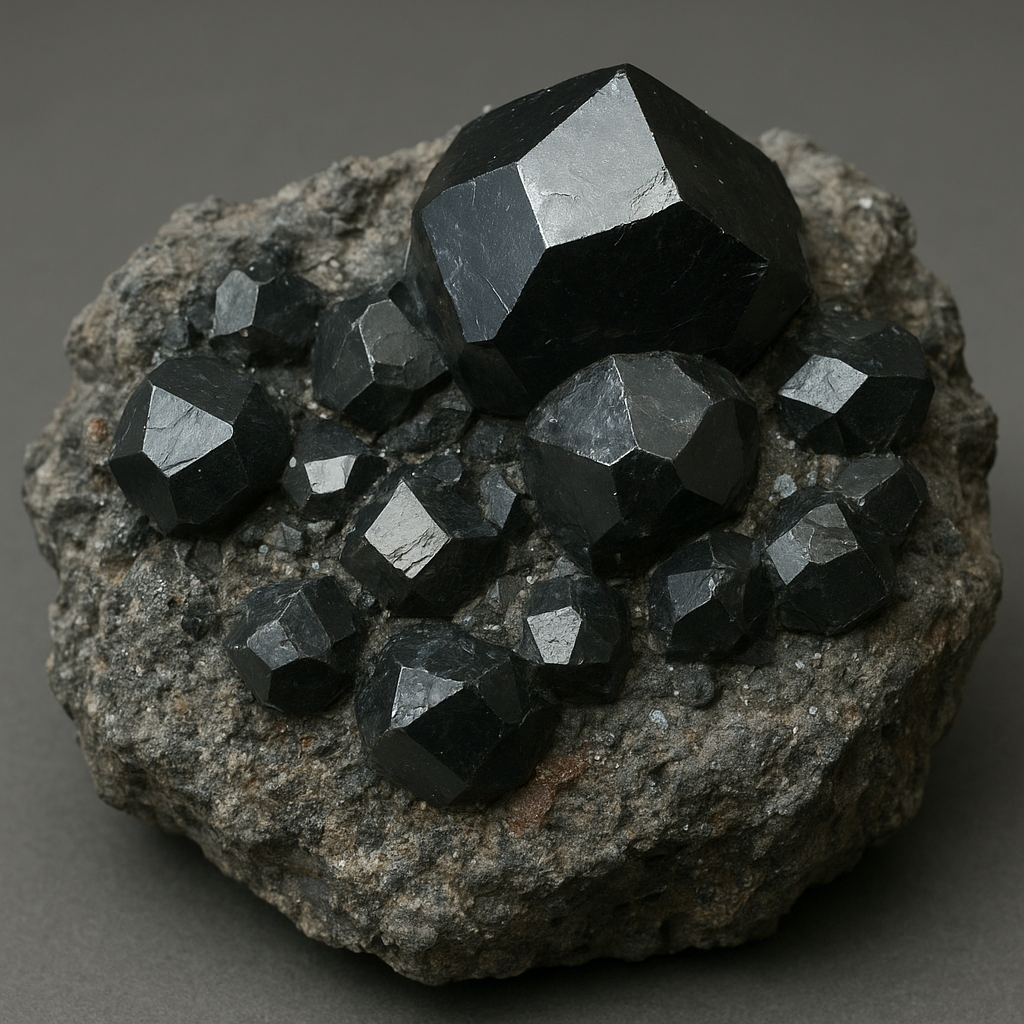
Magnetite, with the chemical formula Fe3O4, is an iron oxide that combines both ferrous (Fe2+) and ferric (Fe3+) iron in a single structure. Its crystal structure is inverse spinel, which contributes to the distinctive electronic and magnetic behavior that makes magnetite so valuable. The mineral often occurs as octahedral crystals or as granular to massive aggregates, and it typically appears jet-black or dark gray with a metallic to submetallic luster.
Key chemical and physical features
- Magnetite is a mixed-valence oxide, meaning iron exists in two oxidation states; this underpins its electronic conductivity and complex magnetic ordering.
- It has a high specific gravity (around 5.2 g/cm3) and a Mohs hardness of about 5–6, making it relatively durable in many environments.
- The mineral shows strong magnetism at room temperature (ferrimagnetism), often retaining a remanent magnetization that records the Earth’s geomagnetic field where it formed.
- At temperatures below the Verwey transition (~120 K), magnetite exhibits changes in electrical conductivity and magnetic anisotropy, a subject of interest in condensed matter physics.
The combination of metallic conductivity and magnetic ordering makes magnetite a bridge between traditional mineralogy and modern materials science.
Natural occurrences: where magnetite is found
Magnetite is widespread in the Earth’s crust and appears in diverse geological settings. Its distribution reflects varied formation processes, from igneous crystallization to sedimentary concentration and biological production.
Major geological environments
- Igneous rocks: Magnetite commonly crystallizes from mafic and ultramafic magmas and is abundant in gabbros, norites, and layered mafic intrusions. It is a common accessory mineral in many plutonic rocks.
- Metamorphic rocks: During metamorphism of iron-rich sediments or banded iron formations, magnetite often forms through recrystallization or reaction processes.
- Magmatic segregation and massive magnetite deposits: Large magnetite-rich ore bodies occur in layered intrusions and skarn systems, forming important iron ore deposits exploited by mining industries worldwide.
- Sedimentary environments: Heavy-mineral sands and placer deposits can concentrate magnetite by mechanical sorting, yielding iron sands in coastal and fluvial settings.
- Hydrothermal and vein systems: Magnetite can precipitate from hydrothermal fluids, sometimes associated with other ore minerals like chalcopyrite.
- Meteorites and extraterrestrial sources: Magnetite is also observed in some meteorites and can form during aqueous alteration on planetary bodies, making it relevant for planetary science.
Biological and environmental occurrences
Certain microorganisms synthesize magnetite within specialized structures called magnetosomes; this process is known as biomineralization. Magnetotactic bacteria align these magnetite crystals to navigate along geomagnetic field lines. Additionally, magnetite particles have been reported in animal tissues (including fish, birds, and possibly humans), where they may play roles in magnetoreception and other physiological processes.
Industrial and historical uses of magnetite
Magnetite has been exploited for centuries as an iron ore source and for specialized applications that capitalize on its density and magnetic properties.
Traditional and current industrial applications
- Iron production and steelmaking: Magnetite ore is a primary source of iron for blast furnaces and direct reduction processes, especially where massive magnetite deposits are available.
- Dense media separation: Because of its high density and magnetic separability, magnetite is used in coal washing and mineral separation processes as a dense medium.
- Pigments and ceramics: Finely ground magnetite can serve as a black pigment or be used in ceramic glazes and special concretes.
- Magnetic recording and components: Historically, natural magnetite was used in early magnetic recording media; today synthetic magnetic materials have largely replaced it in data storage, but magnetite remains relevant in magnetic cores and filters.
- Construction materials: Magnetite sand has been used in radiation-shielding concrete because of its high density.
Applications in environmental engineering and remediation
Magnetite is valuable in environmental contexts because of its surface chemistry and magnetic properties. It can be applied as a sorbent for heavy metals and organic pollutants, and magnetic separation allows recovery of spent sorbent.
- Remediation of contaminated groundwater: Magnetite nanoparticles or supported magnetite materials can adsorb contaminants like arsenic, chromium, and certain organics, enabling magnetic recovery.
- Permeable reactive barriers: Magnetite-containing materials can be integrated into reactive barriers to treat flowing groundwater.
- Water treatment: Magnetite-based filters or flocculants can improve removal of turbidity and contaminants.
Magnetite at the nanoscale: synthesis and biomedical uses
When scaled down to the nanometer range, magnetite acquires distinct physical and chemical properties that enable a range of advanced applications. Controlled synthesis methods produce nanoparticles with tailored size, shape, and surface chemistry.
Synthesis methods
- Coprecipitation: Chemical precipitation of Fe2+ and Fe3+ salts in basic solution is a widely used, scalable route to magnetite nanoparticles.
- Thermal decomposition: Organometallic precursors decomposed at high temperatures yield highly crystalline, monodisperse nanoparticles with narrow size distributions.
- Hydrothermal and solvothermal routes: These techniques allow control over particle morphology and crystallinity under elevated temperature and pressure.
- Biomimetic and green synthesis: Using biological templates or plant extracts can produce magnetite particles under milder, more environmentally friendly conditions.
Biomedical applications
Magnetite nanoparticles have been explored extensively for medical uses thanks to their magnetic responsiveness and potential for functionalization.
- Magnetic resonance imaging (MRI) contrast agents: Superparamagnetic magnetite nanoparticles can enhance contrast by affecting local proton relaxation times.
- Targeted drug delivery: External magnetic fields can guide functionalized nanoparticles to specific tissues, improving delivery efficiency.
- Hyperthermia therapy: Alternating magnetic fields can heat magnetic nanoparticles within tumors, selectively damaging malignant cells.
- Bioseparation and biosensing: Magnetic nanoparticles enable separation of biomolecules and cells, and can be integrated into biosensors.
Biomedical use demands careful surface engineering to ensure biocompatibility and minimize potential toxicity. Coatings such as polyethylene glycol (PEG), dextran, or silica are common.
Scientific relevance: magnetite in geosciences and materials research
Magnetite has a central role in multiple scientific disciplines. Its ability to record and respond to magnetic fields, and its complex electronic structure, make it a subject of ongoing research.
Paleomagnetism and magnetostratigraphy
Because magnetite grains can carry a stable remanent magnetization, they serve as natural recorders of the Earth’s magnetic field. Studies of magnetite in volcanic and sedimentary rocks underpin paleomagnetic reconstructions, plate tectonic history, and magnetostratigraphic dating. In many cases, the direction and intensity of magnetization locked in magnetite crystals allow scientists to infer the latitude and polarity of ancient rocks.
Planetary science and meteorites
Magnetite discovered in meteorites and on Mars (through rover analyses) provides clues about past aqueous activity and redox conditions on other planetary bodies. The presence of magnetite crystals can point to biological or abiotic formation pathways, and distinguishing between these mechanisms is a major research focus.
Fundamental materials science
Magnetite’s Verwey transition, mixed valence electrons, and interplay between charge and spin degrees of freedom make it a model system for exploring correlated electron phenomena. Research into thin films and heterostructures of magnetite also informs the development of oxide electronics and spintronic devices.
Characterization techniques
Investigating magnetite requires a suite of analytical methods to reveal its composition, crystal structure, magnetic properties, and surface chemistry.
- X-ray diffraction (XRD) for phase identification and crystallography.
- Transmission electron microscopy (TEM) and scanning electron microscopy (SEM) for morphology and nanoscale structure.
- Mössbauer spectroscopy to probe iron oxidation states and magnetic ordering.
- SQUID and VSM magnetometry to measure magnetization, coercivity, and temperature-dependent magnetic behavior.
- X-ray photoelectron spectroscopy (XPS) and Mössbauer for surface chemistry and valence analysis.
- Dynamic light scattering (DLS) and zeta potential for nanoparticle dispersion and stability.
Emerging technologies and future directions
Magnetite continues to appear at the intersection of traditional mineral use and cutting-edge technology. Some promising directions include:
- Spintronics: Exploiting magnetite thin films and interfaces for spin-based electronic devices that aim to outperform conventional charge-based electronics.
- Environmental nanotechnology: Designing magnetite-based sorbents and catalysts for sustainable pollution control and resource recovery.
- Quantum materials research: Using magnetite as a platform for studying emergent quantum phases related to electron correlations and spin-ordering.
- Bioinspired materials: Learning from magnetotactic bacteria to produce highly uniform, functional magnetic nanoparticles for sensors and actuators.
Economic, environmental and health considerations
Extraction, processing, and use of magnetite-bearing ores raise several economic and environmental issues. Large-scale mining of magnetite deposits supports steel and infrastructure industries, but also poses challenges.
Environmental impacts of magnetite mining
- Landscape alteration and habitat loss from open-pit operations.
- Water use and potential contamination from tailings and processing operations.
- Energy intensity of iron extraction and transport, contributing to greenhouse gas emissions unless mitigated by cleaner technologies.
Health and safety
Fine magnetite dust and nanoparticles may pose inhalation risks and potential cytotoxicity depending on surface properties and exposure pathways. Occupational safety during mining and nanomaterial handling requires dust control, personal protective equipment, and thorough toxicological assessment.
Interesting facts and cultural relevance
Magnetite has a number of surprising and culturally resonant associations.
- Historical compass material: Naturally magnetic lodestone (a magnetized form of magnetite) was used as an early compass material by ancient navigators.
- Geomagnetic recorders: Magnetite’s role as a natural recorder of Earth’s magnetic field has helped unravel the continental drift of tectonic plates.
- Biological navigation: Research into animal magnetoreception often focuses on magnetite particles in tissues as one plausible mechanism for sensing Earth’s magnetic field.
- Astrobiological clues: Magnetite in meteorites and Martian rocks stimulates debates about past water and potential biological activity on other planets.
Practical tips for researchers and engineers
Working with magnetite—whether as bulk ore, micron-scale particles, or engineered nanoparticles—requires attention to several practical points.
- Careful control of oxidation: Magnetite can oxidize to maghemite (γ-Fe2O3) or hematite (α-Fe2O3) under certain conditions; controlling atmosphere and temperature during processing preserves desired phases.
- Surface functionalization: For environmental or biomedical use, surface coatings are essential to tune dispersibility, reduce toxicity, and add targeting capabilities.
- Separation and recycling: Exploit magnetite’s magnetic properties for efficient separation and potential material recovery.
- Scale-up considerations: Synthesis routes that work in the lab (e.g., thermal decomposition) may be challenging or expensive at industrial scales; coprecipitation and hydrothermal methods often offer better scalability.
Closing note
Across geology, industry, and advanced research, magnetite occupies a unique position: an ancient mineral with a modern technological footprint. Its combination of density, conductivity, and magnetic responsiveness makes it relevant from ore deposits to nanoscale devices. As environmental and technological challenges evolve, magnetite and its engineered forms will likely continue to provide versatile solutions and a fertile ground for scientific discovery.