
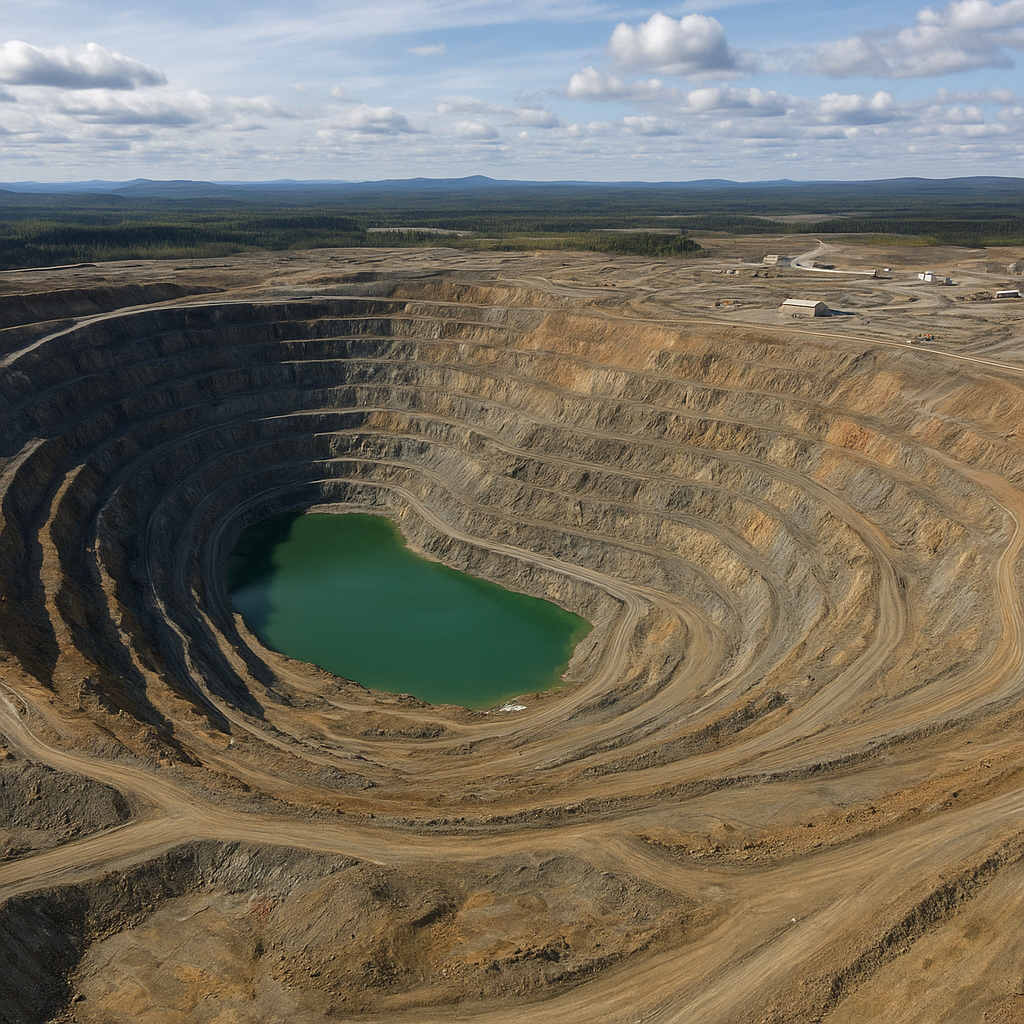
The site known as Giant Mine, located on the outskirts of Yellowknife in Canada’s Northwest Territories, is one of the country’s most historically important and environmentally controversial mining properties. For more than half a century it was a major source of gold that helped shape the regional economy and the development of northern communities. At the same time, the technologies used to extract and process ore created a toxic legacy—most notably large quantities of arsenic trioxide—that now define the site as a long-term remediation challenge. This article examines where Giant Mine is, what was produced there, its economic role, and a number of distinctive and often surprising facts about the mine and its ongoing cleanup.
Location and geological context
Giant Mine sits on the north shore of the Yellowknife Bay arm of Great Slave Lake, a short distance east of downtown Yellowknife, the territorial capital. The mine exploits a deposit hosted in Archean greenstone belt rocks, part of a larger geological terrain that contains numerous gold-bearing veins and shear zones. These ancient rocks, shaped by high-grade metamorphism and later structural deformation, localized concentrations of sulfide and gold, making the immediate area one of Canada’s richest gold districts for the twentieth century.
The proximity of the deposit to Yellowknife—both the town and the shipping access provided by the lake—made development logistically practical despite the region’s harsh climate. Access to the ore was via underground workings rather than large open pits; miners followed veins and stopes deep into the bedrock. The combination of rich gold grades and a relatively accessible location meant that the site produced significant quantities of precious metal, creating a center of economic activity in the otherwise remote North.
History of mining and what was extracted
Giant Mine’s principal commodity was gold, recovered from arsenopyrite- and pyrite-rich ores. Mining operations began in the late 1940s after a period of exploration in the Yellowknife area established the commercial viability of the deposit. Over decades of production, the mine was a major contributor to Yellowknife’s growth, providing employment, infrastructure, and tax revenues that supported regional services and housing.
The ore processing method historically used at Giant involved roasting sulfide concentrates to liberate gold and remove sulfur and arsenic. Roasting oxidizes arsenic-bearing minerals and produces an airborne or particulate form of arsenic trioxide. At the time this approach was common practice in many gold-roasting operations worldwide; it was effective for gold recovery but had significant environmental and health downsides that were not fully addressed at the time.
Beyond gold, the mine’s processing chain produced tailings and other waste streams containing elevated concentrations of heavy metals and metalloids. Tailings were deposited in engineered and unengineered impoundments near the processing plant; fine dust and fugitive emissions from roasters contributed to contamination of soils and sediments in nearby areas. While gold was the primary economic product, the associated wastes produced by historical processing are what now dominate discussions about the site.
Economic significance and social impacts
Giant Mine played a central role in the local and territorial economy for decades. It provided direct employment to hundreds of workers at peak times and supported a supply chain of contractors, transporters, and service providers. The presence of the mine helped sustain businesses in Yellowknife, financed municipal development, and attracted other investments to the region. As a result, the fortunes of the town and the mine became closely linked.
The mine’s influence extended beyond direct jobs. Royalties and taxes helped fund public services, while infrastructure—roads, power, and port facilities—built to support mining activity had broader benefits for other economic sectors. Mining also drove demographic changes: workers from diverse backgrounds relocated to Yellowknife, bringing new skills and cultural elements. For Indigenous communities in the area, mining produced mixed outcomes: opportunities for employment and business partnerships on the one hand, and pressures on traditional land use and long-term environmental impacts on the other. In particular, the Yellowknives Dene and other Indigenous groups have been key stakeholders in decisions about remediation and land stewardship.
When operations wound down, many communities faced economic adjustment. Closure of large-scale mines often leads to work layoffs and an abrupt drop in municipal revenues, and Giant Mine was no exception. The long-term economic picture includes both the benefits generated during operations and the ongoing costs—financial and social—of managing the contaminated site after mining ceased.
Environmental legacy and contamination
Among the most serious environmental legacies of Giant Mine is the quantity of arsenic trioxide dust produced and stored as a by-product of gold roasting. During decades of operation, roasters converted arsenic-bearing minerals in the ore into a fine, white powder—arsenic trioxide—that was captured and stored underground in purpose-built chambers carved into bedrock. Estimates place the stored quantity in the order of hundreds of thousands of tonnes; many official accounts cite approximately 237,000 tonnes of arsenic trioxide in underground storage. These stored wastes are now an enduring hazard because arsenic is highly toxic and can be mobilized into groundwater, soils, and, ultimately, the aquatic environment.
Contamination at the Giant Mine site is not limited to arsenic. Tailings ponds, slag, and historically contaminated soils contain elevated levels of metals and acid-generating minerals. Over time, wind and water have redistributed some contaminated fines beyond the immediate footprint of the processing plant. The proximity to Great Slave Lake—a vital waterbody for local communities—heightened concerns about potential impacts on fisheries, drinking water, and downstream ecosystems.
Human health concerns around arsenic are acute. Arsenic exposure is associated with increased risks of skin lesions, cardiovascular disease, and certain cancers. Local communities, Indigenous organizations, and public health officials have made health and safety considerations central to discussions about remediation priorities and strategies.
Remediation efforts and governance challenges
Because of its contamination legacy, Giant Mine is federal responsibility and has been the subject of extensive remediation planning and consultation. The complexity of the site—underground storage of a highly toxic dust, legacy tailings, contaminated soils, and a location near a major lake—means that there is no quick, simple fix. Remediation has included a mix of containment, removal, treatment, long-term monitoring, and risk management approaches.
One of the most discussed strategies has been the idea of permanently freezing the underground arsenic chambers. The concept—sometimes referred to as a subsurface freeze or frozen block method—involves circulating coolant through a network of freeze pipes to create a frozen barrier or frozen mass around the arsenic storage chambers, immobilizing the dust and reducing the potential for water infiltration and migration. Freezing is appealing because it offers containment in place and avoids the risk of transporting the dust to another location. However, it also commits future generations to maintaining active refrigeration systems or to dealing with the consequences if the freeze is allowed to fail.
Alternatives considered include excavation and removal of the arsenic trioxide to above-ground secure storage or permanent encapsulation beneath engineered caps. Each option has trade-offs: excavation poses short-term risks during handling and transport; permanent encasement requires robust long-term assurances against leakage. The required timescales are long—the hazard of the stored arsenic will persist for centuries—so remediation decisions must weigh technical feasibility, long-term reliability, cost, and community acceptance.
Governance of the remediation has been complex. Multiple levels of government, Indigenous organizations, regulatory bodies, and public stakeholders have been involved in planning and oversight. Community consultations, environmental assessments, and legal obligations to Indigenous peoples have shaped decisions and timelines. The cost of remediation has been substantial; estimates over time have run into the billions of Canadian dollars, and the federal government has allocated significant funds to manage the site responsibly.
Controversies, community engagement, and Indigenous rights
The Giant Mine site sits at the intersection of environmental science, public policy, and Indigenous rights. For many years, local Indigenous communities raised concerns about contamination of traditional lands and waters and pressed for greater involvement in remediation planning. The Yellowknives Dene and other Indigenous groups have sought meaningful consultation and participation, emphasizing that decisions must respect their rights, knowledge systems, and long-term stewardship interests.
Controversies have arisen over the choice of remediation methods, timelines, and the extent to which past harms are being addressed. The idea of freezing the arsenic chambers, for example, has been both supported and criticized: some see it as the best technical solution available, while others see it as transferring risk into the future or as insufficient without concurrent measures to reduce site-wide contamination. Legal and political pressures have encouraged more transparent processes and collaboration, but deeply rooted distrust based on historical interactions with industry and government has sometimes complicated negotiations.
Interesting technical and historical facts
- Underground storage: The arsenic trioxide at Giant Mine was stored underground in chambers carved directly into the rock, a practice that allowed large volumes to be kept on-site but created a unique and difficult containment problem. The scale of storage—hundreds of thousands of tonnes—makes it one of the largest such underground arsenic repositories in the world.
- Roasting technology: The methods used to process the ore involved high-temperature roasting, a practice that produced arsenic-laden flue dust. Roasting was an effective metallurgical route for gold recovery at the time but is now recognized for its environmental and health risks, which have led to changes in processing technologies in more recent decades.
- Long-term stewardship: Any plan for Giant Mine must consider timescales measured in centuries rather than decades. Institutional controls, monitoring regimes, and community trust must be durable across multiple generations, which raises questions about funding, governance, and intergenerational equity.
- Economic driver for the North: Beyond local jobs, Giant Mine contributed to the development of northern infrastructure and helped integrate the Northwest Territories into national markets during the twentieth century. Its history is tightly woven into Yellowknife’s identity as a mining town.
- Lessons for modern mining: Giant Mine is frequently cited in discussions about how to manage legacy sites, design modern mines to avoid similar outcomes, and incorporate community and Indigenous participation early in planning. It underscores the importance of anticipating and planning for waste streams long before mineral extraction begins.
Technical challenges and innovative approaches
Remediation at Giant Mine has required a mix of conventional engineering and innovative thinking. Engineers and scientists are evaluating ways to ensure that contaminated groundwater does not carry arsenic into surface waters, to safely stabilize tailings, and to manage the stored arsenic trioxide without creating unacceptable short-term risks. Among the technical approaches being explored and implemented are enhanced water treatment systems, containment liners and caps for tailings areas, soil remediation and replacement, and long-term groundwater monitoring networks.
Some of the innovative aspects of the project include combining traditional environmental engineering with local knowledge about ice cover, seasonal hydrology, and wildlife patterns—knowledge held by Indigenous harvesters and residents who have lived on the land for generations. Integrating this knowledge with scientific monitoring has improved the context-sensitivity of remediation measures and has helped build community confidence in technical solutions.
Possible futures and broader implications
The future of the Giant Mine site will depend on technical success in containing contaminants, sustained political will and funding, and continued cooperation with local and Indigenous communities. If remediation measures are successful, the site will remain a managed landscape for many generations—proof that legacy contamination can be controlled but also a reminder of the long-term costs associated with historical industrial practices. If challenges arise—such as refrigeration equipment failures, unanticipated groundwater movement, or funding shortfalls—the consequences could be significant for human and ecological health.
Lessons from Giant Mine resonate beyond the Northwest Territories. They inform national debates about mine permitting, environmental safeguards, and the responsibilities of companies and governments to manage wastes. The story of Giant Mine highlights how resource wealth can generate prosperity but also be accompanied by complex and long-lasting liabilities.
Where to learn more and how communities remain involved
Because Giant Mine remains a live remediation project, there are ongoing updates from environmental authorities, federal agencies, and community organizations. Public records from environmental assessment processes, regulatory filings, and community meeting notes provide detailed information about technical decisions and commitments. Local Indigenous organizations often host forums and publish materials discussing their perspectives and priorities for the site’s future, and these are valuable resources for understanding how remediation intersects with cultural and social concerns.
Engaging with the story of Giant Mine means appreciating both the economic role the mine played and the responsibilities that followed. It is a case in which geology, metallurgy, community, and governance meet—revealing the broad, sometimes surprising consequences of extracting what the earth has to offer.

