
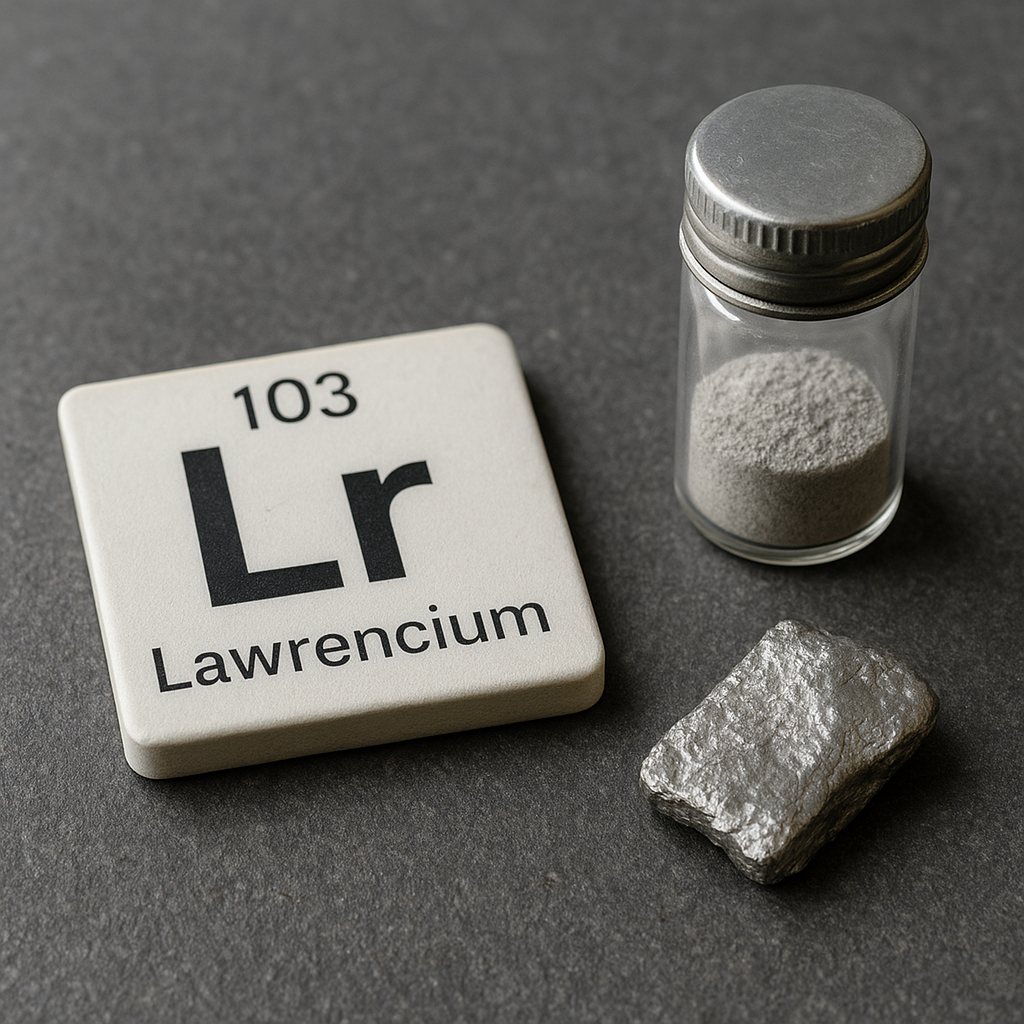
Lawrencium is one of the heaviest and most enigmatic members of the periodic table. With atomic number 103 and the symbol Lr, it sits at the frontier between experimental nuclear physics and advanced theoretical chemistry. Only synthesized in microscopic amounts, lawrencium has played an outsized role in shaping our understanding of how very heavy atoms behave, especially under the influence of strong relativistic effects. This article explores its discovery, production, properties, where it can be found (and where it cannot), its limited uses, and several intriguing aspects that continue to attract researchers.
Discovery, naming and early investigations
The history of lawrencium is woven together with the development of particle accelerators and the rise of heavy-element research in the mid-20th century. The element was first reported in experiments using high-energy projectiles colliding with heavy targets. Its detection relied on identifying characteristic decay patterns among a handful of produced atoms.
Key historical points
- The element carries the name of Ernest O. Lawrence, inventor of the cyclotron, a device that made the synthesis of many heavy elements possible.
- Claims and confirmation came from multiple laboratories over time; research groups in the United States and the former Soviet Union both contributed to the early body of data.
- Because only minute numbers of atoms are formed in any experiment, early chemical and physical studies were necessarily indirect and often controversial, motivating decades of follow-up work.
Those early efforts set the stage for more modern experimental techniques—improved separators, better detectors, and gas-phase chemistry setups—that allowed researchers to probe the element’s behavior even when only a few atoms were available at a time.
Where lawrencium occurs and how it is produced
Lawrencium does not occur in any appreciable amount in nature. Any natural occurrence would be vanishingly rare due to its intense radioactivity and the fact that it is not a product of common natural decay chains. Practically all studies of lawrencium rely on man-made production in specialized facilities.
Production methods
- Lawrencium isotopes are produced in particle accelerators by fusion-evaporation reactions: a heavy target nucleus (often an actinide such as californium or berkelium) is bombarded with lighter ions (for example oxygen, nitrogen, or boron). The compound nucleus formed may evaporate a few neutrons, leaving a lawrencium isotope.
- Facilities engaged in such synthesis include national laboratories and institute-scale centers with high-current ion beams and sophisticated recoil separators—examples are Lawrence Berkeley National Laboratory, the Joint Institute for Nuclear Research (Dubna), GSI Helmholtz Centre (Darmstadt), and RIKEN (Japan).
- Because production rates are extremely low—often only a handful of atoms per day, week, or month—experiments must be carefully optimized and detectors must distinguish rare signals from significant background noise.
Isotopes and lifetimes
A range of isotopes of lawrencium has been synthesized. Their half-lives cover many orders of magnitude, from milliseconds to hours. For practical experiments, isotopes with half-lives measured in minutes or hours are most useful, but even those are fragile and must be handled essentially atom-by-atom via on-line separation and immediate detection.
Physical and electronic properties
Because only tiny amounts of lawrencium exist at any one time, macroscopic properties like melting point or density have never been measured. Understanding lawrencium therefore depends on nuclear decay data, atomic spectroscopy, and high-level quantum calculations that include significant relativistic corrections.
Atomic number, symbol and classification
- Atomic number: 103.
- Chemical symbol: Lr.
- Placed among the actinide series, lawrencium is the heaviest actinide typically listed. Its placement in the periodic table and relationship to the transition metals has been the subject of debate.
Electron configuration and unexpected behavior
One of the most interesting aspects of lawrencium is its electronic structure. For many years, the expected ground-state configuration was analogous to the lighter lanthanide/actinide tradition with a d-electron: [Rn]5f14 6d1 7s2. However, theoretical predictions that fully account for relativistic effects suggested a different ordering, and experimental measurements have provided support for these predictions.
A crucial experimental breakthrough came from measuring the first ionization potential of lawrencium. The measured ionization energy indicated that a 7p1 electron lies at lower energy than the 6d1 configuration, implying a ground-state electronic configuration more like [Rn]5f14 7s2 7p1. This makes lawrencium exceptional among the actinides and underscores how relativistic effects can rearrange orbital energies in very heavy atoms.
Chemistry and oxidation states
Chemical investigations, carried out atom-by-atom, generally show that lawrencium most commonly exhibits a +3 oxidation state in aqueous and gas-phase chemistry—paralleling most of the actinides and lanthanides. There are experimental indications and theoretical suggestions that other states, such as +2, could be stabilized under special conditions, but +3 remains the practical and reproducible state observed in chemical separations and adsorption experiments.
- Lr3+ behaves similarly to other trivalent heavy ions in many chemical contexts, but small differences in ionic radius and electron configuration lead to subtle deviations that are of high interest to chemists testing periodic trends.
- Because experimental chemistry uses only individual atoms or very small numbers, techniques include gas-phase thermochromatography and rapid liquid-phase extraction systems designed to identify chemical analogies and adsorption enthalpies.
Applications and research uses
Lawrencium has no commercial or industrial applications because of its scarcity and radioactivity. Its value lies entirely in fundamental research—both as a probe of nuclear stability and as a testbed for relativistic quantum chemistry.
Scientific roles
- Probing nuclear structure: Lawrencium isotopes provide data about shell closures, deformation, and decay modes in the heavy-element region. Such data inform nuclear models used to predict properties of yet-heavier nuclei.
- Testing theoretical chemistry: The unexpected ordering of valence orbitals in lawrencium offers a stringent test of computational methods that include relativistic and electron-correlation effects.
- Method development: The experimental challenges of producing and studying lawrencium have driven innovations in detector technology, rapid chemical separations, and on-line spectroscopy techniques that benefit broader nuclear and radiochemical research.
Indirect and potential future applications
While lawrencium itself is not used in applied technologies, research on this element contributes to knowledge that can be relevant elsewhere:
- Understanding of heavy-element behavior feeds into the search for new superheavy elements and for isotopes with longer lifetimes that might have practical uses.
- Advances in accelerator and target design, developed to synthesize lawrencium and its neighbors, support isotope production for medicine and industry when applied to more accessible nuclides.
Experimental techniques and detection
Because researchers typically create only a handful of lawrencium atoms at a time, every study must pair highly efficient production with ultra-sensitive detection. Several experimental strategies are central to modern work on lawrencium.
- Recoil separators and electromagnetic filters separate reaction products from beam particles and target debris, guiding desired nuclides to detection stations.
- Alpha and spontaneous fission spectroscopy identify decay chains that pinpoint the production of specific isotopes.
- On-line chemical separations and gas-phase chromatography permit rapid study of adsorption and reaction behavior for single atoms, revealing chemical analogies.
- Laser spectroscopy and ionization-potential measurements, though extremely challenging, provide direct atomic-structure information that can resolve orbital ordering.
Controversies, periodic table placement and intriguing facts
Lawrencium is at the center of several conceptual debates and fascinating scientific insights.
Placement in the periodic table
There is an ongoing discussion about the best way to display the periodic table’s f-block and d-block transitions, particularly whether group 3 should include lanthanum and actinium or lutetium and lawrencium. Arguments hinge on electronic configuration, chemical behavior, and historical convention. The peculiar electron ordering in lawrencium strengthens arguments that the heaviest actinide series behaves differently from lighter members, making a single “correct” tabular layout less obvious than it might seem.
Relativistic effects made visible
One of lawrencium’s most scientifically valuable features is how clearly it shows the impact of relativity on chemistry. As nuclear charge grows, innermost electrons move at speeds approaching a significant fraction of the speed of light. Their effective mass increases, orbital energies shift, and usual periodic trends are altered. Lawrencium exemplifies these effects: its valence orbital ordering deviates from lighter analogs, producing surprising atomic behavior that must be captured by relativistic quantum theory.
An element of few atoms and many questions
It is striking that so much of what chemists and physicists know about lawrencium comes from experiments that detect and manipulate single atoms. This scarcity imbues every new piece of experimental data with disproportionate weight: one improved measurement of ionization energy, one refined decay-scheme assignment, or one chemical adsorption result can shift interpretations and prompt revisions to theoretical models.
Safety, handling and ethical considerations
Lawrencium is intensely radioactive, and the tiny quantities produced eliminate any practical hazard beyond the specialized environment in which it is synthesized. Nevertheless, handling, detection and disposal require standard protocols for highly radioactive materials: remote handling, shielding, contamination control and rigorous legal compliance. The ethical aspects relate mainly to the allocation of scarce research resources: building and running facilities that produce lawrencium is expensive, so projects must be justified by their expected scientific return.
- Work with lawrencium is confined to well-equipped national or international laboratories.
- Because the element has no industrial use, research is motivated by fundamental science rather than commercial prospect.
Why lawrencium still matters
Although it exists only for fleeting moments in accelerator targets, lawrencium occupies a privileged place in science. It acts as a magnifying glass for the interplay of nuclear structure, quantum mechanics and relativity. Each experiment—no matter how small in material terms—yields insight into how matter behaves under extreme conditions and helps refine models that predict the properties of yet-unknown nuclei and atoms. Researchers continue to push experimental boundaries, looking for clearer spectroscopic signals, better chemical data, and improved nuclear decay information that will expand our understanding of the heaviest elements.
Notable bolded terms in this article: Lawrencium, Lawrence, cyclotron, relativistic, actinide, particle accelerators, radioactivity, spectroscopy, isotope, chemistry