
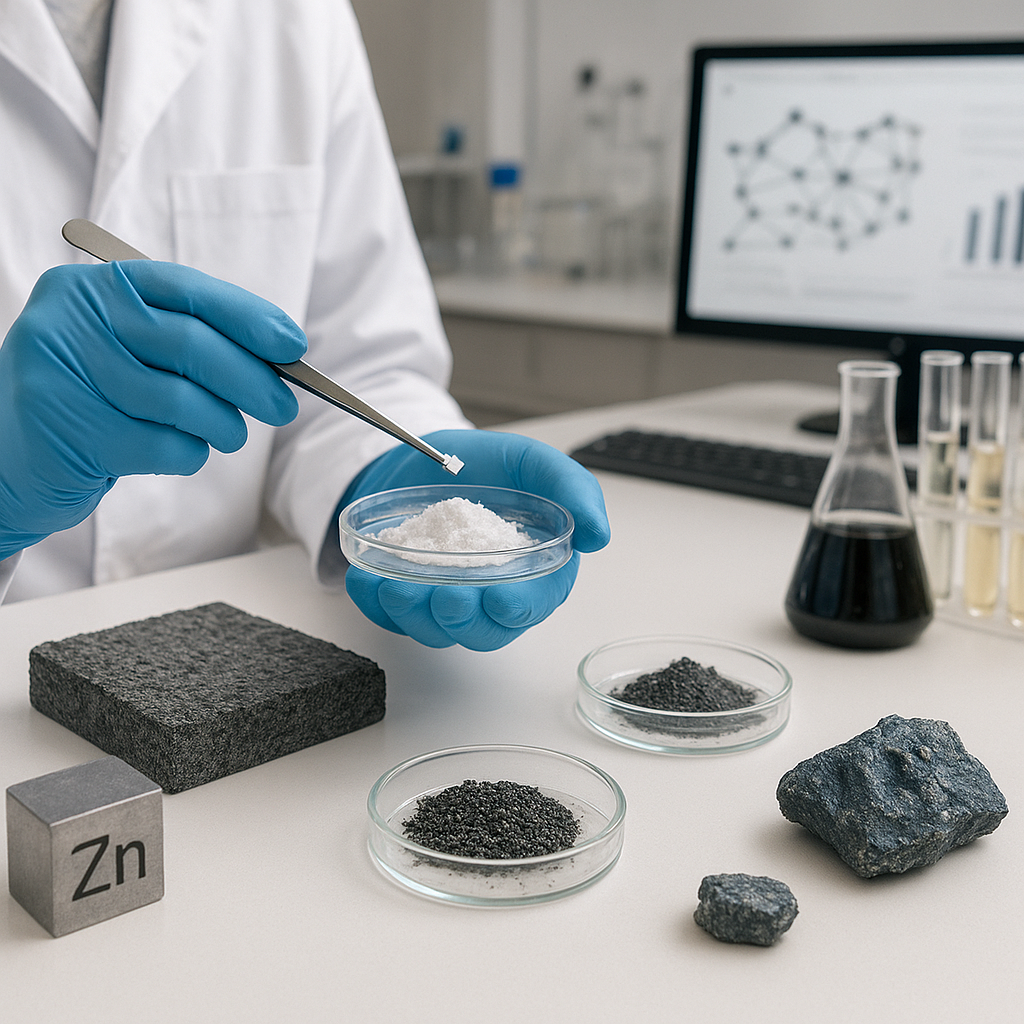
The global transition to high-performance technologies increasingly depends on a narrow set of mineral resources. Research into critical mineral substitution in advanced materials is therefore central to enabling resilient, low-carbon, and affordable technologies. This article surveys the scientific strategies, experimental approaches, and technological pathways being developed to reduce reliance on constrained mineral supplies while preserving or improving functional performance in applications from energy storage to permanent magnets and catalysts.
Context and urgency: why substitution matters
A growing portion of modern industry relies on a relatively small group of elements that are geographically concentrated and subject to volatile markets. Batteries, electric motors, wind turbines, and electronics often require elements such as lithium, cobalt, nickel, and rare-earth elements. The combination of rapid demand growth and supply chain vulnerability creates an impetus for research focused on material substitution, efficiency gains, and circular strategies. Substitution research aims not simply to replace one element with another, but to reimagine functional requirements so that performance, cost, and environmental footprint are optimized simultaneously.
Scientific strategies for substitution in advanced materials
Substitution research operates at multiple levels, integrating chemistry, physics, and engineering. Key scientific strategies include:
- Designing alternative chemistries that achieve the same electronic, magnetic, or catalytic properties without the problematic element.
- Optimizing microstructure and processing to enhance performance of less critical or more abundant elements.
- Developing composite or hybrid materials that combine modest amounts of a critical element with supportive matrices to reduce overall use.
- Applying computational screening and machine learning to accelerate discovery of candidate materials.
For example, in battery research, substituting cobalt in cathode chemistries has relied on increasing manganese and nickel fractions while using dopants and advanced coatings to stabilize electrochemical behavior. In magnetics, efforts to reduce heavy reliance on neodymium and dysprosium are pursued by engineering grain-boundary chemistry, texturing, and exploring alternative hard magnetic phases.
Tools and methods accelerating substitution research
Modern substitution research leverages high-throughput and multi-scale tools. Computational methods, from density functional theory to data-driven models, provide predictions of phase stability, defect chemistry, and property trends across compositional spaces. Experimental high-throughput synthesis and characterization enable rapid iteration, while in situ techniques reveal mechanisms under operating conditions.
- High-throughput computation for screening large chemical spaces
- Combinatorial synthesis platforms for fabricating composition spreads
- Advanced characterization such as synchrotron X-ray and neutron scattering to probe structure and magnetic order
- Electrochemical and environmental testing to evaluate lifetime and degradation mechanisms
Integration of these tools makes it possible to identify promising substitution pathways more efficiently than conventional trial-and-error approaches. Cross-disciplinary collaboration between materials scientists, chemists, and systems engineers is essential to translate discoveries into scalable processes.
Case study: batteries and the path beyond cobalt
Batteries exemplify the substitution challenge because they combine strict performance targets with high commodity risk. Cobalt substitution has been pursued aggressively through several complementary approaches:
- Developing high-nickel cathodes with reduced cobalt content while managing thermal and structural stability.
- Designing manganese-rich or iron-based cathodes that replace cobalt entirely, often requiring surface engineering and electrolyte optimization.
- Targeting anode and cell-level innovations that allow wider acceptance of alternative cathode chemistries without sacrificing energy density.
Progress in electrolyte additives, artificial solid-electrolyte interphases, and particle coatings has helped compensate for some deficiencies of cobalt-poor cathodes. Yet, achieving the combined targets of safety, longevity, and energy density remains an active research frontier. Successful substitution demands an integrated perspective: materials discovery, cell architecture, and manufacturing must converge.
Case study: magnets and rare-earth reduction
Permanent magnets are critical for electric motors and generators, but their performance is tightly linked to rare-earth content. Two primary substitution pathways dominate research:
- Enhancing existing rare-earth magnets through microstructural control that reduces or eliminates heavy rare-earth elements such as dysprosium while retaining coercivity.
- Discovering or optimizing rare-earth-free magnetic phases with acceptable energy products for targeted applications, such as anisotropic ferrites or novel intermetallics.
Advanced processing techniques, including rapid solidification, powder metallurgy, and additive manufacturing, enable engineered textures and grain-boundary chemistries that can significantly improve coercivity without additional heavy rare-earths. Parallel computational searches and experimental validation continue to explore non-rare-earth permanent magnets as longer-term solutions.
Case study: catalysts and critical metal minimization
Catalysis often depends on platinum group metals and other scarce elements. Substitution strategies include:
- Developing non-precious metal catalysts for reactions such as oxygen reduction and hydrogen evolution, leveraging transition metal oxides, nitrides, and single-atom catalysts.
- Maximizing utilization by dispersing active sites on high-surface-area supports, enabling orders-of-magnitude reductions in required precious metal mass.
- Employing alloying and core-shell architectures to enhance activity and stability while reducing the content of valuable elements.
Emerging research on single-atom catalysts is especially promising because it combines high atom efficiency with unique electronic structures that can rival bulk precious metal surfaces. Stability under realistic conditions and scalable synthesis remain key challenges.
Lifecycle, circularity, and supply-chain integration
While substitution reduces reliance on specific elements, complementary strategies such as recycling, remanufacturing, and design for circularity are often necessary to achieve robust supply resilience. Lifecycle assessment guides choices by quantifying trade-offs between material substitution and changes in energy consumption, greenhouse gas emissions, and resource depletion.
- Designing materials for recyclability reduces the need for primary extraction and allows for more aggressive substitution strategies if recycled streams can supply critical elements.
- Closed-loop processes, combined with improved sorting and recovery technologies, enhance the supply security for remaining critical materials.
- Responsible sourcing policies and diversified sourcing reduce geopolitical risk while substitution research advances.
Substitution decisions therefore require systems-level thinking that includes mining impacts, processing emissions, and end-of-life flows. In some cases, a modest increase in processing energy for a substituted material may be justified by the net reduction in supply risk and environmental harm from mining.
Policy, standards, and collaborative research ecosystems
Policy frameworks and standards play a pivotal role in enabling substitution. Government funding for fundamental and translational research, incentives for sustainable procurement, and support for pilot manufacturing facilities accelerate the adoption of substitute materials. Industry consortia and open data initiatives stimulate pre-competitive collaboration, enabling shared use of characterizations, databases, and testing protocols.
Regulation and standards that define acceptable performance and durability thresholds help manufacturers transition to alternative materials with confidence. Certification schemes for recycled content and environmental performance further support market uptake of substituted materials.
Challenges and open research questions
Despite progress, several scientific and technological challenges persist:
- Understanding long-term degradation mechanisms in substituted materials under realistic operating conditions.
- Balancing performance trade-offs when moving from a highly optimized critical-element system to an alternative chemistry.
- Scaling laboratory discoveries to cost-competitive industrial processes without introducing new supply vulnerabilities.
- Developing accurate predictive models that couple composition, processing, microstructure, and properties across length scales.
Addressing these challenges will require sustained investment in fundamental science, interdisciplinary training, and close dialog between researchers, manufacturers, and policymakers.
Emerging opportunities and directions
Several promising directions are accelerating substitution prospects. The integration of artificial intelligence with high-throughput experimentation expedites candidate discovery, while advances in in situ characterization clarify mechanisms that enable rational design. Additive manufacturing offers new ways to engineer material architectures that use critical elements more efficiently. Finally, strategic combinations of partial substitution and intense recycling create pathways that can quickly reduce demand pressure on scarce minerals while maintaining performance for critical applications like electrification and grid-scale storage.
Translational research and industrial pilots
Pilots that demonstrate the manufacturability of substituted materials under real-world constraints are crucial. Collaborative demonstration projects, linking academic discovery with industrial process engineering, can validate lifecycle benefits and expose unforeseen barriers early. Successful pilots often combine modest material changes with process innovations and product redesigns to achieve acceptable cost and performance balance.
Education, workforce, and supply-chain literacy
To sustain substitution efforts, the workforce must be fluent in both materials science and supply-chain dynamics. Training programs that emphasize cross-cutting skills—such as sustainable design, circular economy principles, and regulatory literacy—will enable faster adoption of substitution technologies and more informed decision-making across sectors.
Research into innovation in materials substitution is a dynamic, multidisciplinary endeavor. Achieving systemic reductions in dependence on constrained minerals while delivering the next generation of high-performance technologies will require coordinated advances in discovery, processing, lifecycle assessment, and policy. By combining computational foresight, experimental rigor, and systems-level strategies, the field is charting pathways toward more resilient and sustainable material foundations for modern technology.
