
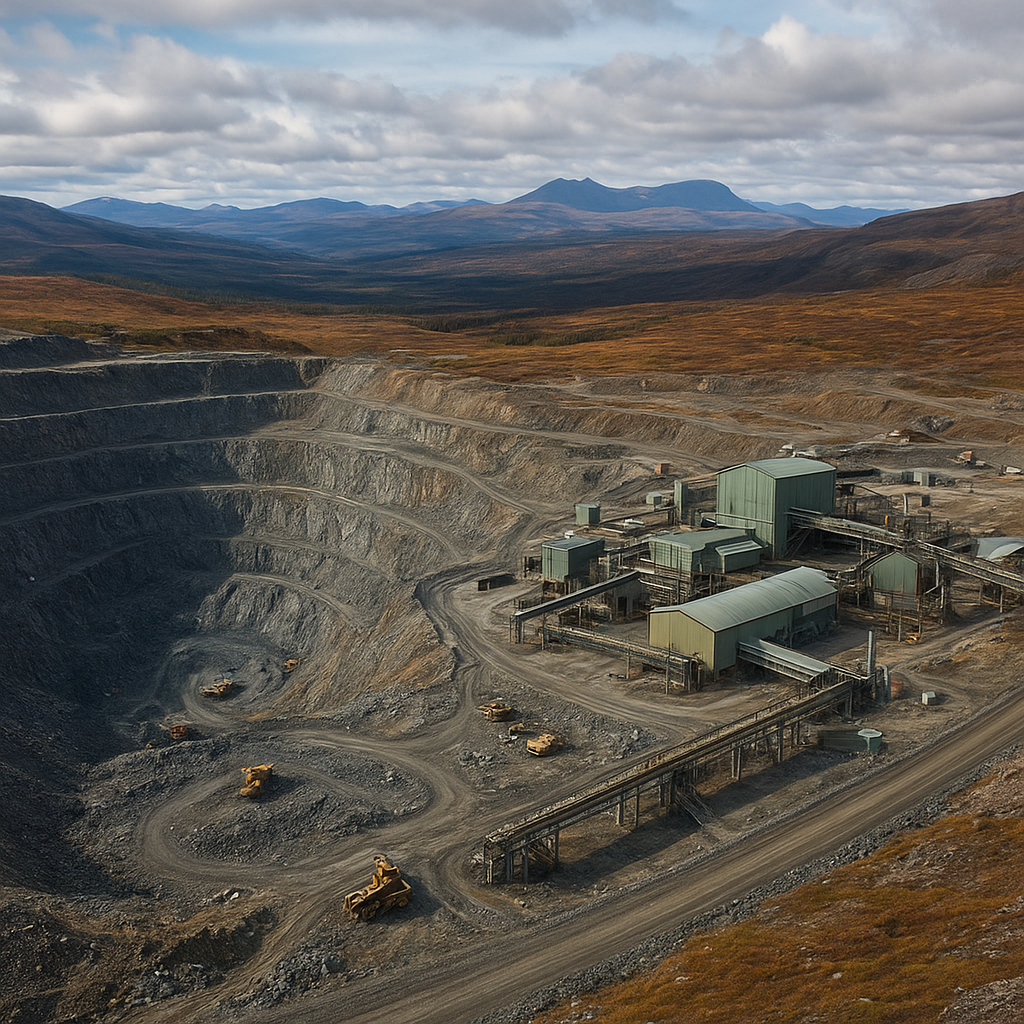
The Caribou Mine is a notable example of Canada’s base metal industry, specializing in the extraction of polymetallic ores rich in zinc, lead and silver. Situated in a region with a long history of mineral discovery and development, the Caribou operation illustrates the geological richness, technological challenges and socioeconomic importance of modern underground mining in eastern Canada. This article explains where the mine is located, what minerals are produced and processed there, its broader economic role, environmental considerations and several less obvious but compelling aspects of its story.
Location and geological setting
The Caribou deposit sits in northeastern Canada, within the province of New Brunswick, in a district widely recognized for volcanogenic massive sulfide (VMS) mineralization. The mine is part of the larger mineralized belt commonly referred to as the Bathurst Mining Camp, a region with a long record of zinc–lead–silver discoveries that have been mined intermittently for decades. Geologically, VMS-style occurrences like the Caribou deposit form on or near ancient seafloors where hydrothermal fluids precipitated sulfide minerals, concentrating zinc, lead, silver and other metals.
Geological characteristics
The deposit type typically exhibits tightly restricted ore lenses or lenses that form compact clusters, often overlain and surrounded by volcanic and sedimentary host rocks. These features favor underground mining rather than open pit extraction. The ores are usually composed of sulfide minerals such as sphalerite (the primary zinc ore), galena (lead), and associated silver-bearing phases. The geological setting demands careful mapping and geotechnical design because the ore bodies can be structurally complex and are commonly enclosed by weaker country rock.
Mining methods and mineral processing
Caribou’s operation has historically relied on underground mining techniques suited to relatively high-grade, compact sulfide bodies. Typical methods used in VMS mines include mechanized drifting, selective stoping, and backfill systems, which balance safety, ore recovery and ground stability. Underground development connects ore zones with ore passes, declines and raises used to move material to surface concentrators.
From ore to concentrate
After extraction the ore undergoes a series of processing steps designed to separate sulfide minerals from the host rock and to produce saleable concentrates. The basic stages are:
- Crushing and grinding to liberate the sulfide mineral grains.
- Physical and chemical separation, most commonly flotation, to produce concentrates for each metal or polymetallic concentrates depending on the ore complexity.
- Concentrate dewatering and drying for safe transport to smelters or tolling facilities.
- Offsite smelting/refining where metals are separated and refined into marketable commodities.
The concentrates produced contain elevated percentages of zinc and lead with silver reported as a valuable by-product. Processing aims to maximize metal recovery while controlling impurities and penalties (for example, excessive silica or deleterious elements) that affect smelter acceptance.
Production profile and operational history
Throughout its operational life the Caribou operation has gone through several phases — exploration, development, production, and sometimes care-and-maintenance. Like many base metal mines in Canada, its fortunes reflect global metal prices, operational costs and corporate strategy. While specific production figures vary by year and operator, the mine has been an important local source of refined metals after concentrate smelting, and it contributed to Canada’s position as a reliable supplier of base metals on international markets.
Typical outputs and market role
- Zinc concentrates — supplying smelters that produce refined zinc metal used in galvanizing and alloying.
- Lead concentrates — a primary feedstock for lead smelters, historically important for batteries, alloys and chemical uses.
- Silver — recovered as a by-product in concentrates and representing an important economic bonus that improves project economics.
Economic significance and regional impact
At the regional level the Caribou operation has been a meaningful employer and contributor to local economies. Mining operations of this type typically provide direct employment for mine and plant staff and indirect employment in contracting, transport, equipment supply and local services. The economic multiplier effect in small communities can be significant: wages paid to workers circulate through housing, retail, professional services and public revenues.
Direct and indirect benefits
- Direct employment for skilled underground miners, metallurgists, engineers and support staff.
- Contracts for local suppliers, heavy equipment maintenance, transport logistics and construction.
- Payments to government through royalties, taxes and permitting fees, which support broader public services.
- Investment in infrastructure — road upgrades, power supply enhancements and sometimes community facilities — that remain after mine closure.
Many modern projects emphasize local hiring and training programs, apprenticeships and partnerships with educational institutions to boost the long-term skill base in the region. For communities near the Caribou operation, that meant job opportunities and often improvements to local infrastructure and services tied to the mine’s presence.
Environmental management and closure planning
Environmental stewardship is a central element of contemporary mineral projects. The Caribou operation, like its peers, would be expected to implement programs that mitigate impacts on water, land and air and to plan actively for eventual closure and reclamation. Common practices include:
- Treatment of mine water and runoff to meet regulatory discharge standards.
- Tailings management with engineered storage facilities and monitoring systems.
- Progressive reclamation of disturbed areas to stabilize slopes and restore vegetation.
- Long-term monitoring of groundwater and surface water to detect any changes over time.
Regulators commonly require detailed closure plans and financial assurance to ensure that reclamation occurs even if an operator changes or discontinues activity. Community consultation and transparency in environmental monitoring are often emphasized to maintain social license.
Community relations and social considerations
Mining projects today generally place high importance on constructive relations with nearby communities and Indigenous groups. Engagement covers employment opportunities, joint ventures or benefit agreements, training initiatives and consultation on environmental and cultural heritage concerns. By involving local stakeholders, projects seek to align their operations with community priorities and to identify shared benefits that last beyond the active life of the mine.
Workforce development and training
One of the tangible legacies of a mine is the upskilling of the local workforce. Mines often sponsor technical training, trades apprenticeships and health-and-safety programs. These initiatives create a talent pool that can support diversified economic activities even after mining has ceased. In regions around the Caribou site, mining has historically driven development of a skilled base of tradespeople and technicians.
Interesting technical and historical features
Several aspects of the Caribou story are noteworthy beyond the headline metal outputs. For example:
- VMS deposits like the Caribou lens are windows into ancient seafloor processes — studying them helps geoscientists reconstruct past tectonic and volcanic environments.
- Polymetallic ores require careful metallurgical design; recovering multiple metals efficiently and separating them into marketable concentrates is both a science and an art.
- Modern mining has adopted digital tools — drone mapping, 3D geological modelling, and real-time monitoring — improving safety and productivity in underground environments.
From a historical perspective, operations in the Bathurst-type districts helped build the Canadian mining workforce and supported regional economies across generations. The technical evolution from small-scale, labor-intensive workings to mechanized underground operations mirrors the broader modernization of the industry.
Wider significance: metals, markets and supply chains
The metals produced at Caribou contribute to several large industrial supply chains. Zinc is essential for corrosion protection through galvanizing, alloys and many chemical uses; lead remains important for certain battery technologies and industrial applications; and silver has both industrial (electronics, photovoltaics, chemical catalysts) and investment demand. Mines that produce reliable concentrates support smelters and refiners, helping stabilize supply in international markets.
Resilience and market sensitivity
Base metal projects are sensitive to global commodity prices, exchange rates and transport costs. When prices fall, operations can be placed on care-and-maintenance or scaled back; conversely, strong prices can trigger reinvestment and expansion. The ability of a mine to respond to market cycles depends on its cost structure, grade, scale and access to logistics.
Final observations and ongoing relevance
Although each mine has a finite life, operations such as the Caribou Mine exemplify the complex interplay between geology, engineering, economics and community stewardship that defines modern resource development. The extraction and processing of zinc, lead and silver from VMS-style deposits continue to be an important part of Canada’s mining landscape, providing employment, technological innovation and materials essential to global industry. Continued attention to environmental management, community engagement and adaptive operational practices ensures that the benefits of such projects can be realized while risks are controlled and long-term land use is considered.

