
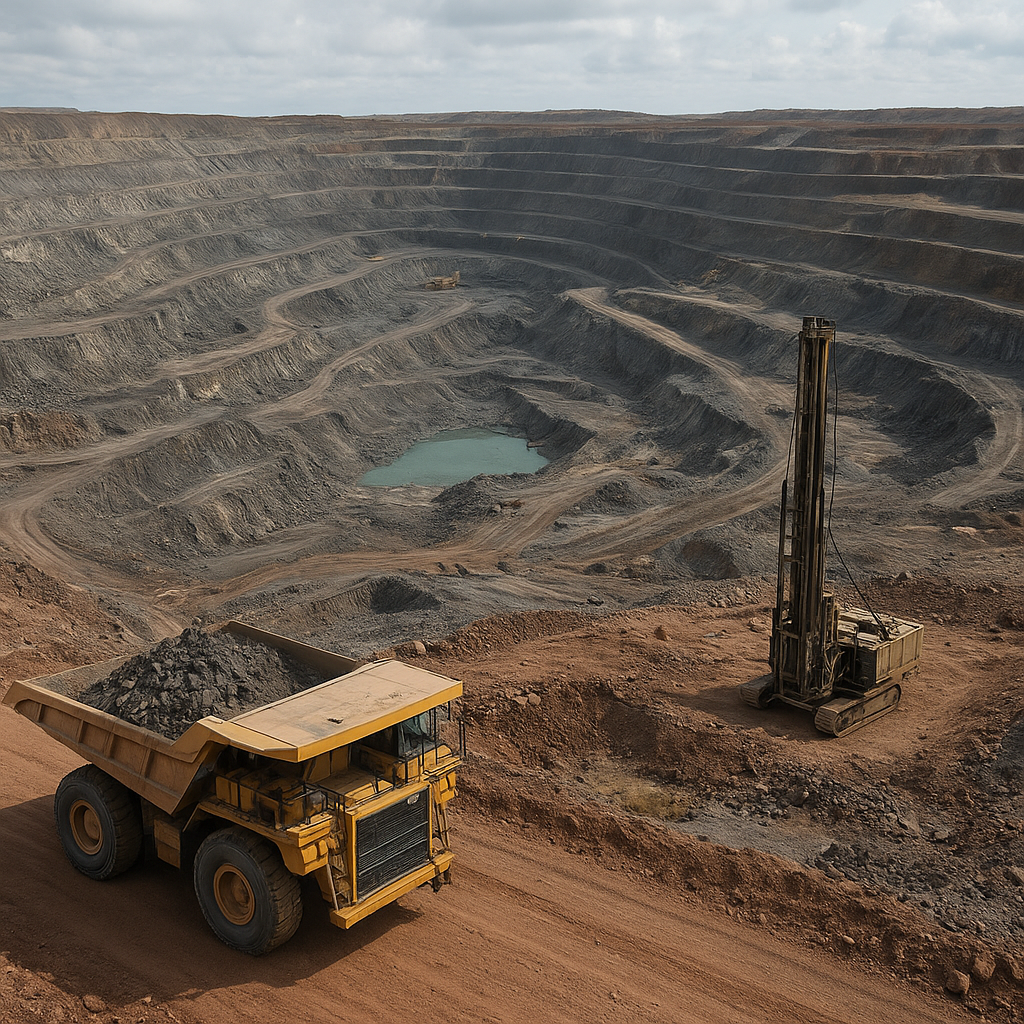
The Voisey’s Bay region in northern Canada has become synonymous with one of the most significant magmatic sulfide discoveries of the late 20th century. Among the various ore occurrences in that area, the South deposit plays an important role in the overall mineral endowment, complementing other nearby bodies and contributing to a broader operation that supplies critical materials to global markets. This article examines where the South deposit is located, what is extracted from it, its economic importance, and a number of intriguing technical, social and historical aspects surrounding its development and future.
Location and geological setting
The Voisey’s Bay mineralized complex sits on the coast of northern Newfoundland and Labrador, near the small community of Nain. The South deposit is one of several discrete ovoids or lobes of mineralization within the Voisey’s Bay intrusion. Geologically, the deposit is hosted in a suite of magmatic ultramafic to mafic intrusions that cut older metamorphic rocks of the Labrador region. These intrusions concentrated sulfide liquids early in their emplacement, producing pockets and channels of massive and disseminated sulfides enriched in base metals.
Nickel-copper-cobalt mineralization at Voisey’s Bay is typically associated with sulfide minerals. In the ore, nickel commonly occurs in pentlandite, copper in chalcopyrite, and cobalt is present in several sulfide phases and in solid solution within other minerals. The South deposit shares this mineralogical character but is distinct in shape, size and local structural controls from the main ovoid and other satellite bodies. Its geological architecture influences how the ore can be accessed and mined.
The regional context is important: the Labrador Trough and adjacent terranes have been the focus of systematic exploration for decades because of their favorable tectonic and magmatic history. Voisey’s Bay stands out because of the combination of high grades and relatively compact, economically minable bodies. While the Main deposit attracted most attention initially, the South deposit provides additional tonnage and flexibility in mine planning, and it helped justify a larger, more sustained operation.
What is mined at the South deposit and how
The South deposit yields a polymetallic sulfide ore dominated by the three metals that define the site’s value: nickel, copper and cobalt. These metals are recovered by conventional mineral processing techniques tailored to the sulfide nature of the ore. Typical flow involves comminution (crushing and grinding), followed by flotation to produce a metal-rich concentrate that is then shipped for smelting and refining.
Mining methods depend on the deposit’s geometry and depth. At Voisey’s Bay, mining across the complex has included a combination of surface and underground techniques over time. The South deposit’s configuration influences whether it is amenable to small-scale open pit extraction or requires underground development. Where underground mining is used, approaches such as long-hole stoping, sublevel stoping, and mechanized drift-and-fill are common for similar ovoid sulfide bodies because they allow selective ore extraction while managing ground conditions and dilution.
Once concentrates are produced, they are typically transported off-site by truck and sea. Historically, concentrates from Voisey’s Bay were sent to smelters capable of handling nickel-copper-cobalt sulfide concentrates. The logistics of operating in a remote northern environment—seasonal navigation, port facilities, and winter transport—add complexity and cost to the operation, and these factors are part of the economic calculus for developing the South deposit.
Economic importance and market role
The metals produced from the South deposit contribute to several global value chains. Nickel remains essential for stainless steel manufacturing and increasingly for the battery sector, where certain chemistries employ nickel to raise energy density. Cobalt is an important battery ingredient, prized for stability in many cathode chemistries, while copper is fundamental to electrical infrastructure and electrification more broadly. The combination of these metals in a single sulfide deposit increases the commercial attractiveness of mining and processing the ore.
- Supply security: Voisey’s Bay, including the South deposit, enhances Canada’s profile as a supplier of critical minerals at a time when countries are seeking diversified, reliable sources of battery-related metals.
- Local and regional benefits: Development brings jobs, procurement opportunities for suppliers, and transfer of technical skills to local communities and service industries in Labrador and Newfoundland.
- National economic impact: Revenues from royalties, taxes and company spending can be meaningful to provincial and federal treasuries, particularly because remote northern projects often stimulate otherwise limited economic activity.
Because the global transition to low-carbon transport and expanded electrification is increasing demand for battery metals, deposits like the South body at Voisey’s Bay have strategic value beyond their immediate financial returns. Companies and governments view such assets as part of long-term industrial planning: the concentrate produced feeds smelters and refiners that in turn supply manufacturers of batteries, electric vehicles, and renewable-energy infrastructure. That link between mine output and downstream industrialization magnifies the deposit’s significance relative to its tonnage alone.
Social, environmental and governance aspects
Operating a mine in the Voisey’s Bay area requires careful attention to the social and environmental context. The territory is home to Indigenous peoples with traditional land use for hunting, fishing and cultural activities. Developers of Voisey’s Bay historically negotiated arrangements with local Indigenous organizations to address employment, training, revenue sharing and land stewardship. These agreements typically aim to ensure that communities receive enduring benefits while companies respect cultural values and subsistence activities.
Environmental stewardship is a core component of modern mining practice at sites like Voisey’s Bay. Baseline ecological studies, continuous monitoring of water and wildlife, tailings management and progressive reclamation are standard requirements. The sensitive northern marine and terrestrial ecosystems demand mitigation measures that account for seasonal cycles of ice, migrating species and limited biological productivity; therefore, management plans are often more conservative and closely scrutinized by regulators and stakeholders.
Governance frameworks include provincial permitting, federal oversight for certain fisheries and environmental aspects, and the conditions embedded in Impact and Benefit Agreements. While these arrangements vary in detail, they often include provisions for employment quotas, training programs, business development targeting Indigenous suppliers, cultural monitoring, and independent environmental oversight. The legacy of the project therefore depends as much on how these relationships are managed as on the technical success of extraction.
Interesting technical and historical points
Several features of the Voisey’s Bay story are notable beyond the everyday mechanics of mining:
- Discovery significance: The deposit’s discovery in the early 1990s is often cited as one of the most important Canadian mineral finds of that era because it was a relatively high-grade nickel-copper-cobalt occurrence discovered in a mature geological province. The find catalyzed a rapid phase of exploration and investment in the region.
- Complex metallurgy: Processing sulfide ores that contain nickel, copper and cobalt together can be challenging. Effective flotation circuits and careful smelter selection are required to maximize recoveries and produce concentrates that meet market specifications.
- Remote logistics: The combination of northern access, seasonal shipping windows and the need for off-site smelting has made planning and supply chain resilience central concerns. Innovations in logistics and infrastructure planning have been required to sustain production.
- Technological adaptation: The mine and processing operations have incorporated automation, remote monitoring and improved environmental controls over time. These adaptations can reduce footprint, increase safety and raise efficiency in a northern setting where labor and transport costs are high.
Another interesting dimension is the way Voisey’s Bay has influenced Canadian mineral policy and exploration sentiment. A world-class discovery in a northern Canadian context helped maintain corporate and institutional interest in searching for similar magmatic sulfide systems across the country. The presence of a high-quality producing asset also supports local research collaborations with universities and research institutes focusing on metallurgy, environmental science and Arctic engineering.
Future outlook and strategic considerations
Looking ahead, the value of the South deposit and the wider Voisey’s Bay complex will be influenced by several converging trends. The shift toward electrification in transportation and grid storage increases demand for nickel and cobalt, potentially improving project economics and motivating further investment in downstream refining and cathode precursor production. Market prices for base metals, the cost of energy and the regulatory environment will continue to shape decisions about extending mine life or developing additional ovoids.
From a strategic perspective, there is growing interest in vertically integrating the supply chain to capture more value inside the producing country rather than exporting raw concentrates. That could mean new smelting or hydrometallurgical plants closer to the mine or within a regional industrial cluster. Such moves raise complex trade-offs around capital intensity, environmental footprint, local employment and the need for robust community and regulatory support.
Operationally, companies will continue to seek improvements in efficiencies—optimizing mine sequencing, reducing energy consumption, lowering greenhouse gas emissions and improving tailings and water management. Investments in electrified mining fleets, renewable energy integration, and digital mine planning are feasible pathways to reduce operating costs and environmental impacts while maintaining or increasing production rates.
Key considerations for stakeholders
- Balancing development with Indigenous rights and cultural values is essential to lasting social license.
- Environmental monitoring and adaptive management reduce long-term ecological risks and maintain regulatory compliance.
- Market diversification and partnerships with downstream processors can increase economic resilience.
- Investment in local skills, training and businesses can turn a finite resource into more sustained regional development.
Concluding observations
The South deposit at Voisey’s Bay is an integral part of a mineral complex that has had a disproportionate impact on Canada’s profile as a supplier of strategic metals. While the geological story—of magmatic sulfides concentrating nickel, copper and cobalt in compact, high-grade bodies—is the technical foundation, the broader narrative is about how a remote deposit connects to global supply chains, local communities, and the transition to low-carbon technologies. The site illustrates the modern challenges and opportunities of mining in remote environments: balancing economic benefits, environmental care and meaningful partnerships with local populations, all while producing metals that are essential to contemporary industry and the energy transition.

