
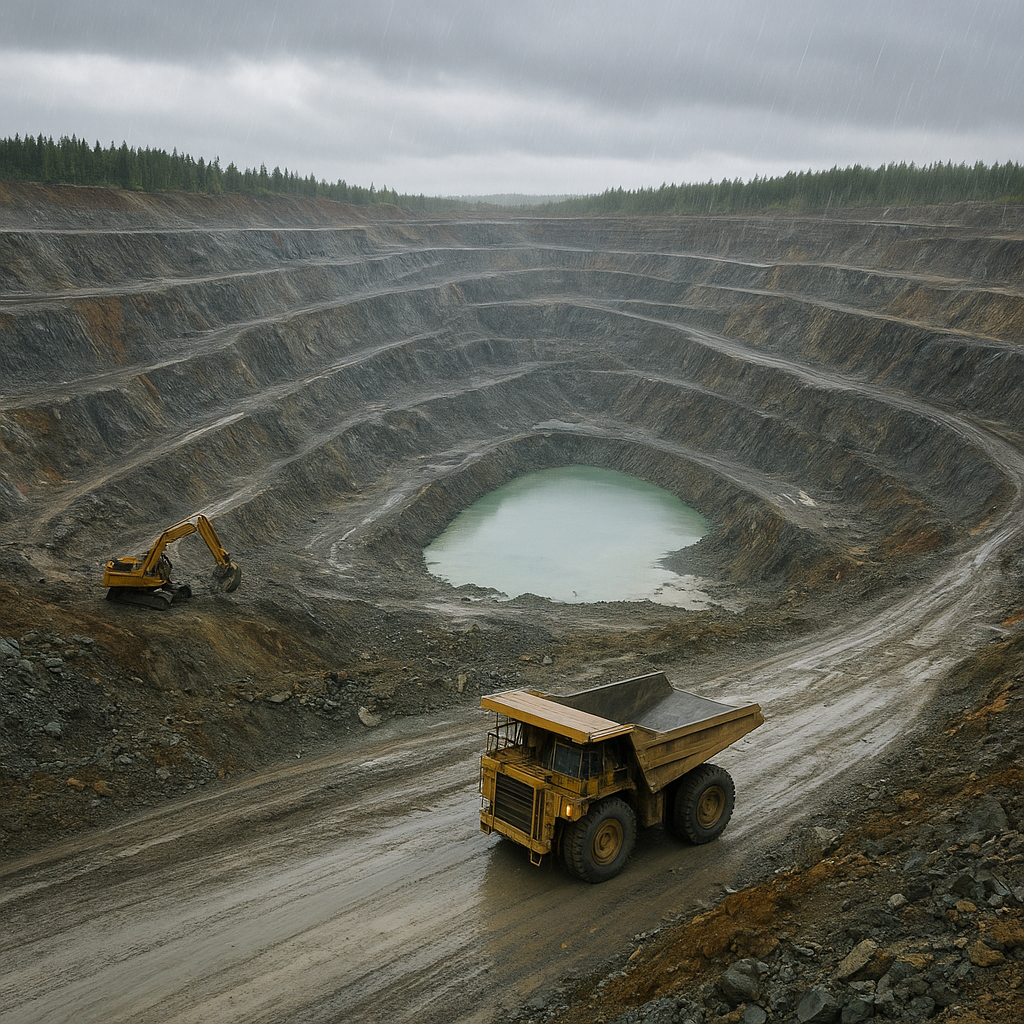
The Rainy River complex in northwestern Ontario is one of Canada’s modern gold mining operations that combines large-scale open-pit mining with a full on-site processing facility. Located in a region shaped by glacial history and rich Precambrian geology, the project stands out not only for its production of gold but also for its role in local economic development, technological application, and environmental management. This article describes where the operation is situated, what is extracted, its broader economic significance, and several features that make the site noteworthy.
Location and geological setting
The Rainy River project lies in the Rainy River District of northwestern Ontario, close to the international boundary with the United States (Minnesota). The mine sits within a belt of greenstone and older volcanic-sedimentary rocks that belong to the Superior Province of the Canadian Shield, a geological terrain well known for hosting a large number of gold-bearing deposits. The immediate area is a mosaic of lakes, rivers and forested uplands, typical of boreal landscapes in this part of Canada.
Geologically, Rainy River is interpreted as an orogenic-style gold deposit. These deposits are normally associated with compressional tectonics that produce structurally controlled veins and disseminated mineralization in metamorphosed volcanic and sedimentary sequences. At Rainy River, gold occurs in a combination of vein-hosted and replacement-style mineralization, often with associated sulphide minerals and sometimes with appreciable silver credits. The rock packages host a variety of alteration zones, and the project’s exploration history documented multiple mineralized zones that were later incorporated into a comprehensive mine plan.
Key geographical and logistical aspects
- Proximity to transportation corridors and border crossings facilitates access to regional supply chains and markets.
- Existing regional infrastructure reduces the need for extensive new public roads; however, the mine maintains its own haul roads and site logistics.
- Climate is continental with cold winters and relatively short operating seasons for some surface works; however, modern mine planning accounts for year-round operations where feasible.
What is produced and how it is processed
The primary commodity from the Rainy River operation is gold, with silver typically recovered as a by-product. Ore is mined from open pits and fed to an on-site processing facility where it is crushed, ground and subjected to chemical extraction processes to liberate and recover gold-bearing material. Standard processing circuits for such deposits include gravity concentration, cyanide leaching and carbon-in-leach (CIL) or carbon-in-pulp (CIP) recovery systems, followed by smelting and refining steps to produce doré bars that are shipped off-site for final refining.
At the operational level, the mine integrates mine planning, pit sequencing and ore blending to optimize recovery and economics. Tailings management and water treatment systems are an integral part of the processing chain, ensuring that effluent quality meets regulatory requirements before discharge and that long-term stability of tailings facilities is addressed through engineered design and monitoring.
Typical production characteristics
- Commercial production commenced after an extended development phase that included exploration, feasibility studies and construction of processing infrastructure.
- Annual production is measured in hundreds of thousands of ounces of gold in many years, depending on ore grade, throughput and operational efficiencies.
- Silver is recovered as a by-product and contributes to overall project revenue.
Ownership, investment and operational structure
The Rainy River enterprise was advanced and built by a corporate sponsor through a multi-year capital investment program. Modern gold projects of this scale combine equity, debt and internal cash-flow strategies to finance construction and ramp-up. The on-site organizational structure includes mine operations, processing plant operations, maintenance, environmental management and community relations teams. Contractors and service providers supply equipment, specialized personnel and logistics support under a mix of short- and long-term agreements.
Project development required significant upfront capital to build the processing mill, site infrastructure, tailings and water control systems, and to establish community and regulatory frameworks. The capital investment supports long-term operations that can span more than a decade, depending on resource conversion success and additional exploration results that may expand mine life.
Economic importance and regional impact
The economic footprint of a modern gold operation like Rainy River extends beyond direct mineral sales. Key economic contributions include direct employment, procurement of goods and services from regional suppliers, infrastructure improvements, and royalty and tax payments to provincial and federal governments. The presence of the mine stimulates local businesses in housing, transportation, catering, mechanical services and professional services such as engineering and environmental consulting.
Direct employment at the site includes operators, technicians, engineers and administrative staff, while indirect employment supports a wider supply chain. Training and apprenticeship opportunities are commonly established to increase local hiring and build local capacity. In many cases, impact and benefit agreements, community investment programs and supplier development initiatives aim to maximize local participation in procurement and employment.
- Job creation: The operation provides a mix of specialized and non-specialized employment, often with competitive wage structures compared with other regional industries.
- Local procurement: Equipment, fuel, consumables and services sourced locally help keep economic benefits in the region.
- Public revenues: Mining royalties, corporate income tax and payroll taxes contribute to public finances at multiple levels.
Community relations, Indigenous engagement and social license
Securing and maintaining a social license to operate is central to long-term success. Engagement with local communities, municipalities and Indigenous groups in the region is structured through formal agreements, consultations and collaborative programs. These partnerships may include training, employment targets, community investment funds and environmental stewardship projects designed to align the mine’s activities with local priorities.
Many modern projects place emphasis on meaningful consultation and negotiated agreements, recognizing Indigenous rights, cultural heritage concerns and the importance of economic participation by local peoples. Such relationships help reduce project risk, accelerate permitting, and provide a framework for cooperative monitoring and problem solving over the life of the mine.
Environmental management and reclamation
Environmental planning at Rainy River-style operations centres on minimizing ecological footprint, managing water quality, controlling tailings and reducing greenhouse gas emissions where possible. Initial environmental assessments define baseline conditions for air, water, wetlands and wildlife, and guide the design of mitigation measures. During operations, monitoring programs track water chemistry, biodiversity indicators and the performance of containment systems.
Tailings management is a critical focus: engineered storage facilities are designed with impervious liners, seepage collection, staged embankment construction and water treatment systems. Modern best practices stress progressive reclamation—returning disturbed areas to vegetated cover as soon as sections of the mine are no longer needed for operations. Closure planning is developed early and updated regularly to ensure financial provisions for post-closure monitoring and landform stability.
Notable environmental and technological practices often applied
- Effluent treatment and water recycling to minimize freshwater withdrawals.
- Progressive rehabilitation of disturbed lands to accelerate ecosystem recovery.
- Use of diesel particulate filters, optimized haul profiles and route planning to reduce fuel consumption.
Interesting technical and historical aspects
Several aspects of the Rainy River operation make it interesting from both technical and historical perspectives. The deposit sits in a region with a long history of mineral exploration dating back decades, and modern exploration techniques—geophysics, 3D modelling and systematic drilling—helped define a mineable resource that was not always evident from surface outcrops. Integrating geological understanding with large-scale mining economics illustrates how many once-small prospects can evolve into significant industrial projects.
Technological innovations at operations like Rainy River include advanced ore sorting and coarse particle recovery systems in some installations, high-efficiency grinding circuits that lower energy consumption, and digital systems for fleet optimization and predictive maintenance. These advances contribute to improved recovery, lower unit costs and reduced environmental footprint.
Regional history and mining legacy
- The broader area has seen episodic mineral exploration and small-scale mining for more than a century, with modern large-scale projects emerging once economic conditions and technologies align.
- Discoveries made with modern geoscience tools can re-evaluate previously marginal deposits, transforming them into viable operations.
- Mining projects often leave a long-term legacy of improved infrastructure—roads, communications and local services—that benefit surrounding communities.
Financial performance and market context
Gold mines like Rainy River operate in a global market where the price of gold is influenced by macroeconomic conditions, currency movements and investor sentiment. Operational performance—measured by production volumes, cash costs, all-in sustaining costs (AISC) and recovery rates—determines profitability. Successful projects balance capital discipline during construction with efficient operations and continuous improvement programs to lower costs and extend mine life.
Revenue management may include hedging policies (though many producers prefer unhedged exposure), careful working capital control and reinvestment in exploration to sustain future production. Furthermore, stronger community relations and stable environmental performance reduce regulatory and social risks that can otherwise interrupt production and harm value.
Opportunities and challenges ahead
Like any sizeable mining operation, Rainy River faces both opportunities and challenges. Exploration upside remains a key opportunity: successful infill and step-out drilling can convert inferred ounces to measured and indicated categories, extend mine life and improve project economics. Operational improvements—such as mill optimisation, blending strategies and cost control—can increase margins.
Challenges include fluctuating commodity prices, input cost inflation (fuel, reagents, labour), and the perennial need to meet environmental and regulatory expectations. Climate change adds an additional planning variable as companies adapt to more extreme weather events and evolving expectations for greenhouse gas reductions.
Why Rainy River matters
On a local level, the operation provides jobs, contracts and fiscal contributions that underpin community services and local businesses. On a national level, Rainy River contributes to Canada’s status as a stable, reliable source of precious metals for global markets. Geologically, it demonstrates the continuing potential of the Canadian Shield to host world-class mineral deposits and highlights how modern exploration and engineering can convert geological potential into tangible economic benefits.
The mine exemplifies how a modern resource project can combine large-scale mineral extraction with community engagement, environmental systems and ongoing exploration to create an operation with multi-decade implications for the region. For observers of the mining sector, Rainy River provides a case study in the intersection of geology, engineering, economics and social responsibility—each essential in delivering the metals that feed global industry and investment.

