
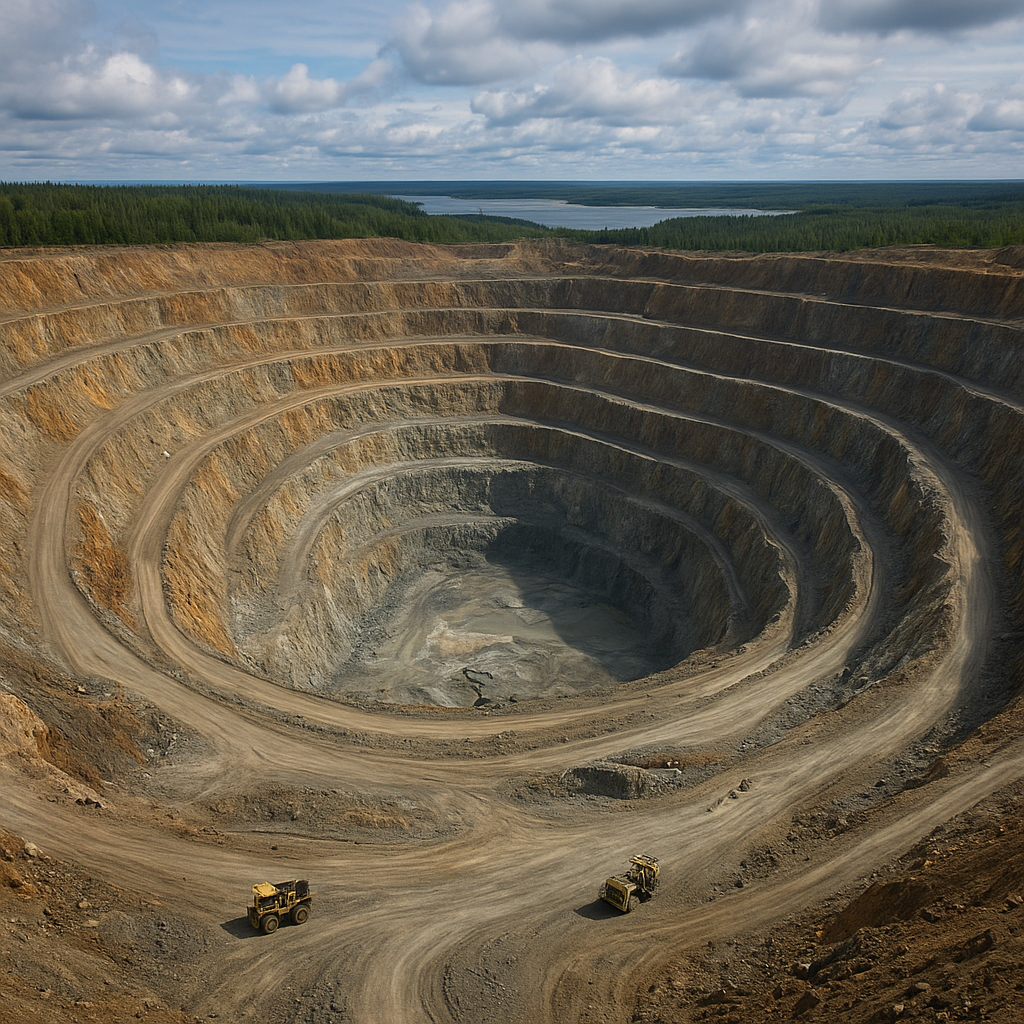
The Côté Gold Mine is a major new mining operation in northeastern Canada that has attracted international attention for its scale, strategic importance, and modern approach to resource development. Located in the mineral-rich landscapes of Ontario, the project represents a significant chapter in Canadian mining, combining large-scale investment, contemporary processing technology and extensive engagement with local communities and stakeholders. This article explores where the mine is, what is extracted there, its economic role, and several notable or unexpected aspects that make Côté Gold a compelling case study in 21st century mining.
Location and geological setting
The Côté Gold Mine is situated in northeastern Ontario, within the traditional territory of Indigenous communities and surrounded by mixed boreal forest and lakes. Geographically, it lies in a region that has long been recognized for significant mineral potential and is accessible by a network of seasonal and permanent roads connecting to larger urban centres in northern Ontario.
Geologically, the deposit targeted at Côté is a large, bulk-tonnage gold system hosted in complex greenstone belt and related intrusive rocks. Rather than being a narrow, high-grade vein deposit, Côté is characterized as a low- to moderate-grade, disseminated gold deposit that is well suited to open-pit mining. The style of mineralization and the scale of the deposit allowed project developers to envisage a large-scale surface extraction operation with a processing plant designed for continuous, high-throughput treatment of ore.
What is being mined and how it is processed
The primary commodity at Côté is gold, produced from ore extracted by large-scale open-pit techniques. The ore is transported to an on-site processing facility where it undergoes a sequence of crushing, grinding and metallurgical recovery processes typical for bulk-tonnage gold operations. The processing route is designed to maximize gold recovery while controlling costs and environmental impacts.
- Mining method: conventional open-pit mining using truck-and-shovel fleets and ancillary heavy equipment for waste removal and ore haulage.
- Comminution and recovery: multi-stage crushing and grinding followed by a cyanide-based leach circuit such as carbon-in-leach (CIL) or a comparable modern recovery system optimized for diffuse gold distribution.
- Tailings management: engineered tailings storage facilities and water management systems, with modern monitoring and progressive reclamation planning.
By combining efficient physical processing with large throughput, the operation is designed to manage relatively low-grade ore on an industrial scale. This approach converts a sizeable resource base into consistent annual gold production over multiple decades, aligning the mine’s output profile with global gold market demand cycles.
Ownership, development timeline and capital structure
Côté Gold was developed as a partnership between international mining interests and Japanese strategic investors, reflecting the global capital flows that support major mining projects. Development required several years of exploration, feasibility studies, environmental assessment and permitting before major construction commenced. The project attracted substantial investment during its construction phase, deploying capital for mine infrastructure, the processing plant, site roads and workforce camps.
Construction phases typically included: site preparation and clearing, pit pre-stripping and initial access roads, mill and plant erection, installation of power and water systems, and workforce housing and services. During peak construction, hundreds to thousands of direct construction jobs would be created, followed by several hundred permanent operational roles once production stabilized.
Economic significance and regional impacts
The Côté Gold Mine has broad economic implications at local, provincial and national scales. Some of the primary economic contributions include:
- Employment: Creation of thousands of short-term construction jobs and a sustained cohort of long-term operational positions in areas such as mining, metallurgy, environmental monitoring and administration.
- Local procurement: Significant demand for goods and services—fuel, parts, catering, accommodations, security and transportation—benefits local suppliers and service industries.
- Royalties and taxes: Ongoing royalty and tax payments to the provincial and federal governments provide fiscal revenues that support public services and infrastructure.
- Infrastructure: Upgrades to roads, power connections and communications arising from the project improve access for surrounding communities and can catalyze additional economic activity.
- Indigenous partnerships: Agreements and benefit-sharing arrangements with Indigenous communities enable economic participation, training and direct employment opportunities, as well as support for community projects.
Because the mine taps a large resource base, its multi-decade life of mine means a long-term anchor for regional economic planning. It draws skilled labour, invests in training, and encourages secondary businesses to establish supply chains in the region. For local municipalities and Indigenous partners, predictable production and revenue flows are key to planning for schools, health services and community development initiatives.
Environmental management and sustainability initiatives
Large-scale mining projects in Canada are subject to rigorous environmental assessments, regulatory oversight and community review. Côté Gold adopted multiple measures to manage environmental effects, comply with provincial regulations and integrate sustainability principles into operations.
- Water management: engineered systems to control runoff, treat process water and protect local aquatic ecosystems from contamination.
- Progressive reclamation: plans to progressively rehabilitate disturbed areas during mine life rather than postponing reclamation until after closure.
- Wildlife and habitat protection: monitoring and mitigation to reduce impacts on local species and migratory pathways.
- Emissions control: efforts to minimize greenhouse gas emissions from heavy equipment and processing operations, including efficiency improvements and potential use of cleaner power sources.
Environmental stewardship at Côté also involves ongoing dialogue with nearby communities to monitor water quality, noise and dust. Transparent monitoring programs and third-party reporting help maintain social license to operate over the life of the mine.
Social dimensions and Indigenous engagement
A defining feature of contemporary resource development in Canada is meaningful engagement with Indigenous peoples and local stakeholders. Côté Gold’s developers negotiated impact and benefit agreements with nearby Indigenous groups to ensure that project benefits—economic, social and cultural—are shared and that traditional rights are respected.
Key elements of these relationships typically include:
- Employment and training initiatives designed to increase Indigenous participation in the workforce.
- Business development support and preferential contracting to grow Indigenous-owned enterprises.
- Cultural protection measures to avoid or minimize impacts on heritage sites and traditional land use.
- Regular consultation forums and dispute resolution mechanisms to address concerns during construction and operation.
These partnerships can serve as a model for how mining projects and Indigenous communities can collaborate on long-term economic and cultural objectives.
Noteworthy technical and operational features
Côté Gold incorporates several technical and operational choices worth noting:
- Scale and design: The project is engineered for high throughput, enabling economies of scale that lower unit production costs—an important factor for long-life, low-grade deposits.
- Modern processing: Use of proven recovery technologies and plant automation supports operational efficiency and safety.
- Tailings management: Contemporary tailings design with layered monitoring and contingency planning reflects lessons learned industry-wide about long-term storage safety.
- Digitization: Increasing use of digital mine planning, fleet management and remote monitoring improves productivity and reduces downtime.
By combining established metallurgical approaches with new operational technologies, the mine balances reliability with the continuous pursuit of performance improvements. The technical profile is tailored to deliver predictable output while managing environmental and safety risks.
Interesting facts and broader significance
Beyond the nuts and bolts of geology and economics, Côté Gold has several aspects that make it particularly interesting:
- Strategic timing: The mine came online at a time when global demand for precious metals was influenced by economic uncertainty, making gold a strategic asset for investors and governments alike.
- Local transformation: In areas where resource projects are major employers, a single mine can change the socio-economic trajectory of towns and First Nations communities—affecting housing, services and local business development.
- International partnerships: The involvement of global companies in a Canadian mine underlines how modern mining is a cross-border endeavour, combining local resource stewardship with international capital and expertise.
- Long-term planning: With a life-of-mine measured in decades, planning horizons for Côté extend well beyond typical business cycles, necessitating long-term commitments to communities and the environment.
Challenges and future outlook
No large mining project is without challenges. Common issues include fluctuating commodity prices, operating cost pressures, workforce availability in remote regions, and maintaining strong relations with local and Indigenous stakeholders. For Côté Gold, success depends on navigating these variables while adhering to stringent environmental standards and responding to evolving public expectations.
Looking forward, the mine’s continued contribution will be shaped by gold market dynamics, technological advances in mining and processing, and the effectiveness of local partnerships. If managed well, Côté can remain a stable source of economic value and a reference point for how large-scale mining projects can integrate technical performance with community and environmental responsibilities.
Final remarks
The Côté Gold Mine stands out as a significant modern mining enterprise in Canada: a project that pairs a large, bulk-tonnage gold resource with contemporary engineering, environmental oversight and socio-economic engagement. Its influence extends beyond ounces produced — affecting local employment, regional infrastructure and the broader conversation about sustainable resource development in Canada. Observers of the mining sector will likely continue watching Côté as an example of the opportunities and responsibilities that accompany major resource projects in the 21st century.

