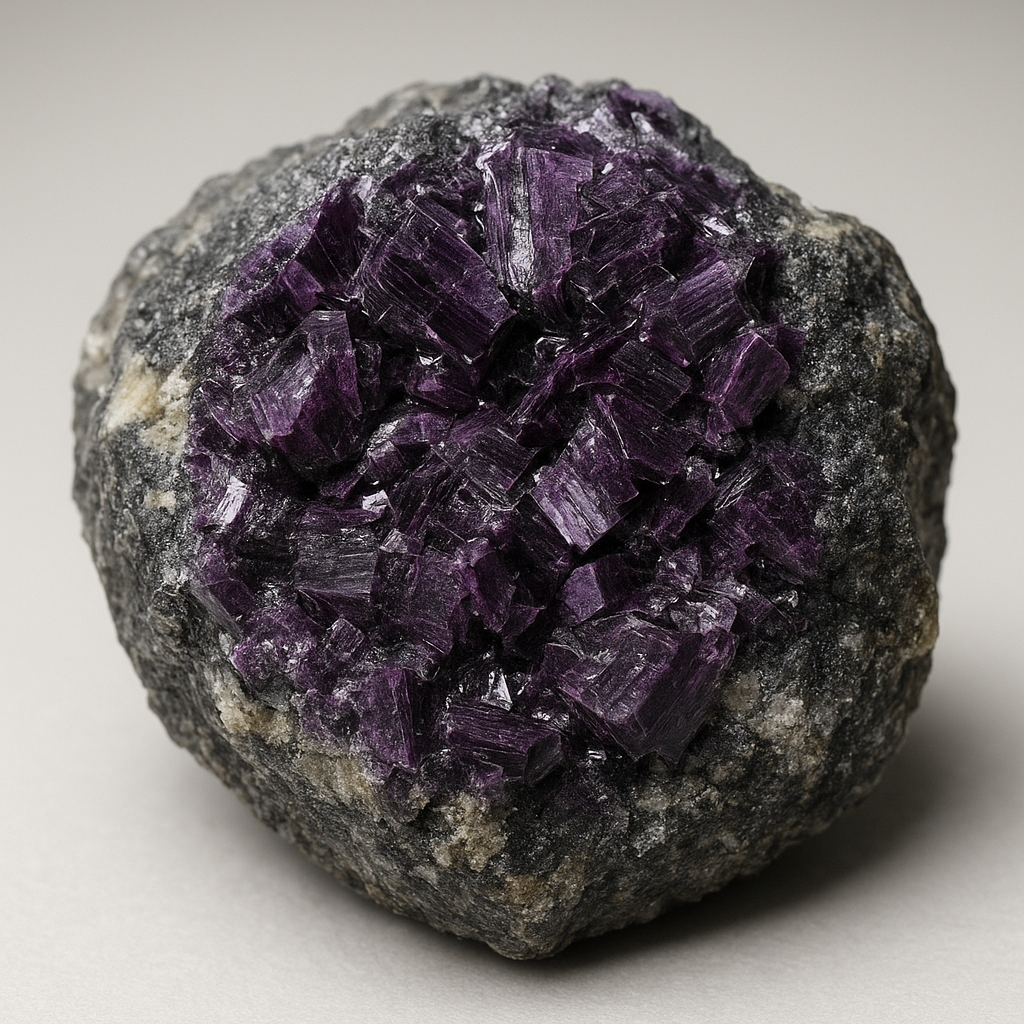
Kämmererite is an uncommon and visually striking member of the chlorite group — a chromium-bearing, pink to purple phyllosilicate that captures the attention of mineral collectors, gem enthusiasts, and geologists alike. Although it seldom appears in large masses, its distinct coloration and geological implications make it an object of study and admiration. This article explores its mineralogical identity, the environments where it forms, practical and scientific uses, and a few fascinating aspects that make kämmererite special.
Appearance and mineralogical characteristics
Kämmererite presents itself most often as thin coatings, minute veinlets, or flattened aggregates rather than as large, well-formed crystals. Its most notable visual trait is a range of pink to violet hues produced by trace amounts of chromium substituting into the mineral structure. The material typically displays a pearly to silky luster on cleavage surfaces and a more subdued vitreous sheen on fracture faces.
- Kämmererite belongs to the broad family of chlorite minerals, which are layered phyllosilicates formed by sheets of silica tetrahedra and octahedrally coordinated cations.
- The characteristic pink-purple color is due to chromium (Cr3+) replacing aluminum or other octahedral cations in the structure; this chromophore is the same ion that gives emeralds their green when substituting into beryl.
- Physically, specimens are generally soft and can be easily scratched by a knife; they cleave well along the foliation typical of chlorite minerals.
- Because kämmererite is a form of clinochlore or a closely related chlorite, it shares the group’s layered habit, relatively low density, and moderate to low hardness.
Beyond color and habit, kämmererite can be characterized spectroscopically and crystallographically. X-ray diffraction confirms its chloritic sheet structure, while optical absorption and electron microprobe analyses reveal chromium concentrations and confirm substitutional chemistry. Those analytical methods are essential for distinguishing true kämmererite from superficially similar pink minerals or altered materials.
Where kämmererite occurs
Kämmererite is a rare mineral and is encountered only in specific geological contexts — generally where chromium is available during low- to medium-grade metamorphism or hydrothermal alteration. Notable environmental settings include:
- Chromium-enriched skarns and contact-metamorphosed zones where chromium-bearing solutions interact with host rocks, enabling Cr to enter chlorite structures.
- Alteration halos around ultramafic intrusions or chromite-bearing layers, where weathering and metasomatism mobilize chromium into secondary minerals.
- Specialized iron-manganese ore deposits with complex mineral parageneses, where unusual geochemical conditions concentrate trace elements including chromium, manganese, and iron.
One of the classic type localities for kämmererite is the Långban deposit in Sweden, famous for an extraordinary diversity of rare minerals. At Långban and comparable European localities, kämmererite appears as attractive pink coatings on host minerals or as thin seams in veins. Smaller occurrences have been reported from other chromium-bearing districts worldwide where conditions permit chromium to substitute into chloritic phases. Because the mineral forms under particular chemical conditions, each find is of interest to mineralogists trying to reconstruct local geochemical histories.
Uses, value and the market
Kämmererite’s rarity and color make it primarily a mineral collector’s item rather than a commodity with broad industrial application. Its uses and value can be summarized as follows:
- Collector interest: High-quality kämmererite specimens — with vivid pink to violet hues and good preservation — are sought after by museums and private collectors. Small but well-colored pieces can command premium prices in specialty mineral markets.
- Gemstone and lapidary use: On rare occasions kämmererite is fashioned into cabochons or small ornamental pieces. Because of its softness and cleavage, it is best suited to pieces that will see light wear only, such as pendants or display stones rather than rings.
- Scientific and educational value: Geologists and mineralogists value kämmererite as an indicator mineral that reveals the presence and mobility of chromium in a rock system. Its chemistry helps in reconstructing metamorphic and metasomatic processes.
Kämmererite does not have substantial industrial uses. Its scarcity, softness, and fragility prevent utility in applications requiring durability. It sometimes appears in jewelry catalogs targeted at collectors or those seeking unusual stones, but these items are niche and priced accordingly.
Scientific significance: what kämmererite tells us about rocks
Although not abundant, kämmererite is important diagnostically. Its presence signals particular geochemical and metamorphic pathways:
- Chromium mobility and availability: The formation of kämmererite requires chromium to be mobile in the local system and available to enter the chlorite structure. This often implies fluid-mediated transport during hydrothermal events or metasomatic alteration near ultramafic bodies.
- Redox and pH conditions: Chromium exists in multiple oxidation states, and its incorporation as Cr3+ into phyllosilicates informs geochemists about reducing conditions and pH during mineral formation.
- Metamorphic fingerprints: In metamorphic terrains, the presence of chromium-bearing chlorite can point to specific temperature and pressure ranges and can be used together with other index minerals to refine metamorphic histories.
Analytical techniques that probe kämmererite — such as electron microprobe, Raman spectroscopy, and X-ray diffraction — yield precise information about its composition and structure. These data are invaluable for petrologists reconstructing fluid compositions, reaction pathways, and the sequence of mineral formation in complex ore systems.
Associated minerals and paragenesis
Kämmererite rarely occurs in isolation. It is typically part of a rich mineral assemblage that may include other chlorites, mica-group minerals, carbonates, manganese oxides, and various oxide or silicate phases. In manganese- and iron-rich deposits, kämmererite may be found alongside minerals that reflect oxidizing conditions or late-stage hydrothermal fluids.
Understanding the paragenesis — the sequence of mineral formation — helps determine whether kämmererite formed early as a primary metamorphic phase or late as a secondary alteration mineral. Field observations combined with microscopic petrography and geochemical analysis clarify whether chromium was introduced episodically or was resident in the protolith and redistributed during metamorphism.
Care, treatment, and identification tips
Collectors and lapidary artists working with kämmererite should be aware of its physical limitations and how to distinguish authentic specimens:
- Care: Because of the mineral’s softness and perfect or good cleavage, avoid ultrasonic cleaners and harsh chemicals. Clean gently with a soft brush and mild soap if needed. Store specimens away from harder minerals that could scratch them.
- Treatments: Kämmererite is usually sold in its natural state. Heat or chemical treatments are uncommon because they can damage the delicate layered structure and alter color.
- Identification: Visual identification is aided by the combination of pink-violet color and chloritic habit, but confirmation requires analytical methods — polarized light microscopy, X-ray diffraction, or electron probe analyses — to distinguish kämmererite from other pink minerals or coatings.
- Imitations: Because it is not a mainstream gem, kämmererite is rarely imitated in commercial jewelry, but dyed or altered materials may be passed off as attractive pink stones. Always seek provenance and test results for valuable pieces.
Interesting aspects and curiosities
Kämmererite offers several scientific and aesthetic curiosities that make it stand out:
- Color chemistry parallel: The pink-to-violet coloring mechanism — Cr3+ in octahedral sites — is shared with other chromium-bearing minerals and provides an instructive example of how trace elements control mineral color.
- Thin-film occurrence: Often occurring as coatings or thin films, kämmererite can give a surprising splash of color on otherwise dull specimens, enhancing their museum or collector value despite small mass.
- Indicator of exotic environments: Because it requires chromium selectivity to form, kämmererite is a signature that an unusual geochemical environment existed at the time of its formation, making small specimens valuable pieces of a larger geological puzzle.
- Scarcity and variety: Even within the small set of known kämmererite occurrences, color intensity, grain size, and association minerals vary, meaning that each new find can yield fresh insights into local formation conditions.
Further reading and study directions
For those interested in exploring kämmererite in more detail, resources to consider include mineralogical atlases, peer-reviewed papers on chromium geochemistry in metamorphic and hydrothermal systems, and specimen catalogs from classic localities. Field studies at well-documented deposits such as Långban provide firsthand experience of how kämmererite fits into complex ore parageneses. Analytical work — particularly electron microprobe and spectroscopic methods — continues to refine understanding of the chromium substitution mechanisms and the precise structural role Cr plays within chlorite sheets.
Whether admired for its delicate pink color, studied as a chemical indicator in rocks, or prized as a rare collector’s specimen, kämmererite occupies a niche that links aesthetic appeal to geological significance. Its presence in a rock tells a nuanced story about chromium, fluids, and metamorphic or metasomatic processes that shaped the host environment.