
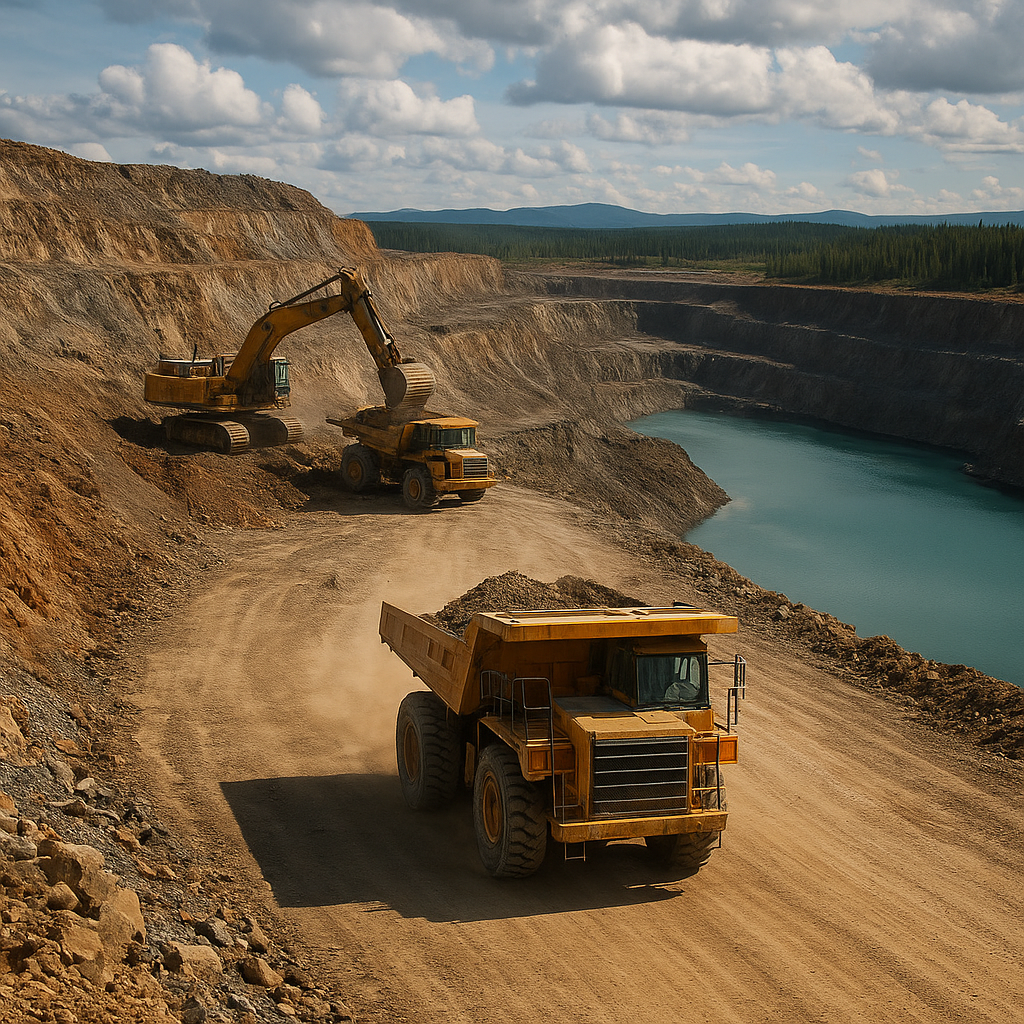
The Detour Lake Mine is one of Canada’s most prominent gold operations, notable for its size, remote setting, and role in the country’s mining sector. Located in northeastern Ontario, the project transformed a long-known mineral occurrence into a modern, large-scale open-pit mine that produces significant quantities of gold each year. This article describes where the mine is situated, what is produced and how, its broader economic significance, and several interesting technical and historical aspects that make Detour Lake a striking example of contemporary mining in Canada.
Location and geological setting
Detour Lake Mine sits in the boreal, forested region of northeastern Ontario, within a part of Canada known for its rich mineral endowment. The operation occupies land near Detour Lake and is accessible by a network of seasonal and permanent roads from regional service centres. Its remoteness is a defining characteristic: the site is several hours’ drive from major cities and lies in a landscape of lakes, wetlands and mixed forest that is representative of the Canadian Shield.
Geologically, the deposit is hosted in ancient Precambrian rocks and forms part of the broader greenstone-hosted gold systems that make up much of Canada’s mineral wealth. The orebody is primarily a near-surface, low-grade, bulk-tonnage gold deposit amenable to open-pit mining. Such deposits differ from high-grade, narrow-vein mines by being mined and processed in very large volumes. The mineralization at Detour Lake typically occurs as disseminated and vein-hosted gold associated with altered volcanic and sedimentary rocks, reflecting a long geological history of fluid flow and structural controls that concentrated gold into economically recoverable zones.
Mining method and processing
The mine is operated as a conventional large-scale open pit. Mining involves drilling, blasting, loading and hauling by large earthmoving fleets, followed by primary crushing and milling. The process route is designed to maximize gold recovery from a low-grade feed by employing primary and secondary grinding, followed by gravity recovery steps and a carbon-in-leach (CIL) circuit or equivalent cyanide-based recovery system. Final gold is produced as doré bars that are then refined off-site.
- Open-pit extraction: bulk removal of overburden and ore in successive benches, using large haul trucks and shovels.
- Crushing and grinding: reducing rock to a suitable size for recovery circuits.
- Gold recovery: combination of gravity concentration and chemical leaching with carbon-in-leach or similar technologies to extract gold from the ore matrix.
- Tailings management: engineered storage facilities designed to contain process residues and minimize environmental risks.
Because Detour Lake processes large volumes of ore with relatively modest grade per tonne, operational efficiency, economies of scale, and robust processing circuits are essential to maintain profitability. The mine’s infrastructure includes processing plants, waste rock and tailings facilities, a site access road, workshops, and a suite of support services. Reliable sources of power and fuel logistics are also critical in such a remote setting, necessitating investment in transmission lines and on-site fuel storage.
Production, reserves and operational scale
Detour Lake is recognized as one of Canada’s larger gold mines in terms of production and contained ounces in resource and reserve categories. It is characterized by a sizeable mineral resource that supports multi-year production plans. Annual production volumes fluctuate with the mine plan and gold prices, but the operation is structured to produce hundreds of thousands of ounces of gold annually at full operation.
Key economic drivers at the site include scale of tonnage moved, processing throughput, and metallurgical recovery rates. Because the deposit is relatively low-grade compared to narrow-vein mines, the economics depend heavily on maintaining low costs per tonne and high plant uptime. The mine plan typically stages pit expansion, waste stripping and ore extraction to balance operating costs against metal recovery schedules and market conditions.
Economic significance
Detour Lake Mine contributes to the regional and national economy in several ways:
- Employment: The mine provides direct jobs for miners, technicians, engineers and tradespeople, and indirect employment in services, maintenance and contractors. While construction phases require a large temporary workforce, steady-state operations sustain hundreds of direct positions and many more in the supply chain.
- Local procurement: Goods and services—from catering and transportation to heavy equipment maintenance—are sourced locally and regionally where possible, stimulating business activity in nearby communities.
- Government revenues: Through royalties, corporate taxes, and property taxes, the mine generates public revenue that supports provincial and municipal services.
- Export earnings: Gold production contributes to Canada’s resource export profile, bringing foreign currency inflows when metal is sold on international markets.
- Infrastructure development: Investment in roads, power lines and communications to support the mine can have spillover benefits for other industries and communities in remote regions.
Beyond direct monetary contributions, the presence of a major mine can anchor regional economic development. Suppliers scale up, service sectors expand, and training for technical trades increases the local workforce’s capabilities. At the same time, the long life of a large open-pit operation can provide decades of sustained economic activity when planned and managed responsibly.
Social and Indigenous relationships
Given its location, Detour Lake’s operations interact with local Indigenous communities and other nearby settlements. Modern mining projects typically pursue consultation, impact-benefit agreements, and employment and procurement commitments with neighbouring First Nations and Métis organizations. These arrangements are intended to ensure that affected communities share in economic opportunities, receive training and employment, and have a voice in environmental management and cultural heritage protection.
Partnerships may include clauses for local hiring preferences, contracting opportunities for Indigenous businesses, scholarship and training programs, and funding for community projects. Respectful consultation processes and collaboration on monitoring programs are important to maintain social licence to operate and to address historical concerns about resource development.
Environmental management and mitigation
Operating in the sensitive boreal environment requires careful environmental planning. The mine employs mitigation measures to manage impacts on water quality, wildlife habitat, and vegetation. Key elements of environmental management at large open-pit mines typically include:
- Comprehensive water management systems to control runoff and protect downstream aquatic ecosystems.
- Engineered tailings facilities following modern design and monitoring standards to avoid uncontrolled releases.
- Progressive reclamation of disturbed areas, seeding and reshaping of waste rock dumps, and reforestation initiatives where feasible.
- Wildlife monitoring and mitigation measures to minimize impacts on fish and wildlife corridors.
- Continuous environmental monitoring and reporting to regulators and stakeholders.
Regulatory oversight by provincial and federal agencies ensures compliance with environmental laws, permitting requirements, and monitoring obligations. Innovations in waste management, water treatment and emissions control are central to reducing the environmental footprint of the operation over its life and into closure.
Community benefits and challenges
Large mining projects bring both benefits and challenges to nearby communities. Benefits include jobs, infrastructure improvements and increased economic activity. Challenges can include housing pressures, increased traffic on regional roads, and socio-economic adjustments as the local economy shifts toward resource dependency.
To address these challenges, operators and governments often collaborate on measures such as housing initiatives, public services investment, road upgrades, and community liaison committees. Transparent communication about mine plans, closure timelines and workforce transitions can help communities plan for the future and diversify their local economies.
Interesting technical and historical aspects
Several features make Detour Lake Mine particularly noteworthy:
- Scale and engineering: The mine is designed for large-scale bulk tonnage mining, requiring massive earthmoving fleets and high-throughput processing facilities. Engineering challenges include managing pit slopes, water inflow from a lake system and long-term stability of waste rock and tailings facilities.
- Remote logistics: Operating in a remote northern environment demands sophisticated logistics for fuel, consumables, and personnel rotation. Seasonal conditions, including harsh winters and variable road access, shape operational planning.
- Long resource life: The deposit supports a multi-decade mine life under many development scenarios, which influences community planning, workforce development, and staged capital investment strategies.
- Historical continuity: While the modern Detour Lake Mine represents a 21st-century development, the area has a long history of exploration and small-scale prospecting. The recognition of the deposit’s potential and the subsequent technology and capital investments reflect how mining-developments evolve over generations.
- Technological adoption: Large operations like Detour Lake often adopt technology to improve safety and efficiency—examples include fleet management systems, remote sensing for pit design, and advanced metallurgical flowsheet optimization.
Regional and global context
In the global gold sector, Detour Lake stands as an example of how geologically large but lower-grade deposits can be developed economically through scale and efficient processing. It highlights a persistent pattern in mature mining jurisdictions: exploration finds that may lie dormant for decades until market conditions, technology, and financing align to make development viable.
Regionally, the mine contributes to Ontario’s standing as a leading mining jurisdiction in North America. Its development demonstrates government and industry capacity to manage permitting, environmental assessment and community consultation in a large-scale project context.
Future considerations and legacy
Looking forward, the mine’s future depends on a combination of factors: gold prices, operating costs, ability to expand or extend reserves, and ongoing relationships with stakeholders. As the operation transitions through different phases—from ramp-up to steady production and eventually to closure—planning for reclamation, community transition and environmental stewardship will shape its legacy.
Advances in processing efficiency, possible extensions to reserves through exploration, and improvements in environmental technology can all affect the mine’s lifespan and regional impact. Lessons learned at Detour Lake about community engagement, large-scale logistics in remote settings, and environmental safeguards will inform future projects in similar terrains.
Conclusion
Detour Lake Mine exemplifies the modern, industrial-scale approach to extracting Canada’s mineral wealth. Located in remote northeastern Ontario and hosted within ancient geological formations, the mine produces significant quantities of gold using open-pit methods and high-throughput processing. Its economic contributions are felt locally and provincially through employment, government revenues and procurement opportunities, while its development underscores the importance of environmental management and collaboration with Indigenous and local communities. Technical scale, logistical complexity and long-term planning are among the features that make Detour Lake a noteworthy operation in Canada’s mining landscape.

