
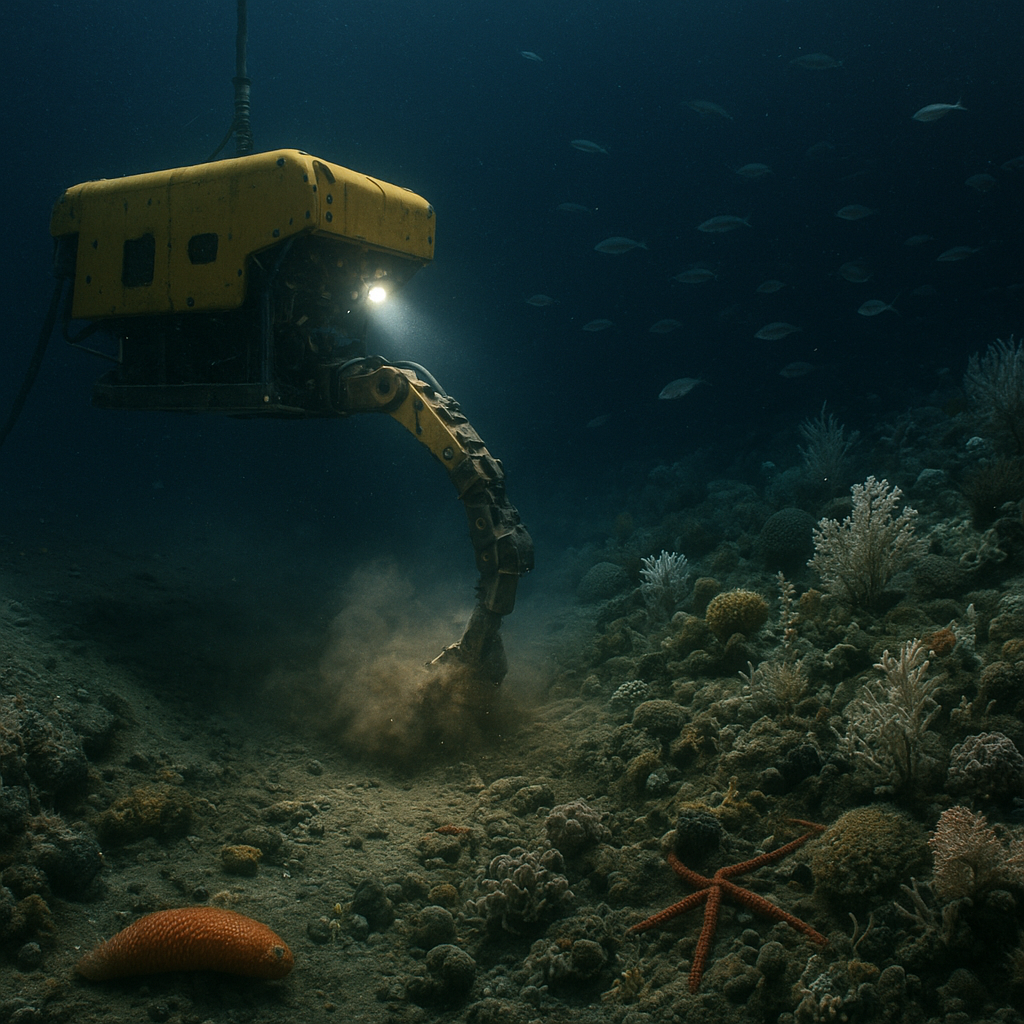
The prospect of extracting minerals from the deep seafloor has captured the attention of industry, governments and scientists. Yet beneath the waves lies a web of living systems that are poorly understood, exceptionally fragile and deeply interwoven with global processes. This article explores how seabed ecosystems complicate the ambition of large-scale deep-sea mining—highlighting ecological complexity, technical and legal obstacles, monitoring and mitigation challenges, and why many researchers urge caution before commercial exploitation proceeds. Throughout the text, I emphasize how unique biological and physical characteristics of the deep ocean create risks that are hard to predict or manage.
Ecological richness in the dark: what lives on the seabed and why it matters
The deep ocean hosts a surprising array of habitats, from vast abyssal plains covered in scattered nodules to oasis-like chemosynthetic communities at vent fields. These environments support high levels of endemicity and specialized adaptations. Many species are slow-growing and have life histories adapted to stable, low-energy conditions. The result is that even small disturbances can have long-lasting impacts.
Certain features are especially important to understand. Polymetallic nodules are potato-sized mineral accretions on the seafloor that take millions of years to form and provide hard substrate for sessile animals. Hydrothermal vents and cold seeps support chemosynthetic food webs based on chemical energy rather than sunlight. Seamounts and canyon systems concentrate productivity and serve as important corridors for pelagic and benthic species. Collectively, these habitats contribute to global ecosystem services—carbon sequestration, nutrient cycling and genetic resources for biotechnology—that tie seabed ecology to human well-being.
Because many of the deep-sea species are undescribed, baseline knowledge is sparse. That ignorance increases uncertainty in impact assessments and complicates the design of effective protective measures. The ecological biodiversity present on the seabed often includes slow-replicating taxa whose population dynamics do not recover on human timescales, undermining simple assumptions about resilience.
Physical and ecological processes that amplify mining impacts
Mining the seafloor is not only a matter of removing metal-bearing material; it triggers a cascade of physical and biological responses. Many of these arise from the interplay of sediment disturbance, altered geochemistry and biological interactions.
Sediment plumes and wide-area smothering
Mechanical disturbance, vehicle movement and processing of material at the surface create sediment plumes. A sediment plume can travel far beyond the footprint of direct extraction, carried by bottom currents and episodic events. Plumes reduce light in the water column (where light matters), clog gills of filter feeders, smother sessile organisms and change substrate properties. Predicting plume dispersion requires detailed oceanographic data that are often lacking.
Disruption of biogeochemical cycles
Deep-sea sediments and chemosynthetic sites are hubs of complex chemical transformations. Disturbance can release trapped compounds—nutrients, metals and greenhouse gases such as methane—with consequences for local chemistry and potentially for broader oceanic processes. For instance, remobilized metals can alter microbially-mediated pathways, affecting carbon cycling and the balance of oxygen consumption in sediments. Seabed disturbance may also affect long-term carbon sequestration by exposing buried organic matter.
Connectivity and compensatory dynamics
Many management concepts rely on the possibility that undisturbed refuges can repopulate impacted areas. However, the deep sea is characterized by limited dispersal and highly patchy populations. Larval connectivity is often weak or unpredictable. As a result, the expected recovery from a localized mining footprint may not occur within reasonable time frames—if it occurs at all. The slow growth rates and long-lived nature of many deep-sea organisms reduce the chance of rapid recolonization.
Cumulative and synergistic impacts
Mining rarely occurs in isolation. Fisheries, climate-driven changes, pollution and shipping can interact with mining impacts to produce nonlinear outcomes. Cumulative stressors can push systems past thresholds, after which they reorganize into different states with reduced functionality. These complex interactions complicate impact forecasts and management responses.
Technical, regulatory and monitoring challenges
The biological and physical complexity of seabed ecosystems creates demanding requirements for technology, law and environmental monitoring. Several interlinked challenges stand in the way of robust governance and responsible practice.
Limitations of existing environmental baseline data
Before any extraction, comprehensive baseline surveys are required to quantify species presence, habitat heterogeneity and ecosystem processes. But the deep sea is vast, sampling is expensive and time-consuming, and many areas are still uncharted. This scarcity of data undermines environmental impact assessments and invites large uncertainties into decision-making.
Enforcement and international governance
Many potentially mineable resources lie beyond national jurisdictions on the high seas. The International Seabed Authority (ISA) is the main body responsible for regulating activities in these areas, but its framework is evolving and has been criticized for gaps in precaution, transparency and scientific requirements. National waters introduce a patchwork of rules and enforcement capacities—making consistent protection uneven. Robust regulations must balance resource access, environmental protection and equitable benefit-sharing—but technical complexity makes that balance contentious and hard to verify.
Monitoring in a remote environment
Effective mitigation requires continuous, reliable monitoring of biological, chemical and physical variables. The deep sea complicates monitoring because sensors must endure high pressure, low temperatures, and biofouling; data transmission is difficult; and interpreting signals from complex systems requires expert analysis. Autonomous platforms and remote sensing are improving, but they do not yet provide the spatial and temporal coverage needed for confident detection of long-term ecological change.
Engineering trade-offs and unanticipated impacts
Mining technologies—whether nodule collectors, cutter-suction devices, or seafloor shredders—vary in their disturbance footprint, bycatch risk and sediment resuspension. Developers propose engineering solutions to minimize harm, but every technology has trade-offs. Attempts to avoid one impact often increase another (e.g., less substrate removal but larger plumes). Moreover, scale-up from pilot trials to commercial operations can reveal unforeseen system-level consequences.
Mitigation, restoration and the limits of human intervention
The engineering and policy tools commonly used in terrestrial contexts are harder to implement or less effective in the deep sea. Understanding these limitations is essential for realistic planning and risk assessment.
Mitigation hierarchy and practical limits
The mitigation hierarchy—avoid, minimize, restore, offset—is a common framework for environmental management. In the deep sea, the “avoid” step often requires designating protected areas and no-mining zones. Identifying areas worthy of protection depends on solid scientific evidence and international cooperation. Minimization can reduce some impacts but rarely eliminates them. Restoration—actively returning an area to its pre-disturbance state—is especially problematic: the unique physicochemical conditions and slow biological processes severely constrain restoration techniques. Offsetting impacts by protecting other areas assumes equivalent ecological function and connectivity, an assumption that may fail in such specialized systems.
Restoration research and technological prospects
Experimental work has explored seafloor recolonization, artificial substrates and transplantation. Results show limited success; many species either do not settle on artificial surfaces or take decades to reach previous biomass levels. Attempts to cultivate or reseed populations face the challenge of replicating microhabitat conditions and food-web dynamics. While novel technologies (e.g., in situ incubation chambers, robotics for targeted interventions) can reduce uncertainty, they are unlikely to make large-scale commercial mining ecologically neutral.
Marine spatial planning and stakeholder involvement
Effective mitigation requires participatory approaches that involve scientists, industry, local coastal communities, Indigenous groups (where relevant), NGOs and international bodies. Marine spatial planning can integrate multiple uses and identify trade-offs, but it depends on transparent data sharing and adaptive governance. Conservation strategies such as marine protected areas, networks of reference zones and strict no-take areas are tools to preserve critical habitats and maintain natural variability.
Research priorities and ethical considerations
Because the deep sea remains among the least-known frontiers on Earth, targeted research is essential to inform decisions about mining. Key priorities include:
- Comprehensive taxonomic surveys and assessments of functional roles to quantify the true value of deep-sea biodiversity.
- Studies on life-history traits, larval dispersal and population connectivity to improve recovery models and reserve design.
- Long-term experiments on disturbance and recolonization to estimate realistic timelines for ecosystem resilience and recovery.
- High-resolution oceanographic modeling to predict the fate of sediment plumes and remobilized contaminants.
- Biogeochemical research into the consequences of disturbance for carbon cycling and the potential release of greenhouse gases such as methane.
- Socioeconomic analyses of the value of seabed resources versus intact ecosystem services and the costs of potential ecological degradation.
Beyond science, there are ethical questions about intergenerational equity, the rights of the global commons, and whether rare deep-sea habitats should be preserved for their intrinsic value rather than commodified. The possibility of irreversible loss of unique biological lineages calls for precaution in decision-making.
Paths forward: balancing resource needs and protection
There are several pragmatic pathways societies can follow, each with different risk profiles. One option is to suspend commercial exploitation until robust, peer-reviewed evidence demonstrates that specific technologies and governance measures can prevent unacceptable harm. Another is to proceed cautiously with small-scale, tightly regulated pilot projects paired with transparent baseline science and independent monitoring. A third option emphasizes turning away from seabed extraction by accelerating terrestrial recycling, circular-economy strategies and substitution to reduce demand for seabed-sourced metals.
Any path must reckon with the reality that seabed ecosystems are not simple resources to be mined without consequence. Their unique characteristics—specialized species, slow dynamics, complex biogeochemical roles and connectivity—make management a scientific, technical and moral challenge. Emphasizing precaution, investing in long-term research, strengthening international regulations and prioritizing conservation zones are practical steps that can reduce the risk of irreparable harm while society debates the role of deep-sea mining in a sustainable future.
