
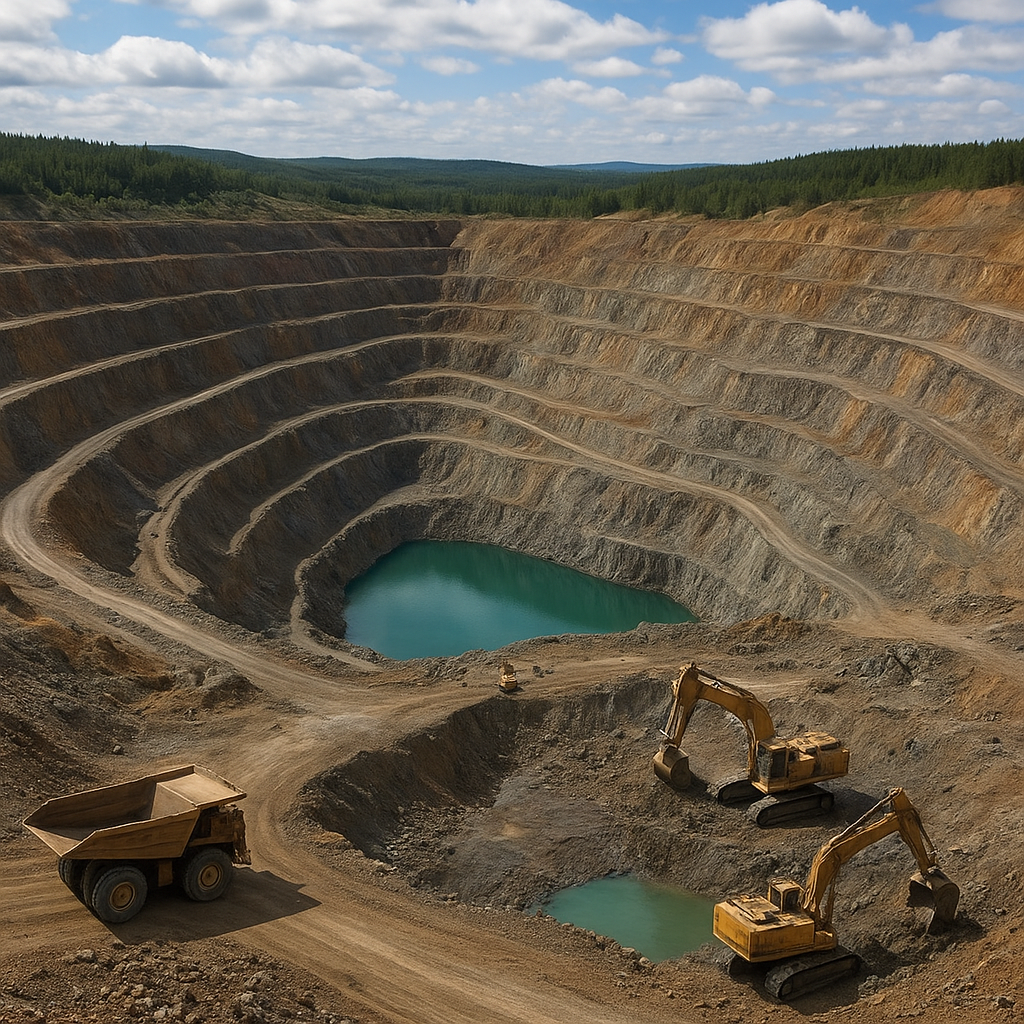
The Meadowbank Mine is one of the most prominent modern mining projects in northern Canada. Located in the remote sub-Arctic landscape of the Kivalliq Region, it brought large-scale industrial activity to an area where the rhythm of life has traditionally been shaped by the seasons, hunting and small communities. The mine’s development, production and legacy touch on geology, engineering, community relations and environmental stewardship. Below are detailed sections describing where Meadowbank is, what it produced, how it operated, and why it matters economically and culturally — along with several aspects that many readers find especially interesting about mining at the edge of the Arctic.
Location and regional setting
Meadowbank is situated in the Kivalliq Region of Nunavut, in northern Canada, in relative proximity to the community of Baker Lake (Qamani’tuaq). The mine sits within a remote, largely tundra environment characterized by low vegetation, scattered lakes and numerous wetlands underlain by discontinuous permafrost. Accessibility is limited: during the short summer season, resupply relies heavily on marine shipments to nearby ports and air transport for personnel. In winter, specialized ice roads and winterized logistics systems are used for heavy equipment and supplies.
The remoteness of the site posed both challenges and opportunities. On one hand, the lack of nearby industrial infrastructure meant the project required substantial upfront investment in roads, airports, power systems and a full-service camp for workers. On the other, the mine became an important economic anchor for the local region, increasing employment opportunities and prompting investments in community infrastructure.
Geology, mineralization and what was mined
The mineralization at Meadowbank is typical of many northern Canadian gold deposits: gold hosted in metamorphic and volcanic sequences of the Archean-to-Proterozoic crust, often concentrated in structural zones, shear-hosted veins and disseminations within greenstone-type rocks. The economic commodity at Meadowbank was exclusively gold, recovered from near-surface, oxide-weathered zones amenable to conventional open-pit mining methods and gravity/processing circuits.
Geologically, the deposit is part of a broader mineralized trend with several associated satellite zones and deposits. These satellite zones — developed in parallel or sequentially to the main pits — helped extend the project life. For mining engineers and economic geologists, Meadowbank is an instructive example of how northern greenstone-hosted gold systems can be successfully delineated and mined at relatively shallow depths using open-pit techniques, with processing adapted to handle oxide ore and transition material.
History, project development and operations
Initial exploration in the region identified economically interesting gold concentrations that were progressively drilled, analyzed and converted into a full feasibility study. Commercial production at Meadowbank began after substantial investment in site infrastructure, including processing facilities, trucking and haulage systems, on-site power generation, tailings storage facilities and accommodation for a fly-in/fly-out workforce.
The mine was designed primarily as an open-pit operation. Ore was mined, hauled to a central crushing and milling facility, and processed using gravity and flotation techniques typical of oxide gold operations, followed by gold recovery processes tailored to maximize recovery while minimizing environmental discharge. Supporting facilities included a maintenance shop, office complex, water treatment systems and a tailings management area engineered for sub-Arctic conditions.
Over time, development of adjoining or nearby deposits such as Amaruq (a satellite deposit and later an underground project in the same regional trend) helped sustain production at a regional scale and showcased how combined project planning — integrating open-pit and underground methods — can extend the productive life of a remote mining complex.
Economic significance
At the regional and territorial level, Meadowbank’s economic impact was multi-faceted. As a major industrial project in Nunavut, it:
- provided direct employment for a significant number of people, including both fly-in workers and local hires;
- increased demand for local services and supplies, stimulating businesses in Baker Lake and other communities;
- generated royalties, taxes and other revenues for territorial and federal governments, contributing to public finances;
- supported training programs designed to increase the participation of Indigenous residents in the mining workforce, often under Impact and Benefit Agreements (IBAs) or similar arrangements;
- promoted local procurement and procurement strategies that sought to include Inuit-owned businesses where possible.
For the operating company and investors, Meadowbank represented an opportunity to bring a large, near-surface gold resource into production relatively quickly compared with remote underground projects. The existence of satellite deposits in the same mineralized belt improved project flexibility and reduced per-ounce capital requirements for incremental production expansions.
Beyond immediate payroll and purchasing effects, the mine’s presence helped justify upgrades to regional infrastructure, such as improvements to local airstrips and community services, some of which provided longer-term benefits to residents.
Social and community relations
Operating in northern Canada requires navigating complex social, cultural and regulatory landscapes. The mine’s operators worked to establish formal agreements with local communities and Inuit organizations to define employment targets, training programs, procurement preferences and environmental monitoring commitments. In many cases these agreements included
- hiring commitments and pre-apprenticeship training;
- support for cultural programs and local education;
- participation in community monitoring of wildlife and traditional land uses;
- mechanisms for dispute resolution and continuing dialogue.
While these measures improved participation, operations also brought disruption: seasonal hunting routes, traditional harvesting activities and local wildlife patterns were affected. The project’s social legacy is a mix of economic gains, new opportunities and changes that communities continue to manage.
Logistics, engineering and operating in a cold environment
Transporting heavy equipment, fuel and supplies to a remote Arctic site is a major logistical challenge. The Meadowbank project relied on a combination of air transport, summer marine resupply via coastal ports and carefully timed winter hauling when ice roads provided additional heavy-lift options. The short northern construction and shipping seasons necessitated precise planning; missed shipments or delays could add substantial costs.
Engineering at the site had to account for permafrost, seasonal freeze-thaw cycles and extreme weather. Foundations, roads and tailings facilities were designed to limit permafrost thaw and to remain stable under thermal stress. Buildings and processing equipment were winterized, and personnel accommodations were purpose-built for extended stays in sub-zero conditions.
Another logistical novelty was the use of seasonal sea lift operations. During the brief Arctic summer, barges and sealift services would carry bulk fuels, consumables and large equipment to a nearby port, from where materials were moved inland. This method reduced reliance on costly air freight and was essential for transporting heavy, low-value items like fuel and construction steel.
Environmental management, reclamation and legacy
Environmental stewardship is a central concern for northern mining projects. Meadowbank’s operators implemented water treatment systems, progressive reclamation plans and wildlife monitoring programs designed to minimize ecological disturbance. Tailings management in a cold region required special consideration to prevent seepage and to protect nearby water bodies and fish-bearing systems. Continuous monitoring of water quality, tailings performance and air emissions was part of regulatory compliance and community reporting.
Reclamation planning was integrated into the project from early stages: disturbed areas were progressively reshaped, seeded with native species where feasible, and capped or insulated to protect permafrost. Following cessation of mining in particular pits, buildings and equipment were removed or decommissioned, and long-term monitoring commitments were made to ensure that site performance met regulatory closure criteria.
Climate change introduces additional complexity — permafrost thaw, changing precipitation patterns and modified wildlife migration routes can all affect the stability of engineered features and the long-term success of reclamation measures. Mine operators and regulators increasingly treat climate resilience as a key design parameter in the Arctic.
Interesting aspects and lesser-known details
Several elements of the Meadowbank story draw particular interest from engineers, economists and the public:
- Integration of satellite deposits — Rather than relying on a single pit, the project’s planners developed a strategy to mine multiple deposits in the same trend, optimizing the centralized processing plant’s throughput and reducing capital intensity per ounce of gold produced.
- Workforce dynamics — The mine combined a fly-in/fly-out roster with efforts to increase local Inuit employment. Training programs, mentorship and partnerships with vocational institutions were used to expand the local skilled labour pool.
- Technical adaptation to cold climate — From frost-protected foundations to heated pipelines and insulated tailings systems, the engineering solutions at Meadowbank illustrate how standard mining technology must be modified for Arctic conditions.
- Community monitoring — Continuous collaboration with community monitors provided local oversight of wildlife observations, changes to hunting areas and water quality results, creating a two-way channel for assessing on-the-ground impacts.
- Economic multiplier effects — Local businesses providing catering, accommodation, transportation and equipment services benefited from the project, and some Inuit-owned enterprises grew around mine-related contracts.
- Regulatory complexity — Navigating multiple jurisdictional requirements (federal, territorial and Indigenous governance frameworks) required a robust compliance and engagement approach and created precedents for future Arctic projects.
Research, technology transfer and future opportunities
Meadowbank’s operations have generated data and experience useful for future Arctic projects. Environmental monitoring datasets, permafrost studies and lessons on logistics and workforce management have informed subsequent developments in the region. Technologies trialed at the site — from cold-adapted processing techniques to remote monitoring systems — have potential applicability for other remote mining operations.
Additionally, as many mines in northern Canada move from production to closure or to new phases (e.g., underground development of nearby deposits), the cumulative experience sets a precedent for better-designed community agreements, more resilient infrastructure and stronger environmental safeguards. The knowledge transfer aspect — between companies, regulators and local organizations — is an important, if sometimes understated, legacy.
Concluding remarks on significance
Meadowbank illustrates both the promise and the complexity of modern mining in the north. It delivered valuable gold production and meaningful economic benefits to a remote region, while also highlighting the challenges of operating in fragile ecosystems and of ensuring that social and environmental costs are responsibly managed. For students of resource development, Meadowbank is a case study in logistical ingenuity, Arctic engineering and the evolving relationship between industry and northern communities.

