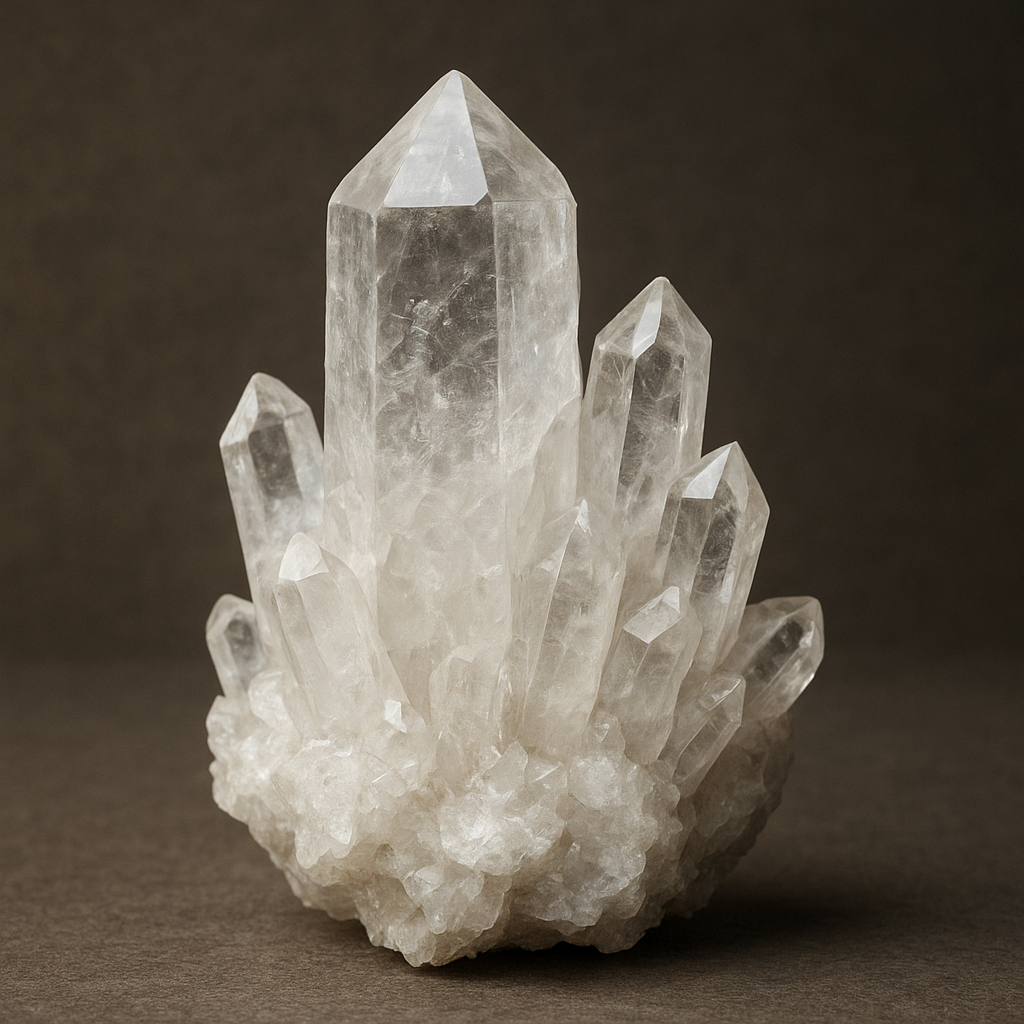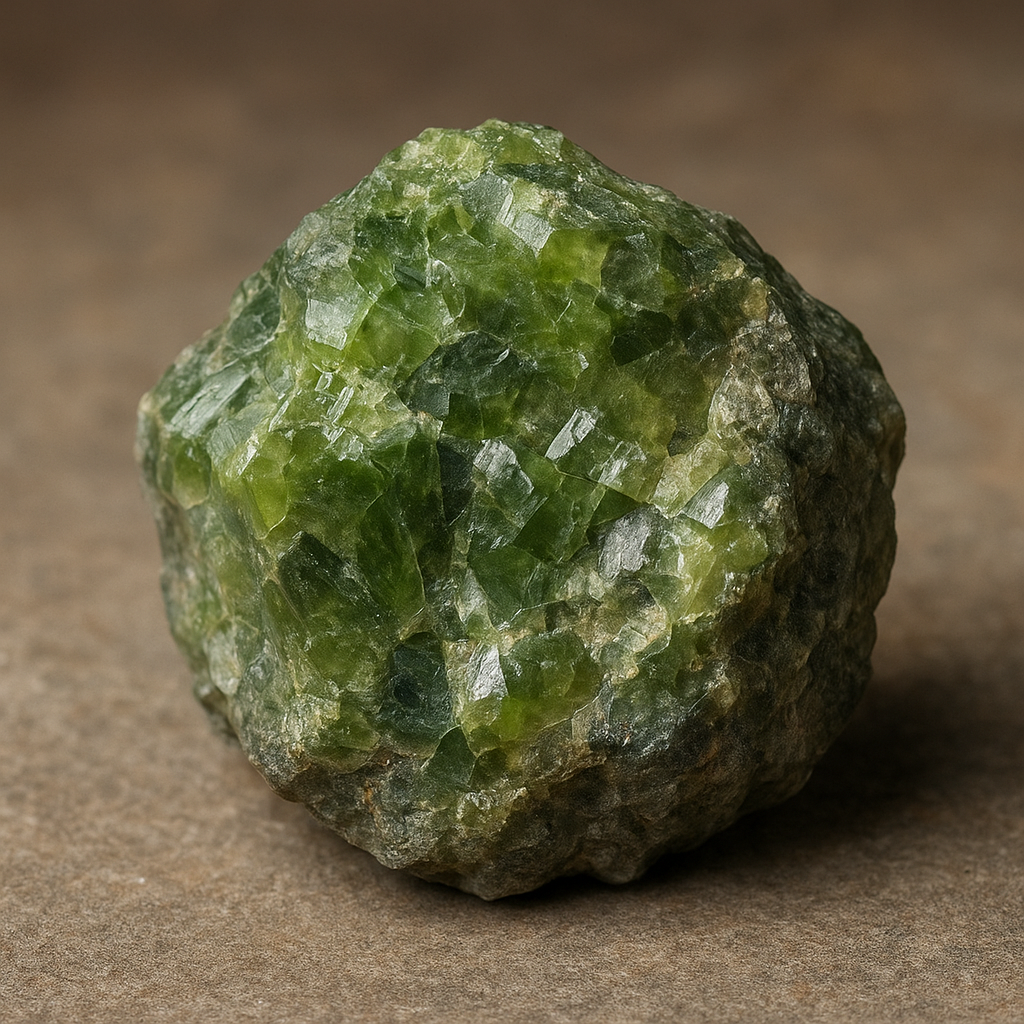
Idocrase, more commonly known in modern mineralogy as vesuvianite, is a striking and versatile silicate mineral that attracts attention from collectors, gem cutters, and geologists alike. Found in a variety of colors and crystal habits, it forms in environments that tell vivid stories about contact metamorphism and metasomatic processes. The following article explores its mineralogy, geological contexts, practical uses, notable occurrences, and the reasons this mineral remains an object of fascination for both science and the jewelry trade.
Appearance, Composition and Mineralogy
At its core, idocrase is a calcium-bearing silicate whose chemical composition can vary because of the presence of additional elements such as iron, magnesium, manganese, chromium and aluminum. Chemically it is commonly represented by a complex formula (often simplified in literature) and is classed among the sorosilicates and inosilicates depending on structural descriptions. It most frequently crystallizes in well-formed prismatic crystals or in granular masses, often exhibiting a vitreous luster and a glassy to resinous sheen when polished.
Key physical properties help identify idocrase in the field and under the hand lens or microscope. It typically has a Mohs hardness around 6.5–7, which makes it durable enough for many jewelry uses but still susceptible to cleavage-related breakage during cutting. Specific gravity commonly ranges from about 3.2 to 3.5, depending on composition and the presence of heavier elements like iron. Cleavage is usually indistinct to imperfect; fractures are uneven to conchoidal in many specimens.
Coloration is one of the most captivating aspects of idocrase: hues may include vivid greens, yellowish greens, browns, deep blues, pinks and near-black varieties. These colors are controlled by minor and trace elements. For example, iron imparts brown or green tones, manganese can promote pinkish shades, and trace amounts of chromium or vanadium can intensify green. Because of these influences, idocrase can demonstrate optical effects such as weak to moderate pleochroism in transparent crystals and occasional zoning in larger specimens.
Optical and Structural Notes
Under polarized light and in gemological testing, idocrase may show refractive indices that vary with composition — refractivity tends to lie in a moderate to high range for silicates of this type. The mineral’s crystallography is often described as tetragonal or related structural symmetries, and crystals commonly form prismatic habits with well-developed terminations in high-quality samples. Microscopic inclusions, growth zoning and healed fractures are frequently observed and can add to a specimen’s aesthetic or scientific interest.
Geological Environments and How It Forms
Idocrase is emblematic of skarn and contact metamorphic environments. Skarns are the product of chemical exchange between intrusive magmas (typically granitic) and carbonate-rich host rocks such as limestone and dolomite. When hot, silica- and metal-bearing fluids from the cooling intrusion interact with carbonate rocks, a suite of calcium-magnesium-aluminum silicates and oxides can form. Idocrase commonly appears alongside minerals like garnet (grossular-andradite), diopside, wollastonite, epidote, scapolite and magnetite within these assemblages.
Besides skarns, idocrase also forms during regional metamorphism when suitable protoliths containing calcium and silica are transformed at elevated temperatures and pressures. Hydrothermal veins and metasomatic zones adjacent to intrusions can likewise produce idocrase, particularly where fluids are rich in aluminum and silica and where trace elements can be incorporated into the growing crystals.
- Common geological settings: metamorphism of carbonate rocks, contact aureoles, hydrothermal metasomatism.
- Typical paragenesis: associated with garnet, diopside, wollastonite, calcite, quartz and magnetite.
- Indicator mineral: idocrase can be a useful indicator of skarn-forming processes and the chemical evolution of metasomatic fluids.
Where It Occurs: Notable Localities
Idocrase is distributed globally but concentrated in areas where carbonate rocks have been subjected to igneous intrusion or strong regional metamorphism. Some localities have produced particularly aesthetic or gem-quality material and are frequently cited by collectors and researchers.
- Italy: The species was first identified and closely associated historically with volcanic and metamorphosed terrains near the Bay of Naples. The classic association with Mount Vesuvius gave rise to the common name vesuvianite.
- Switzerland: Alpe Arami is renowned among mineralogists for producing attractive, often blue-tinged crystals prized by collectors.
- Canada: The Jeffrey Mine area in Quebec has yielded notable green and brown crystals and has a long history as a productive skarn locality.
- United States: Several Californian and other North American localities (including historic sites in San Benito County and certain skarn districts) have produced gem-quality and specimen material.
- Pakistan and Myanmar (Burma): These regions are important sources of gem-quality green and blue stones that enter the international lapidary market.
- Norway and Russia: Both countries host skarn and contact-metamorphosed limestone terrains where idocrase has been collected and studied.
Collectors and museums often prize locality-specific specimens because they can display unique color zoning or habit, and locality details help petrologists reconstruct the thermal and chemical history of the host rocks.
Uses and Applications
Idocrase’s primary uses fall into three broad categories: collector specimens, gem and jewelry material, and scientific research.
Collecting and Display
Large, well-crystallized idocrase specimens with good transparency and color are sought after by mineral collectors. Well-formed crystals that display sharp prism faces and intact terminations command attention in display cabinets and exhibitions. Attractive crystal aggregates embedded in skarn matrices, often with associated garnet or diopside, are prized for their aesthetic and scientific value.
Gemology and Lapidary Use
Gem-quality idocrase is faceted and set in jewelry, often marketed under the mineral name vesuvianite rather than the older term idocrase. The green varieties can resemble tourmaline or peridot in tone but usually differ in optical properties. Transparent pieces with uniform color cut well into faceted gems; less transparent material can be fashioned into cabochons or beads. Lapidary cutters value its intermediate hardness: it is hard enough to take a good polish but must be handled carefully around cleavage planes and inclusions.
Because idocrase may show subtle pleochroism, gem cutters often orient a rough stone to best display its preferred color when faceting. Treatments such as heat may be applied in some cases to enhance color, although mass-market treatments are not as common for this mineral as they are for more valuable gemstones.
Scientific and Practical Applications
In geology and petrology, idocrase serves as an important petrogenetic indicator. Its presence and chemistry inform scientists about the temperature, pressure and fluid composition during skarn formation. Trace-element analysis of idocrase crystals can record the evolution of metasomatic fluids, partitioning of elements and the role of redox conditions during mineral growth. These insights are useful in regional metamorphic studies and can assist in mineral exploration by indicating potential skarn-related ore deposits.
Varieties, Identification and Imitations
While idocrase is not commonly synthesized for the gem trade, various imitations and look-alike materials exist. Glass, certain tourmalines, and green garnets may be mistaken for idocrase by casual buyers. Distinguishing idocrase typically relies on a combination of color, refractive index, specific gravity and crystal habit. Professional gemological testing, including spectroscopy and microscopic examination, can reliably separate idocrase from impostors.
- Color varieties: green (most common in gem use), brown, blue, pink and almost black specimens.
- Common imitations: glass and other silicate gemstones; careful gemological testing is advised for valuable pieces.
- Diagnostic features: crystal habit, hardness, associated skarn minerals and localities provide useful context for identification.
Cutting, Care and Market Considerations
When idocrase is cut as a gemstone, care is required due to natural inclusions and cleavage directions. Faceting should aim to minimize the visibility of fractures and maximize color consistency. Polishing results in a bright, glassy luster that showcases internal color tones and any attractive zoning.
On the market, idocrase/vesuvianite occupies a niche position — more affordable than mainstream precious gems but often valued higher than common semi-precious stones when transparency and color are exceptional. Fine green and blue transparent gems can fetch notable prices from collectors and designers seeking distinctive stones. Because the supply of gem-quality material is limited and locality-specific, provenance can influence value: stones from celebrated localities may carry a premium.
Collecting Tips and Ethical Considerations
For collectors interested in idocrase, several practical tips improve the experience:
- Acquire specimen locality information — geological context increases scientific and monetary value.
- Handle gem rough carefully; inspect for cleavage, fractures and inclusions before purchase.
- Buy from reputable dealers who disclose treatments and provide return policies.
- Consider environmental and mining ethics — some skarn localities are small-scale operations where careful, responsible collecting reduces impact.
As with many minerals, responsible collecting and sourcing matter. Collectors should prefer sellers who comply with local regulations, avoid conflict zones and support sustainable practices where possible.
Cultural, Historical and Metaphysical Notes
Historically, the mineral has been studied since the early days of modern mineralogy and has been the subject of name changes and taxonomic refinements. While “vesuvianite” is the widespread contemporary name, “idocrase” appears in older literature and persists in certain contexts such as gem trade and collector circles.
Beyond scientific and aesthetic appeal, idocrase has found a place in metaphysical and crystal-healing communities. Adherents attribute to it qualities such as grounding, transformation and emotional clarity. While these beliefs are culturally interesting and meaningful to practitioners, they are not supported by scientific evidence — nevertheless, they contribute to the stone’s popularity among certain buyers and artisans.
Why Mineralogists and Gem Enthusiasts Value Idocrase
There are several reasons this mineral remains compelling to a wide audience:
- Its occurrence in skarn and contact metamorphic environments provides important geological information and beautiful matrix specimens.
- Color variability and occasionally transparent crystals make it desirable as a gemstone.
- Trace-element chemistry records metasomatic and thermal histories that are valuable in petrologic research.
- Locality-specific material — for instance, fine blues from certain alpine sites or deep greens from select mines — adds collectibility and market variety.
Collectors relish a specimen for its story: a crystal that grew where magma met limestone records a bygone episode of Earth’s dynamic processes. Gem cutters and designers appreciate idocrase for its unique hues and relative durability. And scientists value it as a recorder of metamorphic and metasomatic conditions.
Further Study and Resources
For those wishing to study idocrase in more detail, consider these approaches:
- Consult mineralogical handbooks and peer-reviewed petrology articles on skarn mineralogy for in-depth chemical and structural analyses.
- Visit museum collections or university geology departments to view well-documented specimens with locality data.
- Engage with gemological laboratories for accurate testing (refractive index, specific gravity, spectroscopy) if evaluating gem material.
- Join mineral clubs or online communities to share information on new finds, ethical collecting practices and cutting techniques.
Idocrase/vesuvianite bridges the gap between scientific utility and aesthetic appeal. Its presence in a rock narrates a chapter of thermal and chemical exchange; its color and form invite admiration and creativity. Whether approached as a subject of geological inquiry, an object of collection, or a medium for jewelry, this mineral continues to reward curiosity with variety, beauty and insight.