
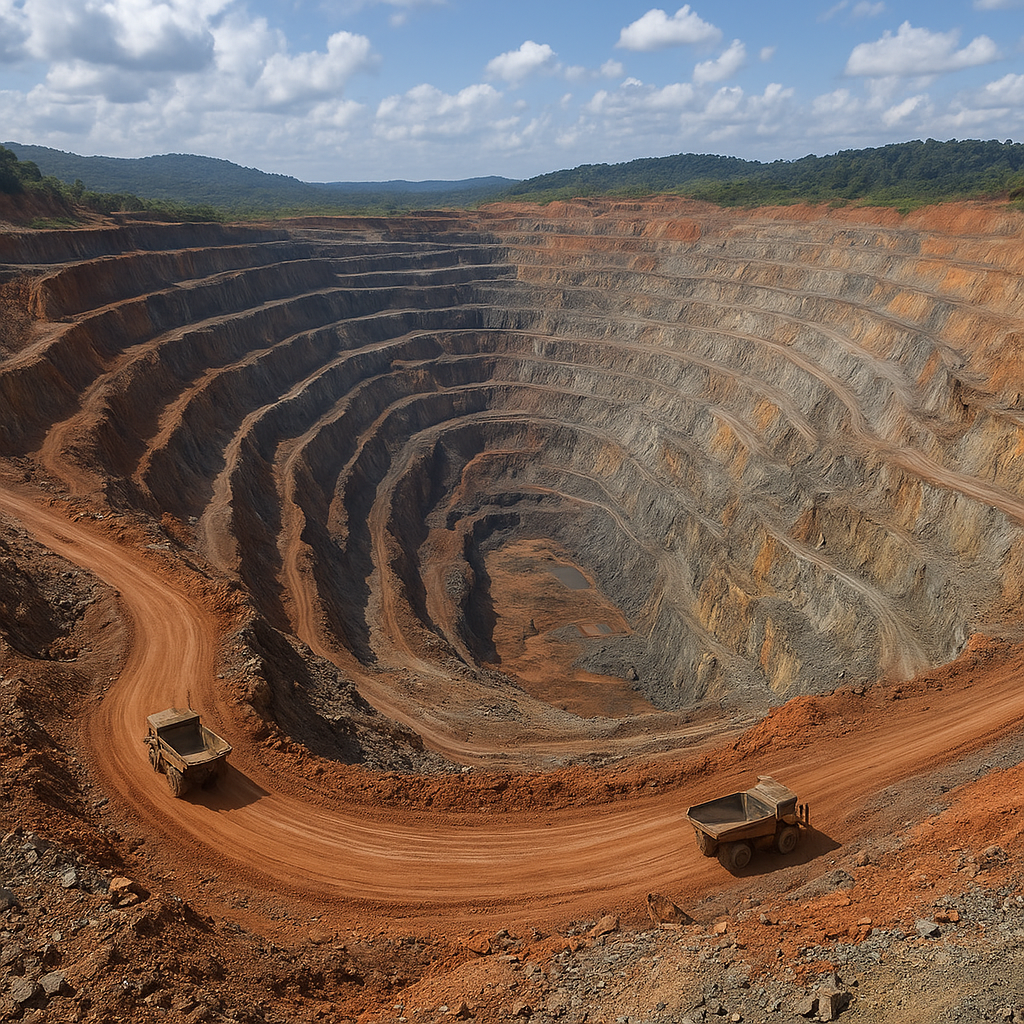
The Kamoto Mine is one of the most prominent and strategically important mining operations in the Democratic Republic of the Congo. Located in the heart of the African copper and cobalt belt, it has played a central role in supplying critical industrial metals to global markets. This article examines where the mine is located, what is produced there, its economic importance to the DRC and the world, and a number of notable and sometimes surprising aspects of the operation and its context.
Location and geological setting
The Kamoto Mine sits near the city of Kolwezi in a mineral-rich region historically known as Katanga, now administratively reorganized into provinces such as Haut-Katanga and Lualaba. Geologically, the site is part of the larger Central African Copperbelt, one of the world’s richest concentrations of stratiform sediment-hosted copper and associated cobalt deposits. The Copperbelt extends across southeastern Democratic Republic of the Congo and northern Zambia, forming a continuous geological province that has generated major mining projects for more than a century.
Deposits at Kamoto are typically found in stratified sedimentary rocks where copper and cobalt have been concentrated through ancient hydrothermal and depositional processes. These ore bodies are often amenable to large-scale open pit and underground mining, with associated beneficiation facilities that include crushing, grinding, flotation and hydrometallurgical processing to produce concentrates and refined products. The mine’s proximity to Kolwezi gives it access to local infrastructure such as roads, power lines and a regional labor pool—but also places it in a densely mined landscape where industrial and artisanal activities coexist.
Minerals produced and mining methods
The primary metals extracted at Kamoto are copper and cobalt. While copper has long been the economic anchor of the Copperbelt, cobalt has become increasingly important due to its central role in modern energy technologies, including lithium-ion batteries. Operations at Kamoto typically combine both open pit and underground mining methods depending on the depth and geometry of the ore bodies. Once ore is mined, it is processed on-site in concentrators to produce copper-cobalt concentrates that can be further refined either locally or at downstream facilities.
Modern mechanized techniques are used alongside more traditional approaches. Large haul trucks, shovels, drilling rigs and underground development equipment enable the extraction of hundreds of thousands to millions of tonnes of ore per year at large mines in the region. At Kamoto, metallurgical processes aim to recover both copper and cobalt efficiently because cobalt, although present in lower absolute tonnage than copper, carries significant economic weight due to its high value per tonne in global markets.
History and ownership structure
The Kamoto deposits have been known and exploited intermittently since the early 20th century, when the Belgian colonial administration began systematic exploration and development across Katanga. In the post-colonial era, the state-owned company Gécamines became the primary manager of many national assets in the mining sector. Over recent decades, many of these operations were reorganized through joint ventures or partnerships with private international mining companies. Historically, the Kamoto operation has been operated by a vehicle often referred to as the Kamoto Copper Company (KCC), a partnership involving the Congolese state miner Gécamines and international investors, with major foreign mining houses participating in various ownership configurations at different times.
These partnerships reflect a broader pattern in the DRC: the pairing of state assets and mineral rights with foreign capital, technology and market access. The precise ownership stakes can evolve due to sales, mergers, and local government agreements, but the presence of large international partners has been a constant factor in enabling the investment-intensive work of large-scale copper-cobalt mining and processing.
Economic significance — local, national and global
At the national level, Kamoto is a key asset for the DRC’s economy. Revenues from copper and cobalt sales contribute to export earnings, government royalties, and taxes—funds that are theoretically available for public services and development. Employment at large mines generates thousands of direct jobs and many more indirect positions in logistics, service industries and vendor supply chains. For communities around Kolwezi, the mine is a major employer and an anchor for local commerce.
Globally, Kamoto and similar operations in the Copperbelt are strategically important because the DRC is the dominant source of cobalt, a metal central to the electric vehicle and portable electronics supply chains. Interruptions, policy shifts, or capacity constraints at large DRC operations can ripple through global markets, affecting battery manufacturers, automakers and technology firms that rely on stable supplies of cobalt and copper. The site’s production therefore matters not only to metal traders and smelters but also to countries and companies seeking to secure supply chains for decarbonization technologies.
Beyond raw export receipts, the mine’s activities can spur investment in regional infrastructure: roads, power lines, and sometimes social infrastructure such as clinics or schools funded through corporate social responsibility programs or via negotiated community development agreements. However, the extent to which local and national benefits are realized depends on contract terms, governance, transparency, and how revenues are allocated and spent.
Social and environmental aspects
Mining at Kamoto, like most large mines, has complex social and environmental consequences. On the environmental side, concerns center on land disturbance, waste rock and tailings management, water use and potential water contamination, dust, and biodiversity impacts. The management of tailings and mine water is a perennial concern in the Copperbelt, and operators typically maintain engineered tailings storage facilities and water treatment systems to reduce environmental risk. Compliance with modern environmental standards and the effectiveness of mitigation measures are key to reducing the footprint of operations.
Socially, there are both positive and challenging dynamics. The mine provides employment, training and secondary economic opportunities for the local population. Many mining companies support local initiatives in health, education and infrastructure. Yet the presence of large-scale mining can also aggravate land tenure conflicts, displacement issues, and disparities in wealth distribution. One distinct feature of the DRC’s copper-cobalt landscape is the coexistence of formal industrial operations and extensive informal or artisanal mining. Artisanal miners often operate in or near concessions, seeking to recover high-grade pockets of ore that escape large-scale operations; these activities are a source of livelihood for many families but carry high safety and environmental risks.
Governance, regulation and community relations
Kamoto’s role in the DRC’s mining sector brings it into complex interactions with national and provincial governments, state-owned entities, and local communities. Contracts and joint venture agreements define how profits, taxes and royalties are shared. Transparent governance and independent oversight are critical to ensuring that revenues support national development and that environmental and labor standards are met. In recent years, international attention on ethical sourcing and supply chain traceability has increased pressure on companies and governments to demonstrate responsible practices, from eliminating child labor in cobalt supply chains to improving health and safety and reducing environmental impacts.
Community relations often involve a mixture of negotiated benefits, local hiring commitments, and investment in community projects. Mining companies commonly set up grievance mechanisms, local content programs and partnerships with civil society to address community needs. Effectiveness varies by operator and by the strength of local institutions; sustained, meaningful engagement is essential for social license to operate and long-term stability.
Infrastructure, logistics and processing
Large operations such as Kamoto require significant supporting infrastructure. This includes power (often tied to national grids or dedicated generation), water management systems, roads for heavy haulage, and sometimes rail connections to regional ports or processing hubs. Concentration plants on site reduce ore to a more transportable concentrate form, but further refining—smelting, refining and chemical processing—may occur at dedicated facilities either within the DRC or abroad. The logistics of moving concentrates to global markets involves coordination across transit corridors, customs regimes and global commodity traders.
Investment in infrastructure can have spillover effects: improved regional roads, for example, can facilitate trade and mobility for communities beyond the immediate mining concession. Conversely, inadequate infrastructure can increase operational costs and bottlenecks, limiting the economic upside of resource development.
Interesting and notable aspects
- Strategic metal mix: The combination of copper and cobalt at Kamoto gives it outsized strategic importance. While copper is essential for electrification and grid infrastructure, cobalt’s role in batteries ties the mine directly to trends in electrification and decarbonization.
- Artisanal and industrial coexistence: The Copperbelt’s dense mineralization has encouraged both large-scale industrial mining and widespread artisanal extraction. The coexistence creates unique social dynamics and management challenges at places like Kamoto.
- Market sensitivity: Because cobalt is a relatively small global market by volume but of high strategic value, supply disruptions or policy changes in the DRC can have pronounced effects on battery material prices and the decisions of downstream manufacturers.
- Local talent development: Large mining projects often act as hubs for technical training and skill development, nurturing a local workforce that can support future industrialization.
- Environmental innovation: There is growing interest in introducing greener processing techniques, improved tailings management and water-saving technologies in the Copperbelt—efforts that, if scaled, could reduce long-term environmental risk.
Risks, challenges and opportunities
Risks at Kamoto and similar operations include commodity price volatility, regulatory and fiscal policy shifts, operational hazards, and community disputes. Price swings in copper and cobalt can rapidly alter project economics; likewise, changes in royalties or taxation can affect investment. Opportunities arise from investments in more efficient, lower-carbon processing, value-addition through local refining, and stronger governance frameworks that channel mining revenue into diversified economic development.
For global industry, an important opportunity lies in improving traceability of cobalt and copper to ensure ethical sourcing. For the DRC and local communities, opportunities include leveraging mining revenues for infrastructure and human development, developing downstream processing capacity, and formalizing artisanal activities so they are safer and more sustainable.
Final observations
Kamoto exemplifies many of the defining features of the Congo’s mineral economy: immense resource wealth, complex ownership and governance arrangements, crucial links to global supply chains, and both promise and tension in socio-environmental outcomes. Its copper and cobalt output feeds essential technologies and industries worldwide, while its future impact on the DRC’s development will depend heavily on governance, investment choices, operational practices and the balance between local needs and global market demands. The mine therefore remains a focal point for discussions about resource-led development, responsible sourcing and the long-term stewardship of mineral wealth.

