
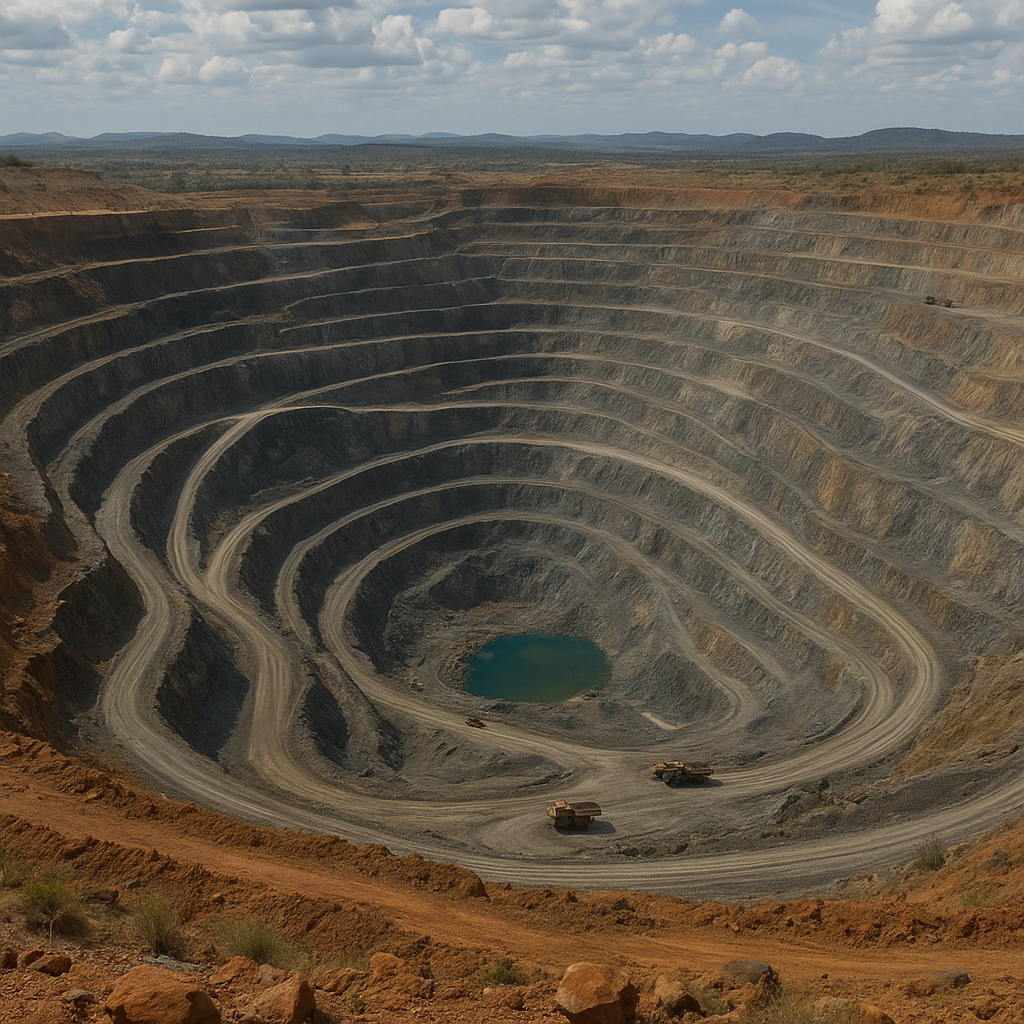
The Lumwana mine stands as one of Zambia’s most significant modern mining projects. Located in the country’s north-western reaches, the operation has transformed a previously remote area into a center of industrial activity, contributing substantially to Zambia’s role as a leading global producer of copper. This article examines where the mine is situated, what minerals it produces, its broader economic importance, and a range of technical and human-interest details that help explain why Lumwana attracts attention from economists, geologists and policy makers alike.
Location and geological setting
The Lumwana mine is situated in the North-Western Province of Zambia, approximately west of the provincial capital of Solwezi. The site sits within a region of complex Proterozoic geology that hosts a variety of sedimentary and metamorphic rocks, which have created favorable conditions for stratabound and disseminated mineralization. While the nearby Central African Copperbelt (the classic copper-producing zone) is to the east and north-east, Lumwana occupies a distinct geological terrane often described as an extension or an outlying mineralized system that shares some characteristics with the larger belt.
From a practical perspective, the mine is in a seasonally warm, wooded landscape with altitudes that moderate the tropical climate. The remoteness of the location historically presented challenges for logistics and infrastructure, but the development of the mine triggered major upgrades in roads, power arrangements and community services. The relationship between geology and logistics is central: the ore is disseminated through large, low-grade bodies that are best exploited by large-scale open-pit mining and centralized processing.
What is mined and how it is processed
Lumwana is primarily a copper operation. The main product is copper in the form of a flotation concentrate, which concentrates the copper minerals and reduces transport costs for export. Production processes at the site typically include:
- Large-scale open-pit mining to remove overburden and access disseminated ore bodies.
- Crushing and milling circuits, often employing SAG (semi-autogenous) and ball mills to reduce ore size.
- Flotation plants that separate copper-bearing minerals from gangue, producing a copper concentrate with elevated metal grade.
- Ancillary processing and reagent handling, tailings management and water recycling systems to support continuous operation.
In addition to copper, many large copper mines produce valuable by-products. Lumwana’s ores can contain trace amounts of gold, silver and molybdenum; such elements may be recovered to varying degrees depending on ore composition and processing choices. Recovery of by-products can materially affect project economics, particularly when copper prices fluctuate.
Scale, production and operational highlights
Lumwana is notable for its size. It is developed as a large-scale operation designed to process tens of millions of tonnes of ore annually. The scale allows economies of scale in mining, crushing and milling, and supports a modern concentrator capable of continuous, high-throughput operation. Plants at Lumwana employ contemporary mineral-processing methods and are supported by extensive ancillary facilities including workshops, fuel farms, and on-site laboratories for metallurgical testing.
Operational highlights include the implementation of advanced mining equipment fleets, scheduled blasting and pit sequencing designed for long-term pit wall stability, and focused metallurgical test work to refine grind size and flotation recipes that optimize copper recovery. Logistics for concentrate export require coordination with national transport networks and port arrangements, and the mine has been part of broader initiatives to improve road and transport capacity in the region.
Economic significance for Zambia
Mining is a cornerstone of the Zambian economy, and the Lumwana mine plays a meaningful role within that national framework. The project contributes to the country’s export earnings, foreign exchange inflows and employment. Key economic impacts include:
- Exports and foreign exchange: Copper concentrate produced at Lumwana adds to Zambia’s export volumes, supporting the balance of payments and providing foreign currency for imports and government reserves.
- Employment: The mine provides direct employment for thousands of workers and supports indirect jobs across services, transport, and local supply chains.
- Investment: Construction and ongoing capital expenditure attract foreign and domestic investment into Zambia, with multiplier effects across construction, engineering and procurement sectors.
- Government revenue: Taxes, royalties, and other payments from mine operations form a material source of public revenue that can finance infrastructure, health and education projects when effectively managed.
- Infrastructure improvements: Upgrades to roads, communications and, in some cases, power, benefit local communities and facilitate other economic activities beyond mining.
The combination of export weight and capital intensity means a mine like Lumwana can shift regional economic prospects, but it also creates sensitivities: national revenues are tied to commodity prices, and local economies can become dependent on a single major employer. Responsible management and diversification policies are therefore crucial to ensuring long-term benefits.
Social and community dimensions
Large mines operate within a social context. The arrival and growth of Lumwana altered local demographic and socio-economic patterns, attracting workers and creating demand for housing, schools and health services. Many mining companies in Zambia invest in community development programs that can include water and sanitation projects, education and vocational training, local enterprise development and health campaigns.
Community relations are a constant priority: issues such as land use, resettlement (where applicable), access to traditional hunting or farming areas, and equitable distribution of benefits require transparent processes and sustained engagement. When social programs are well-aligned with local needs, they can leave a long-term positive legacy; when they fall short, tensions can emerge that affect both the community and the mine’s social license to operate.
Environmental management and sustainability
Mining inevitably affects the environment, so modern operations emphasize mitigation, monitoring and progressive rehabilitation. At Lumwana, environmental management typically covers:
- Tailings storage design and monitoring to prevent failures and minimize seepage.
- Water-use efficiency and treatment systems to maintain downstream water quality.
- Dust suppression, noise control and air quality management to protect workers and nearby communities.
- Progressive reclamation plans that restore disturbed land, replant native vegetation and, where feasible, return land for community use post-mining.
Sustainability efforts may also include investments in local capacity building to ensure former employees can find alternative livelihoods when operations eventually scale down, and partnerships with regulators and NGOs to monitor biodiversity impacts. Zambia’s regulatory framework requires environmental impact assessments and compliance with permit conditions, but enforcement and resources can be uneven, making company-level stewardship an essential complement to public oversight.
Transportation, logistics and export routes
Exporting copper concentrate to smelters or traders requires reliable logistics. From Lumwana, concentrate is typically trucked to railheads or export terminals and then shipped to international smelting centers. Challenges include long distances to ports, seasonal road constraints and the need to coordinate with national rail and port providers. Investments in transport infrastructure that facilitate efficient export flows not only reduce unit costs for the mine but also provide wider benefits to agriculture and non-mineral commerce in the region.
Interesting technical and historical facts
Lumwana has several features that make it an interesting case study:
- Scale: The mine is among the larger open-pit copper operations in Zambia, showing how low-grade, large-tonnage deposits can be economically viable with modern mining and processing techniques.
- Processing innovations: Over time, operators have optimized grinding, flotation and reagent regimes to increase metal recovery, illustrating the importance of metallurgical test work and plant optimization.
- Regional transformation: The mine catalyzed infrastructure upgrades and new businesses in a once-remote area, demonstrating mining’s potential to spur regional development.
- Workforce development: Training programs introduced for miners, technicians and engineers help build a local skills base that can be redeployed in other industries.
- By-product potential: Recovering trace elements such as gold or molybdenum from concentrate can materially improve project returns, showing the interplay between geology and economics.
Challenges and future considerations
Despite its importance, Lumwana faces the same strategic challenges common to large mining projects in emerging markets:
- Commodity price volatility: Copper prices are cyclical, and revenue streams can vary widely, affecting government revenue and local economic stability.
- Energy and utility dependencies: Reliable power and fuel supplies are essential for continuous operation; outages or elevated energy costs can reduce competitiveness.
- Environmental and social governance: Maintaining strong community relations and minimizing environmental impacts requires sustained commitment and transparent reporting.
- Resource longevity and closure planning: Mines have finite lives; planning for eventual closure and economic transition is crucial to avoid “boom-and-bust” outcomes for host communities.
Why Lumwana matters beyond copper
The Lumwana mine is more than a source of copper; it is an example of how modern extractive projects interact with national development goals, global commodity markets and environmental stewardship expectations. Investment in such projects can accelerate infrastructure development, create jobs and increase fiscal resources, but they also demand prudent regulation and proactive community engagement to ensure benefits are broadly shared.
For observers of African mining, Lumwana highlights the potential of large, geographically remote deposits to transform local economies when paired with sufficient capital, technical expertise and long-term planning. It is also an ongoing reminder that the true measure of such projects is not only the tonnes of metal produced, but the quality of governance, environmental care, and human development they leave behind.

