Hauyne is a striking and scientifically significant mineral best known for its vibrant blue shades and its membership in the broader family of framework silicates. As a distinctive representative of the sodalite group, hauyne attracts interest from mineral collectors, gem cutters, and petrologists alike. This article explores its mineralogical characteristics, the geological settings where it occurs, its practical and scientific applications, and several fascinating details that tie hauyne to broader topics in geology and materials science.
Mineralogy and crystal chemistry
Hauyne is a framework aluminosilicate whose crystal lattice forms an interconnected network of tetrahedra made up of silicon and aluminum atoms. The resulting three-dimensional framework encloses cage-like voids that commonly host large anions such as sulfate, chloride, or hydroxyl groups, together with sodium and calcium cations. These chemical and structural features place hauyne within the isometric members of the sodalite group, a group characterized by similar frameworks but variable occupants of the cages.
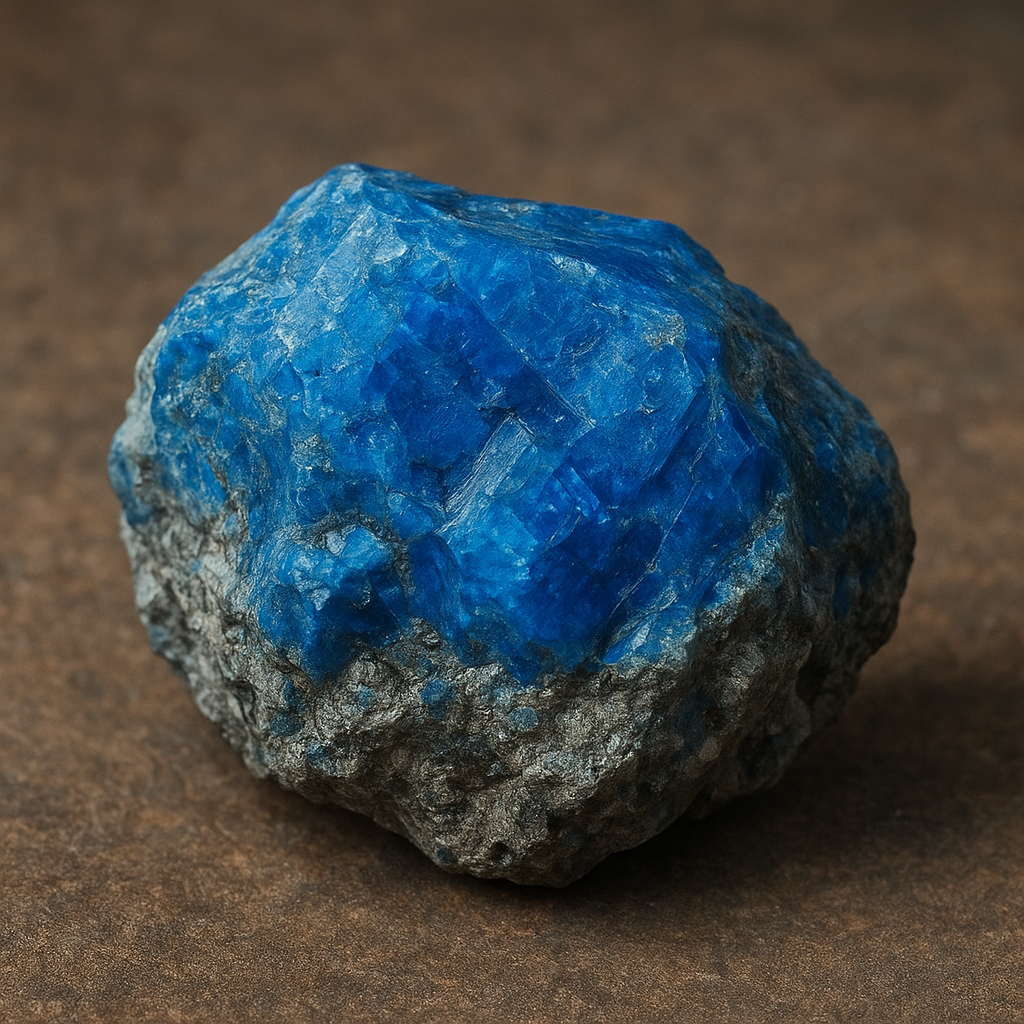
Physically, hauyne often presents in shades that range from deep azure-blue to pale turquoise, sometimes appearing gray, white, or greenish depending on composition and inclusions. Typical properties include a vitreous to greasy luster, a Mohs hardness in the mid-range (around 5 to 6), and a relatively low specific gravity compared with many other silicate minerals. Crystals commonly form in the isometric (cubic) system and may show dodecahedral or massive habits rather than sharply developed single crystals. Many specimens show a white streak and poor cleavage, breaking with uneven to conchoidal fractures.
Chemical variability and substitution
The idealized chemistry of sodalite-group minerals is not fixed; instead, there is a complex pattern of substitution among cations and anions. In hauyne, sodium and calcium substitute to accommodate charge balance and the cages may wrap around sulfate groups that help stabilize the structure. Because of this flexibility, hauyne forms a compositional series with closely related minerals (for example, nosean and other sodalite members), and natural samples often contain measurable quantities of chlorine, hydroxyl, and other minor elements. This substitutability makes the mineral interesting for geochemists studying magmatic fluid chemistry and volatile contents.
Occurrences and geological settings
Hauyne is typically found in silica-undersaturated, alkaline igneous rocks—environments where the mineralogy is dominated by feldspathoids (such as nepheline and leucite) rather than quartz. Common rock types that host hauyne include phonolites, nepheline syenites, leucitites, tephrites, and melilitites. These magmas are enriched in alkalis (sodium and potassium) and often carry higher proportions of volatile elements such as chlorine and sulfur, which help stabilize the sodalite-group minerals.
Volcanic and subvolcanic settings are especially favorable, because rapid cooling and the presence of volatile phases encourage the crystallization of unusual minerals. Classic localities for hauyne include well-known volcanic provinces of southern Europe, where hauyne-rich rocks were first documented; the mineral has also been reported from various alkaline complexes worldwide, including parts of North and South America, Africa, and Asia.
- Famous localities: Many historically important occurrences are associated with Italian volcanoes—where deep-blue hauyne has been admired and sometimes used as an ornamental stone—but significant finds have also been recorded in other alkaline volcanic terrains.
- Formation environments: Hauyne commonly forms as a primary magmatic phase in silica-undersaturated melts, or as a secondary mineral in cavities and veins where late-stage magmatic fluids precipitate sulfate- or chloride-rich phases.
- Alteration and secondary occurrences: In some settings, hauyne can alter to zeolitic or clay minerals if subjected to hydrothermal fluids or weathering, but the more protected cavities and glassy groundmasses often preserve attractive crystals suitable for collecting.
Petrological significance
For igneous petrologists, the presence or absence of hauyne in a rock can be a powerful indicator of the magma’s evolution. Because hauyne is stable only under relatively low silica and high alkali-plus-sulfur conditions, its occurrence signals magmatic differentiation paths that concentrate alkalis and volatiles. The mineral’s chemical composition can therefore provide clues about magmatic volatile budgets, the partitioning of sulfur and chlorine between melt and crystals, and processes like magma mixing or crustal assimilation that influence overall mineralogy.
Uses and applications
Although hauyne is not a major industrial mineral, it has several uses that bridge aesthetics, science, and materials research. One of the most visible applications is in jewelry and ornamentation: attractive blue hauyne can be cut and polished into cabochons or used as inlays. Because of its relative softness compared with beryl or corundum, hauyne is best suited for pendants, earrings, and objects that are not exposed to heavy wear.
- Lapidary use: Deep-blue specimens are sometimes marketed as a type of ornamental stone; careful cutting and stabilization can produce striking pieces. Collectors prize well-formed crystals and large colorful nodules.
- Petrological indicator: In scientific practice, hauyne serves as a diagnostic tool. Its chemistry helps reconstruct magmatic histories and volatile contents, making it valuable in academic studies of alkaline magmatism.
- Materials science relevance: The cage-like framework of hauyne and related sodalite minerals has inspired synthetic analogues and research into framework materials that can encapsulate ions and molecules. These ideas contribute to broader work on ion exchange, catalysis, and even immobilization of problematic anions in waste forms.
One particularly interesting applied topic is the resemblance between natural sodalite-group structures and engineered frameworks used for ion sequestration. Synthetic sodalite-like phases can be designed to trap sulfate or halide anions, a property that has been explored in the context of environmental remediation and waste immobilization. While hauyne itself is not produced industrially on a large scale, the underlying structural concepts are influential.
Associated minerals and broader mineralogical context
Hauyne rarely occurs alone; it is typically associated with a suite of minerals characteristic of alkaline, silica-poor environments. Common associates include nepheline, leucite, feldspathoids, alkali feldspars, melilite, and various mafic minerals. Secondary minerals such as zeolites may form in cavities alongside hauyne. In some occurrences, hauyne is found together with other members of the sodalite family, forming compositional intergrowths or gradational phases.
- Common associates: nepheline, leucite, alkali feldspars, melilite.
- Sodalite-group relatives: nosean, sodalite proper, lazurite, tugtupite.
- Secondary minerals: zeolites, chlorite, calcite in altered cavities where hauyne once formed or coexisted with volatile-rich fluids.
Comparisons within the sodalite group
Understanding hauyne benefits from comparing it with related minerals. For example, nosean typically contains a higher proportion of sulfate relative to chlorine and is commonly white to gray rather than vivid blue. Sodalite often contains chloride and may be deep blue but lacks significant sulfate. Lazurite and other members of the group have different chromophores and coloring mechanisms. These subtle distinctions help mineralogists classify samples and interpret their formation conditions.
Interesting facts and historical notes
The mineral’s name honors the influential French mineralogist René Just Haüy, who made foundational contributions to crystallography and mineral classification in the late 18th and early 19th centuries. Over time, hauyne has been both admired and studied for its aesthetic qualities and its petrogenetic implications.
- Color origins: The blue color in hauyne is often produced by small substitutions within the framework or by trace chromophores; varying levels of iron, sulfur species, and structural defects can influence hue and saturation.
- Fluorescence: Some hauyne specimens fluoresce under ultraviolet light—often producing yellowish or other subtle emissions—making UV imaging a useful tool for collectors and researchers to spot variations within samples.
- Misidentification: Because of its intense blue tones, hauyne has occasionally been confused with more famous blue gemstones such as lapis lazuli or sodalite in the trade. Careful mineralogical and spectroscopic testing can distinguish these materials.
- Cultural and regional prominence: In regions where huayne-bearing rocks are abundant, the mineral sometimes appears in local decorative stone traditions or as part of geological displays in museums that highlight volcanic mineral diversity.
Connections to modern research
Beyond descriptive mineralogy, hauyne contributes to contemporary research topics. Because it incorporates volatiles and large anions into a stable framework, it can record magmatic sulfur and halogen behavior—crucial parameters for volcanic degassing studies and for models of ore-forming processes. In addition, research into synthetic sodalite-like frameworks draws analogies to hauyne’s natural structure when exploring how to design materials for selective ion uptake or immobilization.
Collecting, care, and identification tips
For collectors and gem enthusiasts interested in hauyne, a few practical points are useful. When evaluating specimens, pay attention to color saturation, transparency, and the presence of fractures or inclusions. Because hauyne is not as hard as corundum or quartz, it can be scratched by common abrasives and should be set or displayed with that vulnerability in mind.
- Identification: Visual inspection combined with simple tests (streak, hardness) can often separate hauyne from look-alikes, but definitive identification benefits from X-ray diffraction or careful chemical analysis given the mineral’s compositional overlap with other sodalite-group members.
- Care: Clean hauyne pieces with warm water and mild soap; avoid ultrasonic cleaners for valuable or fragile stones. Prolonged exposure to harsh acids or strong bases may alter the mineral’s surface and color.
- Ethics and sourcing: As with all minerals, prefer ethically sourced specimens, and consult locality information and provenance when purchasing fine material. Some high-quality hauyne comes from limited localities and can be of significant scientific and commercial value.
Concluding observations
Hauyne occupies a unique niche in mineralogy as both a beautiful blue stone and a sensitive recorder of the chemical environment of alkaline, volatile-rich magmas. Whether appreciated for its visual appeal in lapidary work, its role as an indicator mineral for petrologists, or its structural inspiration for materials scientists, hauyne bridges practical and theoretical interests. Studying its occurrences deepens our understanding of how rare and remarkable minerals form within the diverse tapestry of igneous rocks, and it continues to offer avenues for research into magmatic processes and framework silicate chemistry.