
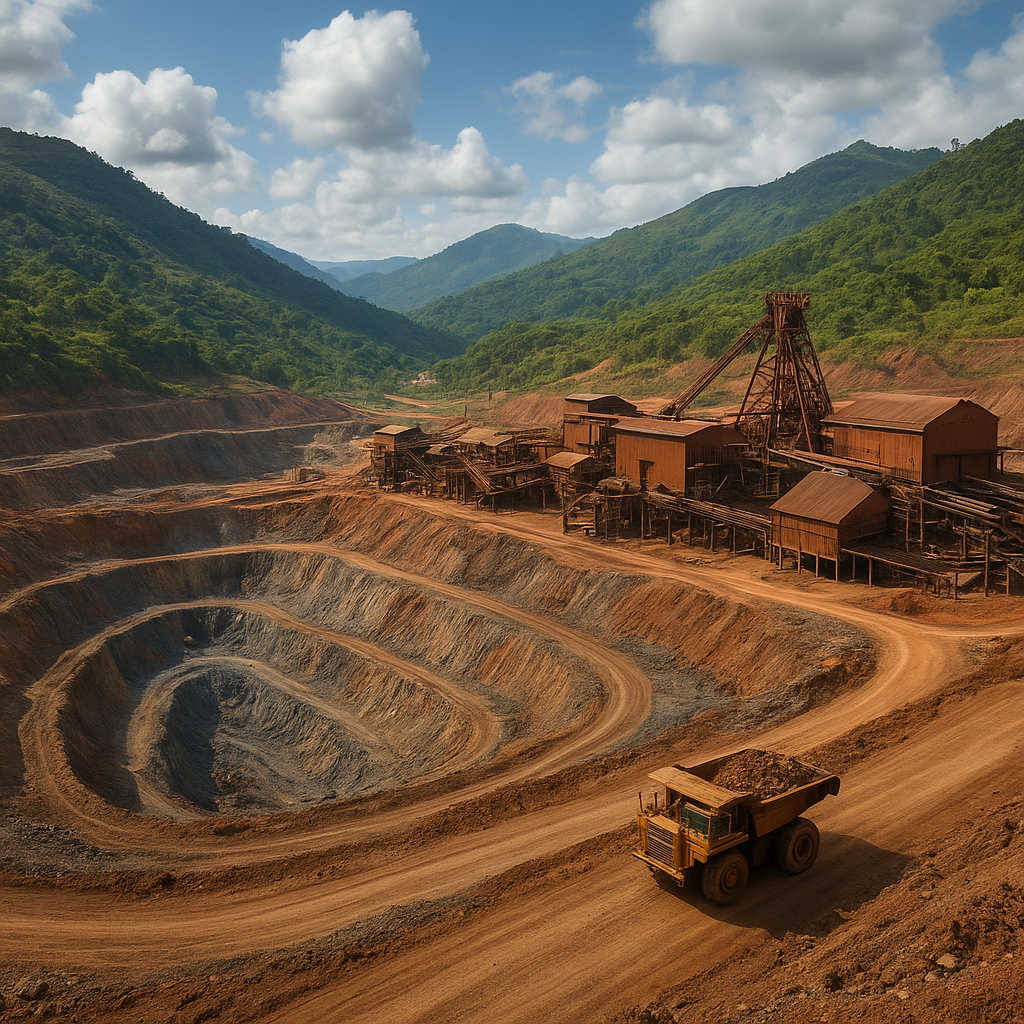
The Kilembe copper deposit, set against the dramatic backdrop of the Rwenzori Mountains in western Uganda, is one of the country’s most historically significant mining sites. Over decades the mine shaped local communities, influenced national mining policy, and left a complex legacy of economic promise and environmental challenge. This article explores where the mine is located, what minerals it produced, why it mattered economically, and several intriguing aspects that make Kilembe unique in the context of East African mining.
Location, geology and setting
The Kilembe mine is located in the Kasese District of western Uganda, close to the foothills of the Rwenzori Mountains, also known as the Mountains of the Moon. The site sits near the town of Kasese and lies within a landscape that combines steep, forested slopes, highland rivers and valleys that feed into the Lake Albert and Lake George basins. This setting helped determine both the mine’s opportunities and its constraints.
Geological background
The deposit at Kilembe is a volcanogenic massive sulfide-type mineralization, which typically yields significant concentrations of base metals. The primary commodity historically extracted was copper, with secondary quantities of cobalt and other trace elements associated with sulfide mineral assemblages. The geology comprises multiple lenses and veins of copper-bearing sulfides hosted within metavolcanic and metasedimentary rock sequences. These geological features attracted early explorers and later industrial-scale development because they offered relatively high-grade ore in a concentrated area.
Accessibility and infrastructure
Access to Kilembe is defined by its remote highland position. During the mine’s active years, company-built roads, housing, medical facilities and support infrastructure were developed to serve workers and their families. The proximity to Kasese town provided essential services and a route for transporting ore and supplies. The juxtaposition of mine infrastructure next to protected and ecologically sensitive areas has been a recurring planning concern since operations began.
History of mining activity and production
Mining at Kilembe began on a commercial scale in the mid-20th century and quickly became one of Uganda’s largest industrial ventures. The mine was developed during a period of expanding global demand for copper and represented a major investment in the region.
Development and peak operations
During its operational peak, the mine supported hundreds to thousands of jobs directly and indirectly. Industrial facilities included a concentrator to process ore, workshops, housing estates, community amenities and support services. The extraction and processing of copper ores at Kilembe contributed substantially to Uganda’s export earnings during those years, even though the majority of final smelting and refining of concentrates often took place elsewhere.
Decline and closure
A combination of factors led to the mine’s decline. Global copper price volatility, operational costs in a remote setting, aging infrastructure and political instability in Uganda during parts of the late 20th century all contributed to reduced production and eventual suspension of large-scale operations. The closure had immediate localized social impacts as employment and company services were scaled back or withdrawn.
Economic significance for Uganda and the region
Kilembe’s economic role extended well beyond raw material extraction. It has had a multi-layered impact on the regional and national economy.
- Employment: At its height, the mine provided direct jobs in mining, processing, maintenance and administration. Indirect employment arose in services, retail, transport and construction that serviced the mine and its workers.
- Revenue generation: Copper exports contributed foreign exchange earnings. Although the exact share varied year to year, mining revenues supported government budgets, infrastructure spending and foreign exchange reserves in the periods when the mine was productive.
- Infrastructure legacy: Company-built infrastructure – roads, a hospital, schools and housing – created long-term assets for the local population. For example, the presence of a company hospital improved access to health services for many residents near the mine.
- Skills and human capital: The mine provided vocational training and technical skills to local workers. These skills had spillover benefits for local industry and enterprises, supporting livelihoods after production slowed.
- Local markets: A mining economy created demand for food, accommodation and services, stimulating small business development in Kasese and surrounding communities.
Macro-economic and strategic considerations
On a national level, Kilembe represented a strategic mineral asset. For a landlocked country like Uganda, mineral exports are a valuable source of foreign exchange and an important complement to agricultural exports. The site’s copper endowment also positioned Uganda to participate in global value chains tied to base metals, electronics and increasingly to the green energy transition, which depends on copper for electrification and renewable infrastructure.
Environmental, social and rehabilitation challenges
Mining inevitably leaves an environmental footprint and Kilembe is no exception. The interplay of mining residues, mountainous terrain and active waterways has presented particular environmental management challenges.
Tailings, water and landscape impacts
Ore processing and smelting historically produced tailings and sulfide-rich waste. When not fully contained, these materials can lead to acid mine drainage and heavy metal contamination of surface and groundwater. Rivers draining the area, which support agriculture and downstream communities, were at risk of contamination. Sedimentation and changes to river courses from tailings spills have been documented in mining districts globally and were a concern at Kilembe during and after operations.
Community health and social disruption
Community displacement, shifts in livelihoods and health impacts are common in mining areas. In Kilembe the closure of the mine meant loss of wages and services that many households had come to rely upon. At the same time, medical facilities established by the mining company continued to serve, but funding and staffing shortages affected service levels. The legacy of mining-related health issues, such as contamination-linked illnesses, has required attention from local health authorities and development partners.
Rehabilitation and remediation efforts
Efforts to rehabilitate former mining lands include reprocessing of tailings, reforestation, stabilization of waste dumps, water treatment works and community development programs. These measures are often costly and require sustained commitment from governments, potential investors and sometimes international donors. The desire to repurpose former industrial assets for modern, more environmentally sensitive mining or other economic uses has driven interest in rehabilitation approaches that combine technical remediation with socio-economic reinvestment.
Contemporary developments and future prospects
Interest in Kilembe has periodically resurfaced as global copper demand has grown and as Uganda’s regulatory framework for mining has evolved. New market dynamics—such as the global push for electrification, renewable energy and electric vehicles—have increased the strategic value of copper deposits worldwide, which makes legacy sites like Kilembe attractive to modern exploration and redevelopment.
Exploration, investment and modern mining models
Reopening or redeveloping Kilembe would require modern geological assessments, environmental impact studies, community consultations and significant capital investment. New investors often propose approaches that emphasize:
- Use of improved processing technologies that reduce waste and emissions
- Stronger environmental safeguards, including tailings storage facilities designed to international standards
- Benefit-sharing arrangements with local communities to ensure jobs, revenue streams and social services
- Integration of local suppliers and workforce development to maximize local economic linkages
Policy and governance considerations
Any future activity at Kilembe will depend on stable regulatory and fiscal frameworks, transparent land and resource licensing, and partnerships that balance national interests with investor certainty. Uganda’s broader mineral policy reforms and its ability to manage environmental and social risks will be decisive in attracting longer-term, responsible investment.
Interesting and lesser-known aspects
The Kilembe mine offers several features that go beyond its economic and environmental dimensions and that make it a subject of wider interest.
Cultural and historical legacy
The company town at Kilembe created a distinct social environment: a mix of workers from different regions, company-led social programs and a built heritage of houses, public buildings and recreational facilities. Some of these structures remain and offer a tangible record of mid-20th-century industrial architecture in East Africa. The story of Kilembe intersects with Uganda’s post-colonial economic history and has been the subject of local oral histories and academic studies.
Landscape and tourism potential
The proximity of the mine to the Rwenzori Mountains and national parks creates a juxtaposition of industrial and ecological landscapes. While mining and conservation can be in tension, there is also potential for carefully managed tourism that highlights both natural beauty and industrial heritage. Heritage trails, interpretive centers and curated visits can help diversify local economies if developed sustainably.
Technology and innovation opportunities
Modern mining technologies—such as improved ore-sorting, water treatment systems and remote monitoring—could reduce the environmental footprint of any new operations. There is also scope for reprocessing legacy tailings with updated metallurgical techniques to extract additional value while remediating environmental hazards. Such technical options make Kilembe a candidate for demonstrating how legacy sites can be transformed with contemporary science and engineering.
Local resilience and adaptation
The community adaptation after mine closure is itself noteworthy. Local entrepreneurs adapted by shifting into agriculture, trade and small-scale enterprises. Public facilities originally built by mining companies—schools, clinics and housing—have been repurposed to serve broader community needs. These adaptive responses illustrate how communities can reconfigure assets left by industrial projects to sustain livelihoods over time.
Key takeaways and why Kilembe matters
Kilembe is more than a closed mine: it is a case study in the lifecycle of extractive projects in developing countries—showing how geology, economics, politics and environment intersect. The site underscores the potential benefits of mineral wealth (in terms of employment, infrastructure and foreign exchange) alongside long-term responsibilities (including environment management and community welfare). The possibility of renewed interest in Kilembe driven by global copper demand makes it strategically important for Uganda’s mining future. Thoughtful redevelopment could convert a legacy challenge into an opportunity for sustainable growth, but doing so requires rigorous planning, transparent governance and genuine partnerships with local communities.
References for further reading
- Academic papers on East African volcanogenic massive sulfide deposits and regional geology
- Reports by Uganda’s mining and environmental authorities on legacy mines and rehabilitation practices
- Case studies of mine town transitions and social heritage in post-extractive contexts
- Industry analyses on copper demand in relation to electrification and renewable energy transitions

