
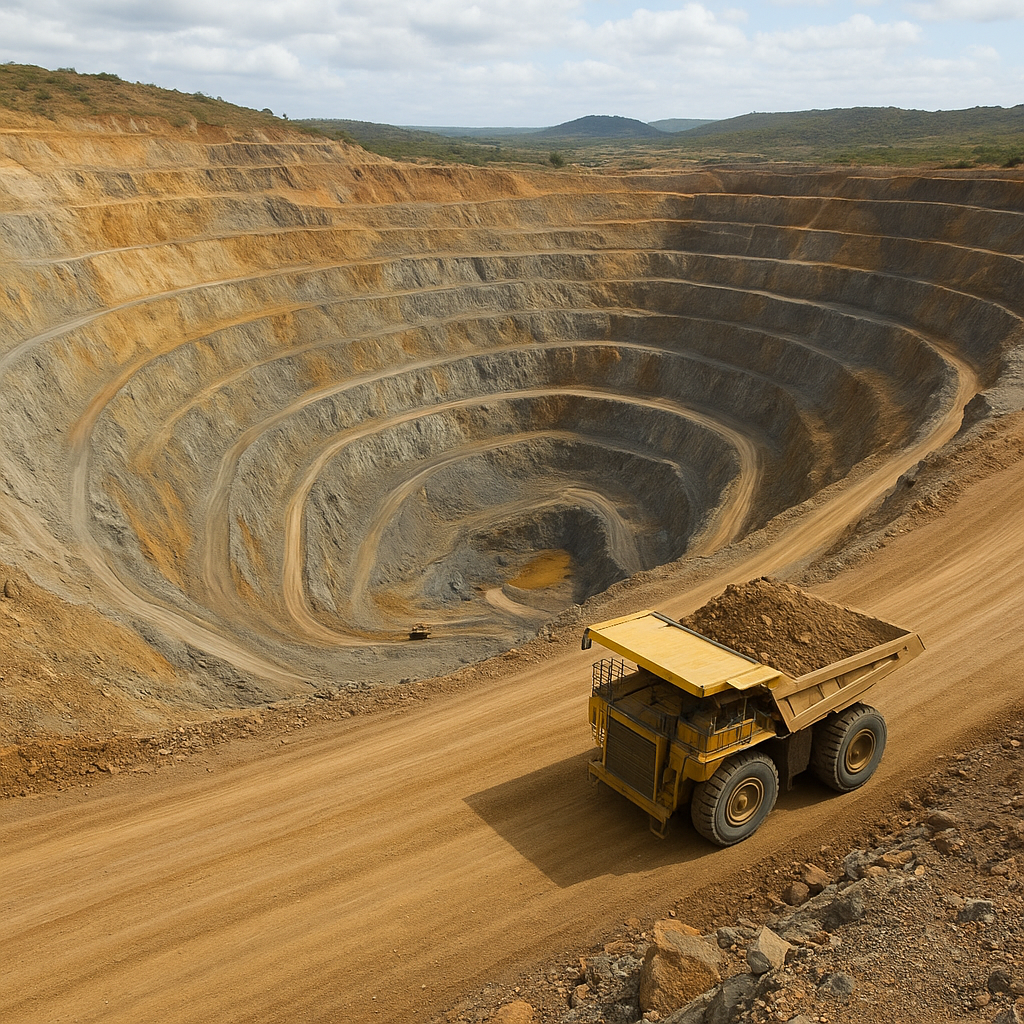
The North Mara Mine is one of the most significant gold-producing operations in northern Tanzania. Located within the geologically rich Mara region, the mine combines large-scale industrial extraction with a complex history of social and environmental interactions. This article explores its location, geology and mineralogy, the methods used to extract and process gold, the mine’s role in the national and local economy, and a selection of noteworthy and sometimes contentious facts that shape public perception and policy around the operation.
Location and geological setting
The North Mara Mine lies in the Tarime District of the Mara Region, in the north of Tanzania, close to the border with Kenya and not far from the northeastern shore of Lake Victoria. The site is situated among rolling hills and a landscape characteristic of the East African greenstone belts that host many of the country’s gold deposits. The mine’s coordinates place it within an area of historical and ongoing mineral exploration activity that has attracted multiple international mining companies over several decades.
Geologically, the deposit is typical of Archaean to Proterozoic greenstone-hosted gold systems, where gold occurs in quartz veins, shear zones and associated sulphide-rich host rocks. Mineralization is often structurally controlled, concentrated along fault and shear zones where hydrothermal fluids precipitated gold. Locally, ores include both oxide material near surface and sulphide-bearing primary ore at depth, which affects the choice of mining method and processing route.
Access and infrastructure
- The operation is accessible by road from regional centers and has infrastructure to support mining activities, including processing facilities, power supply, water management works and waste storage systems.
- Because of its proximity to transport routes leading to the Lake Victoria region, North Mara plays a logistical role in the movement of concentrate, refined product and inputs for operations.
- Over time, the mine has developed associated facilities such as camp housing for staff, maintenance workshops and a network of exploration sites on its concession areas.
What is produced and how
At its core, North Mara is a gold mine. The operation produces gold through conventional open-pit mining techniques, combined with on-site processing to recover the metal. Mining typically involves drilling, blasting and hauling material to a processing plant where crushing and milling reduce ore to suitable sizes for chemical extraction.
Processing at sites like North Mara generally uses a combination of gravity concentration (to recover coarse free gold) and carbon-in-leach (CIL) or similar cyanide leaching technologies to extract gold from finer particles. The presence of both oxide and sulphide ores requires plant configurations capable of handling variable feed mineralogy; oxide ores tend to be more amenable to direct leaching, while sulphide ores may require flotation or pre-treatment to liberate the gold.
Recovered gold is typically refined to dore bars on site or in a regional refinery before onward sale on international markets. Ancillary products are limited; gold is the principal economic commodity extracted, and other metal credits, if present, are usually minor.
Production profile and operations
- Production levels at North Mara have varied over time in response to ore grade, mine life planning, exploration success and global gold prices. The mine has produced at a scale that places it among Tanzania’s important gold operations, contributing to national output.
- The operation has employed modern open-pit techniques, and periodic exploration has aimed at extending the mine life by delineating deeper or lateral ore bodies.
- Ongoing exploration programs and resource drilling are typical on the concession to define reserves and optimize future production schedules.
Economic significance
The economic impact of the North Mara operation extends across multiple levels — local, regional and national. As a gold-producing asset, it contributes to foreign exchange earnings, government revenues through royalties and taxes, and to local employment and procurement.
On a national scale, gold is one of Tanzania’s most valuable mineral exports, and mines like North Mara play a role in maintaining export earnings and attracting foreign investment into the mining sector. Mining revenues support government budgets and can help finance infrastructure, healthcare and education projects when governed effectively.
Local employment and services
- North Mara provides direct employment opportunities for hundreds to thousands of people, including skilled and unskilled labor, technical staff and management. Indirect employment is also generated through local suppliers, contractors and service providers.
- Local communities often benefit from infrastructure improvements connected to mining — such as road upgrades, water supply projects and electrification — though the distribution and longevity of these benefits vary.
- Company-led community development programs may include health clinics, schools, vocational training and small-business support, forming part of corporate social responsibility and social license efforts.
Government revenue and local economies
Through royalties, corporate taxes and export duties, the mine contributes to Tanzania’s fiscal receipts. At the same time, questions of equitable revenue sharing, transparency and the extent to which mining income translates into broader social benefits are persistent issues in mineral-rich countries and are relevant to discussions about the North Mara operation.
Environmental and social considerations
Mines of North Mara’s scale interact intensively with their surroundings, and managing environmental and social impacts is central to sustainable operation. Key areas of concern include water management, tailings and waste rock disposal, land disturbance and the relationship between the mine and neighboring communities.
Cyanide leaching and tailings storage require robust engineering and monitoring to prevent accidental releases. Water use must be balanced against community needs and local ecosystems, especially in regions where agriculture and artisanal activities rely on surface and groundwater resources.
Community relations and artisanal mining
- The proximity of artisanal and small-scale miners to large-scale operations is a common situation in Tanzania. Artisanal miners may operate within or adjacent to concession areas, creating interactions that can be cooperative or conflictual.
- Efforts to integrate artisanal miners through formalization, training and safer mining practices are often discussed as ways to reduce dangerous informal activity and improve community incomes.
- At North Mara, as with other operations, community engagement programs and grievance mechanisms are important tools to manage expectations and resolve disputes over land use, compensation and environmental impacts.
Regulatory framework and mitigation
Tanzania has a regulatory structure governing mining, environmental protection and occupational health and safety. Mines are typically required to maintain environmental management plans, conduct impact assessments, secure permits for wastewater and tailings, and implement closure and rehabilitation plans for post-mining land use.
Compliance with these requirements, transparent reporting and independent oversight are vital to minimizing adverse environmental effects and ensuring that rehabilitation is effective once mining concludes.
Controversies and legal aspects
North Mara’s history includes episodes that have attracted attention from civil society organizations, media and legal entities. Issues that commonly arise around large mining projects include dispute over compensation for displaced or affected residents, allegations of environmental contamination, and concerns about security responses to protests or informal mining activity.
It is important to note that such controversies are often multi-faceted, involving the mine operator, government authorities, local communities, NGOs and sometimes international legal processes. Addressing these matters typically involves investigations, negotiated settlements, court actions or changes in company practices to improve community relations and environmental standards.
Interesting facts and broader context
Several aspects of North Mara and its setting make it noteworthy beyond mere production figures:
- Geological significance: The mine is part of the East African gold belt, a corridor of substantial gold endowment stretching across several countries. Understanding these deposits contributes to broader geological knowledge and guides exploration strategies.
- Historical layers: Gold mining in the Lake Victoria region has a long history that predates industrial projects; many communities have practiced small-scale mining for generations, embedding the metal in local culture and livelihoods.
- Corporate evolution: The mine has been operated under different corporate structures and names as international mining companies have consolidated and reorganized their African assets, reflecting broader trends in the global mining industry.
- Technological adaptation: Modern mines increasingly adopt automation, improved ore-processing techniques and data-driven resource models. These developments influence productivity and environmental footprint.
- Market sensitivity: Like all gold mines, North Mara’s economic health is sensitive to global gold prices, which affect investment, production planning and exploration budgets.
Future prospects
The future for a mine such as North Mara depends on several interlinked factors: continued exploration success and resource definition, the ability to manage environmental and social impacts, the global price of gold, and the regulatory and political climate in Tanzania. If exploration identifies additional economically viable ore, the mine life can be extended through investment in deeper pits or processing upgrades. Conversely, declining grades or unfavourable economics may prompt closure planning and accelerated rehabilitation.
Investment in community development, transparent benefit-sharing mechanisms, and improved engagement with artisanal miners can strengthen the operation’s long-term social license to operate. Technological upgrades, such as more efficient processing circuits or better water recycling, can reduce environmental pressures while sustaining output.
Key takeaways
- North Mara is an important gold producing site in northern Tanzania, embedded in the broader East African mineral province.
- The operation combines open-pit mining with processing methods suited to oxide and sulphide ores, contributing to national export revenues and local employment.
- Environmental management, community relations and the handling of artisanal mining are ongoing challenges that shape the mine’s social and operational environment.
- Its future depends on exploration results, global market dynamics, regulatory conditions and the effectiveness of measures to reduce environmental impact and improve benefits for local communities.
Whether viewed from a geological, economic, social or environmental angle, the North Mara Mine exemplifies the complexities of modern mineral extraction in a resource-rich region. Its story continues to evolve as stakeholders adapt to shifting economic conditions, technological possibilities and societal expectations.

