
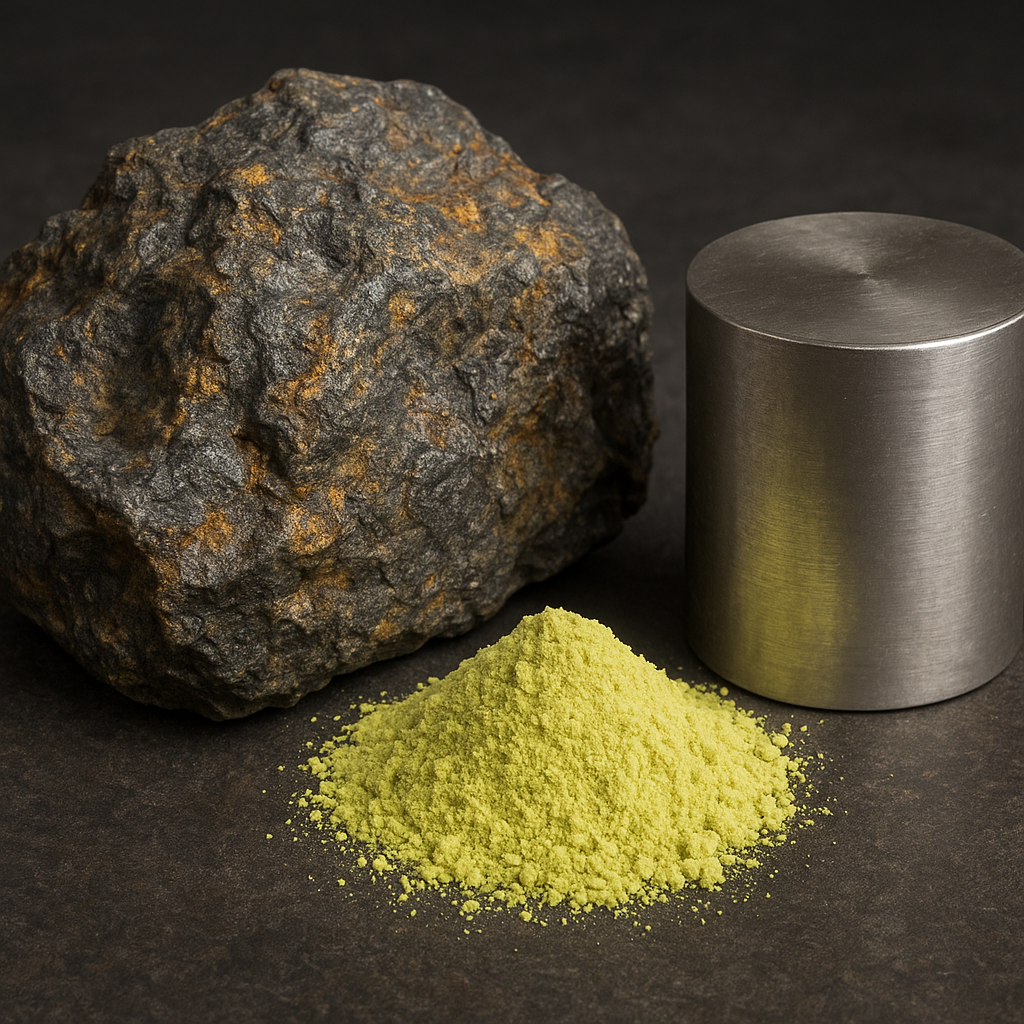
Uranium is a heavy, naturally occurring element that has shaped human history, industry, and science in profound ways. Its distinctive chemistry and **radioactivity** have made it both a valuable resource and a source of controversy. This article explores where uranium is found, how it behaves at the atomic level, the many applications it supports, and several intriguing historical and contemporary aspects surrounding this element.
Geological occurrence and extraction
Uranium is distributed unevenly across the Earth’s crust. It does not occur in metallic form in nature but is commonly found in a variety of minerals and ore deposits. The most important uranium-bearing minerals include pitchblende (also known as uraninite), carnotite, autunite, and coffinite. These minerals can be present in hard-rock veins, sedimentary layers, and as coatings in granitic and volcanic environments.
Where uranium is mined
- Large producers of uranium include countries such as Kazakhstan, Canada, Australia, Niger, Russia, and Namibia. These regions host some of the most economically significant deposits.
- Notable deposit types include high-grade unconformity-related deposits (for example, those in the Athabasca Basin of Canada), sandstone-hosted deposits, and in some places, phosphate-associated or black shale-hosted occurrences.
Mining methods vary with geology and environmental constraints. Traditional techniques such as open-pit and underground mining are used where ore bodies are accessible and economically viable. In some sedimentary deposits, in-situ leaching (also known as in-situ recovery) is employed to dissolve uranium directly in the ground and pump it to the surface, a method that can reduce surface disturbance but raises concerns about groundwater management and chemical contamination.
Environmental and social considerations
Uranium extraction can create environmental challenges. Mine tailings and waste rock contain residual radioactivity and heavy metals, and they require long-term containment and monitoring. Radon gas—a decay product of uranium—poses a health risk if not properly ventilated in mines and improperly managed waste sites. Indigenous and local communities are often affected by mining activities, and issues of land rights, compensation, and long-term stewardship are central to modern uranium development projects.
Isotopes and nuclear properties
At the heart of uranium’s importance are its isotopes and the nuclear properties they exhibit. Natural uranium is a mixture of isotopes with different numbers of neutrons. The two isotopes most often discussed are Uranium-235 and Uranium-238. U-235 is rare compared to U-238 but is the isotope responsible for sustaining certain types of nuclear chain reactions that can produce large amounts of energy in reactor systems.
Basic nuclear behavior
- U-235 is fissile, meaning it can sustain a chain reaction when struck by a neutron under appropriate conditions.
- U-238 is fertile: it is not easily fissile with thermal neutrons but can capture neutrons and transmute into other fissile isotopes over time in reactors.
- The element’s overall behavior is governed by its nuclear structure: neutron capture, fission probabilities, and decay chains that produce characteristic radiation and daughter nuclides.
The inherent radioactivity of uranium and its decay products is responsible both for its useful applications and for the need for careful handling. Radiation fields from uranium are generally dominated by alpha particles from the uranium isotopes themselves and by gamma and beta radiation from their decay daughters. Alpha radiation presents a serious health hazard if radioactive particles are inhaled or ingested, which is why occupational controls and personal protective equipment are critical in mining and processing operations.
Isotopic manipulation
To be used in many modern power reactors or in specific industrial applications, natural uranium often must undergo some form of enrichment to increase the proportion of U-235 relative to U-238. Conversely, uranium that has had most of its U-235 removed is called depleted uranium and has distinct industrial uses. Discussions of enrichment are highly regulated globally, as they are central to both civilian nuclear power and proliferation concerns. The scientific community, regulatory bodies, and international organizations maintain strict oversight to prevent misuse.
Applications across sectors
Uranium’s primary use today is as a fuel for generating electricity in nuclear power plants. Beyond energy, uranium and its derivatives have contributed to medicine, industry, scientific research, and, controversially, military technologies. The following sections outline these varied roles and highlight technological and societal considerations.
Electricity generation
Nuclear power plants use controlled fission reactions—driven by the behavior of uranium isotopes—to produce heat, which then generates steam and drives turbines to produce electricity. The energy density of uranium is extremely high compared with fossil fuels: a small mass of nuclear fuel can yield large amounts of continuous power, which is attractive for baseload electricity supply.
- Various reactor designs use uranium in different ways; some run on low-enriched uranium fuel, while others are designed to use mixed oxide fuels or to breed additional fissile material.
- Spent nuclear fuel contains a mix of unused uranium, newly created isotopes, and fission products. Managing spent fuel through storage, possible reprocessing, or disposal is one of the central challenges of nuclear energy programs.
Medicine, industry, and science
While not the most visible use of uranium itself, nuclear reactors fueled by uranium are key to producing many medical isotopes used in diagnostics and treatment. Uranium-derived radiation sources and instruments are used in industrial radiography, material testing, and scientific research. Historically, uranium compounds were employed as pigments in glass and ceramics (for example, uranium glass with its characteristic green or yellow glow under ultraviolet light).
Military and strategic applications
Uranium has played a role in military history. Briefly stated, certain isotopes of uranium have properties that influenced early nuclear weapon development and remain relevant in strategic considerations and nonproliferation policy. Separately, depleted uranium alloys have been used for armor-piercing ammunition and in armor plating because of their high density and mechanical properties; these uses have raised environmental and health debates following conflict deployments.
Processing, fuel cycle, and waste management
The so-called nuclear fuel cycle encompasses the sequence from uranium extraction through fuel fabrication, reactor use, spent fuel management, and potential recycling or disposal. Each stage involves technical, regulatory, and environmental dimensions.
From ore to fuel
- After mining, ore is milled to produce a concentrated form of uranium (often called yellowcake), which is then chemically converted and prepared for enrichment or direct fuel fabrication depending on the reactor technology.
- Fuel fabrication transforms processed uranium into the physical forms required by reactors—typically ceramic pellets encased in metal fuel rods.
Spent fuel and long-term stewardship
Once uranium fuel has been irradiated in a reactor, it becomes spent fuel, which contains fission products and transuranic elements with long-lived radioactivity. Countries take different approaches to managing this material: some use long-term geological repositories, while others reprocess spent fuel to extract usable isotopes for new fuel—an option that reduces some waste streams but introduces proliferation and economic considerations.
Health, safety, and regulation
Handling uranium requires rigorous attention to radiation protection and chemical safety. Occupational exposure limits, environmental monitoring, and public health guidelines are enforced by national and international agencies. Key protective measures include controlling dust and radon exposure in mines, using sealed systems during processing, and managing contaminated materials and tailings responsibly.
Radiation protection basics
- Alpha emitters like uranium are most dangerous when ingested or inhaled; external exposure to alpha particles is generally limited because they are stopped by skin.
- Gamma radiation from decay products can penetrate tissue and requires appropriate shielding and distance to reduce exposure.
- Long-term monitoring of water, soil, and air near mining and processing facilities is essential to detect and mitigate contamination.
Historical and cultural notes
The history of uranium spans scientific curiosity, artistic application, and geopolitical transformation. The element was named after the planet Uranus after its discovery in the late 18th century. Early chemists and mineralogists identified uranium-containing ores such as pitchblende, and later researchers investigated its radioactive properties—work that laid foundations for the field of nuclear science.
In the 19th and early 20th centuries, uranium compounds were used in ceramics and glass. The pioneering work of scientists who studied uranium’s radioactivity led to breakthroughs in physics and chemistry, and the eventual development of nuclear technologies reshaped energy systems and international relations.
Future prospects and challenges
Uranium will likely continue to play a central role in the global energy mix for the foreseeable future, especially where decarbonization and stable baseload power are priorities. Innovations in reactor design—such as advanced thermal reactors, small modular reactors (SMRs), and fast-spectrum systems—seek to make more efficient use of uranium resources and improve safety and waste profiles. At the same time, social license to operate, long-term waste solutions, and the geopolitical dynamics of fuel supply are active areas of policy and research.
The story of uranium is a reminder of how a single element can intersect science, industry, environment, and society. Its dual nature—as both a powerful energy source and a material that requires careful stewardship—continues to provoke technical innovation, regulatory attention, and public debate.