Goethite is a widespread and scientifically fascinating iron oxyhydroxide mineral whose presence shapes landscapes, soils, industry and even our understanding of past environments on Earth and other planets. With the chemical formula FeO(OH), goethite forms a key part of the iron cycle and appears in diverse contexts—from rusty coatings on weathered rocks to the deep-red and brown pigments used by humans for tens of thousands of years. This article explores where goethite occurs, its properties and transformations, practical and environmental applications, and a few surprising connections between geology, biology and culture.
Occurrence and geological contexts
Goethite forms wherever iron-bearing minerals are exposed to oxygen and water and can accumulate under a wide range of temperatures and chemical conditions. Its formation environments include:
- Weathering zones of iron-rich rocks, where primary minerals such as olivine, pyroxene, magnetite and sulfides break down and release iron that oxidizes and hydrates to produce goethite.
- Bog-iron deposits and wetlands where groundwater or surface water rich in dissolved iron precipitates oxyhydroxides as oxygen levels increase.
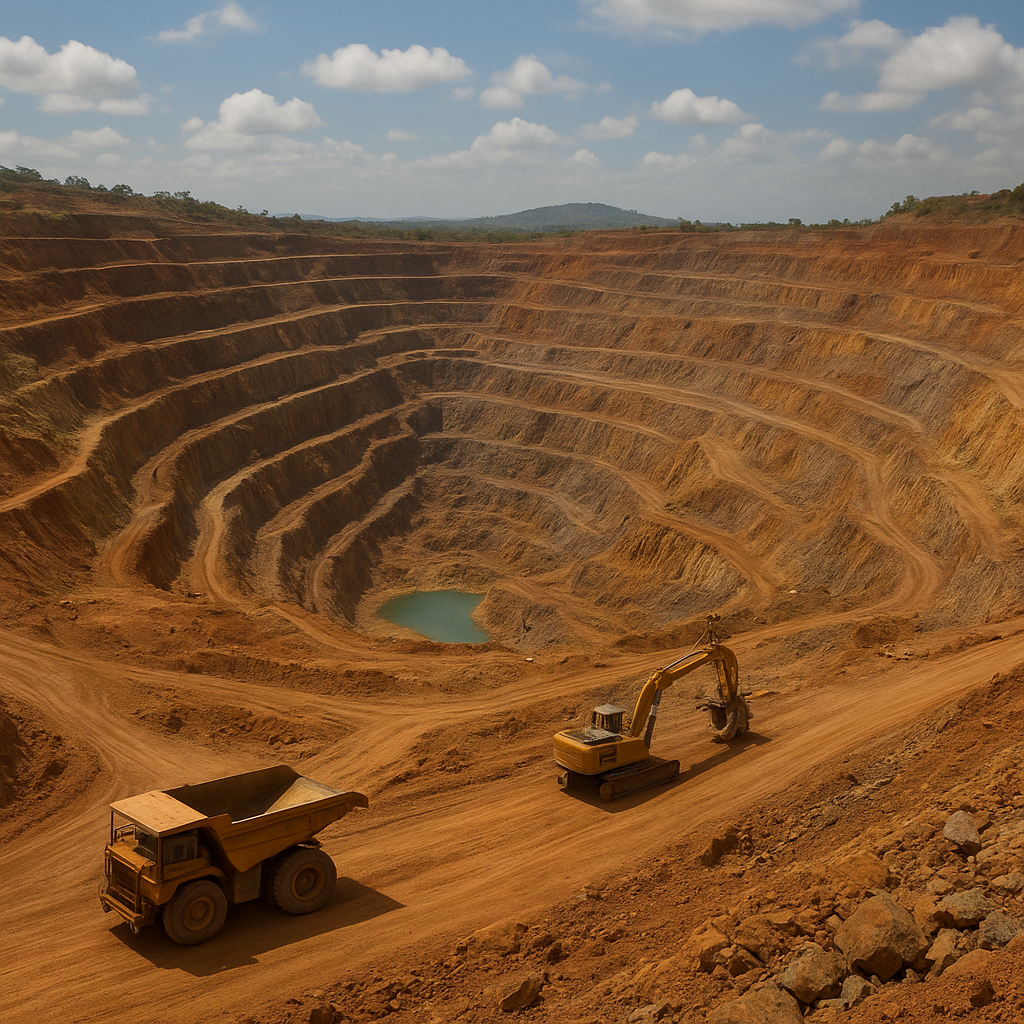
- Lateritic soils in tropical climates, where intense chemical weathering removes silica and enriches iron, often yielding goethite-rich horizons in laterite profiles.
- Gossans and oxidized zones above ore bodies, formed by supergene oxidation of sulfide minerals like pyrite and chalcopyrite; goethite frequently accompanies other iron oxides and secondary minerals in these zones.
- Hydrothermal veins and low-temperature mineralization systems, where iron-bearing fluids precipitate goethite along fractures and cavities.
- Biological settings where iron-oxidizing bacteria and algae mediate precipitation of iron oxyhydroxides, producing characteristic stalks, sheaths and filaments that may be composed largely of goethite.
Goethite is often a principal constituent of what miners and geologists call limonite, a non‑specific term historically applied to various earthy iron-rich materials; in many cases the visible brown, ochre and rust colors of soils and rocks owe more to goethite than to hematite or magnetite.
Crystal habit, physical and chemical properties
Goethite has the chemical formula FeO(OH) and commonly crystallizes in the orthorhombic system. It occurs in a wide variety of habits:
- acicular (needle-like) crystals
- botryoidal (grape-like), stalactitic and reniform masses
- massive earthy aggregates forming ochre and soil coatings
- pseudomorphs after other minerals, especially pyrite and marcasite, in which goethite preserves the original shape of the replaced mineral
Characteristic physical properties include a brown to yellow-brown color, a yellowish-brown streak, and a luster that ranges from earthy to submetallic depending on crystal size and surface development. Goethite is generally moderately hard and dense relative to many clays, and it is chemically reactive because of its hydroxyl content and often large specific surface area in fine-grained forms.
Thermally, goethite dehydrates to form hematite (Fe2O3) plus water when heated, a process exploited in both natural diagenesis and laboratory or industrial treatments. Chemically, its surface sites are active for adsorption and surface complexation reactions, making goethite a major control on the mobility of many trace elements in soils and waters.
Formation mechanisms and the role of life
Goethite forms by both abiotic and biotic processes. Where oxygen and water contact soluble ferrous iron (Fe2+), oxidation to ferric iron (Fe3+) followed by hydrolysis and precipitation can produce goethite. Kinetics of precipitation, pH, the presence of silica or other ions, and drying/wetting cycles determine whether fine-grained ferric hydroxides transform to goethite, lepidocrocite, or hematite.
Biological activity is especially important in many environments. Microbes that oxidize Fe2+—including twisted stalk-forming Gallionella and sheath-forming Leptothrix species—facilitate or catalyze the precipitation of iron oxyhydroxides. The biomineralized products often have distinctive morphologies and enhanced reactivity. Organic molecules produced by bacteria, microalgae and plants can control nucleation and growth, producing nanostructured goethite with high surface areas and unusual shapes.
Because microbial mediation can concentrate iron and trap trace elements during growth, biogenic goethite is of interest for reconstructing environmental conditions and for designing materials for pollution control.
Applications and economic importance
Goethite plays roles in several practical and historical applications, often because of its color, reactivity and abundance.
Pigments and cultural uses
Natural earth pigments—collectively called ochres—are frequently rich in goethite. The warm yellow, brown and reddish-brown hues provided durable pigments used in cave paintings, ancient murals, pottery and cosmetics. The stability and lightfastness of iron‑based pigments made them a mainstay of artists and craft traditions worldwide.
Iron ore and industrial uses
In many iron deposits, especially laterites and supergene ores, goethite is an important ore mineral or a major component of iron-bearing materials. Although hematite and magnetite are often preferred for direct iron extraction due to higher Fe content, goethite-bearing ores are routinely beneficiated and processed to recover iron. Thermal treatment (calcination) is used to convert goethite to hematite, improving metallurgical performance in some processes.
Environmental remediation and adsorption technologies
One of the most significant modern uses of goethite-like materials is in environmental remediation. The high reactivity of goethite surfaces makes them effective at binding oxyanions (such as arsenic, phosphate, and chromate), heavy metals (lead, cadmium), and organic molecules. Engineered iron oxyhydroxides and goethite-coated substrates are employed in filters, permeable reactive barriers and sorption media to remove contaminants from groundwater and industrial effluents.
Catalysis and materials science
Nanostructured goethite and derived iron oxides are studied as catalysts and catalyst precursors for oxidation reactions, Fischer–Tropsch processes, and even as components in electrode materials for batteries and supercapacitors. The ability to tune morphology through synthesis or biogenic control makes goethite attractive for research into functional nanomaterials.
Environmental geochemistry and public health
Because goethite is abundant in soils and sediments and exhibits strong sorptive behavior, it exerts major control on the environmental **fate** of nutrients and contaminants. Key aspects include:
- Arsenic immobilization and release: arsenate and arsenite species strongly adsorb to goethite surfaces. Changes in redox conditions, pH, or competitive ions can cause remobilization, with implications for drinking-water safety in regions with arsenic-rich geology.
- Phosphate cycling: adsorption to iron oxyhydroxides regulates phosphate availability in soils and aquatic sediments, influencing plant nutrition and eutrophication processes.
- Trace metal sequestration: lead, cobalt, nickel and other metals sorb to goethite, often reducing their bioavailability; however, subsequent chemical changes can re-release them.
- Soil color and paleoclimatic indicators: the relative abundance of goethite versus hematite in soils is used as a proxy for formation conditions—goethite tends to indicate formation in wetter, lower-temperature or more hydrated conditions compared with hematite, making it useful in paleoclimate reconstructions.
Analytical methods and identification
Because goethite commonly occurs as fine-grained or poorly crystalline material, a variety of techniques are used to identify and study it:
- X-ray diffraction (XRD): useful when crystals are sufficiently ordered; however, poorly crystalline goethite can be challenging to resolve.
- Mössbauer spectroscopy: highly diagnostic for iron oxyhydroxides and ferric iron-bearing phases, providing oxidation state and magnetic environment information.
- Scanning electron microscopy (SEM) and transmission electron microscopy (TEM): reveal morphology, crystal habit and nano-scale features; energy-dispersive X-ray spectroscopy (EDS) gives elemental composition.
- Infrared and Raman spectroscopy: provide vibrational fingerprints associated with hydroxyl groups and Fe–O bonds.
- Surface studies (BET surface area, zeta potential): important for understanding adsorption behavior and reactivity.
Field identification often relies on color, streak, and the presence of characteristic pseudomorphs after sulfide minerals; laboratory confirmation, however, is recommended for quantitative or regulatory purposes.
Planetary significance and remote sensing
Detection of goethite beyond Earth has profound implications. Because goethite forms only in the presence of liquid water under oxidizing conditions, its identification by spectroscopic methods on planetary surfaces serves as a robust indicator of past aqueous alteration. In planetary exploration, the presence of iron oxyhydroxides supports hypotheses about the duration and chemistry of liquid water on a planetary body.
On Mars, reports of iron oxyhydroxide phases in rover and orbital data have been interpreted as evidence for past water activity, contributing to debates about the habitability and environmental evolution of the planet. Such findings illustrate how a seemingly humble mineral on Earth can become a key piece of the puzzle in extra‑terrestrial science.
Interesting mineralogical phenomena and cultural notes
Goethite is associated with several mineralogical curiosities and cultural intersections:
- Pseudomorphs: goethite often replaces pyrite or marcasite, preserving cubic or striated forms that draw attention from collectors and provide clues to oxidative histories of deposits.
- Streaks and soils: the wide palette of natural earth pigments derived from goethite has influenced prehistoric art, cosmetics and modern pigments used in architecture and restoration.
- Biologically mediated microstructures: the fine-scale textures formed by iron-oxidizing bacteria can fossilize, creating biosignatures preserved in the rock record that help identify ancient microbial activity.
- Color changes with heating: as goethite transforms to hematite upon heating, pigments can shift hue—an effect exploited in ceramic firing and pigment preparation.
Challenges, research frontiers and practical considerations
Despite its ubiquity, goethite poses several challenges and opportunities for research and technology:
- Predicting and managing the mobility of adsorbed contaminants (arsenic, lead) under changing redox conditions remains an urgent public health issue in many regions.
- Synthetic and biogenic routes to produce tailored goethite nanostructures are under active investigation for catalytic, sensor and remediation applications.
- Understanding the long-term stability and transformation pathways of goethite in soils and engineered systems is important for waste management, conservation of cultural heritage and improving iron ore processing.
- High-resolution analytical methods continue to reveal complex structural, magnetic and surface properties that challenge simple models of iron oxyhydroxide behavior.
As a mineral, goethite sits at the intersection of geology, biology, chemistry and human culture. Its presence colors landscapes and artifacts, controls the fate of nutrients and toxins, and offers clues to past environments on Earth and beyond. Continued study of goethite—across scales from molecular surfaces to planetary occurrences—promises both practical benefits and deeper insights into the dynamic processes that shape the solid and aqueous worlds.