
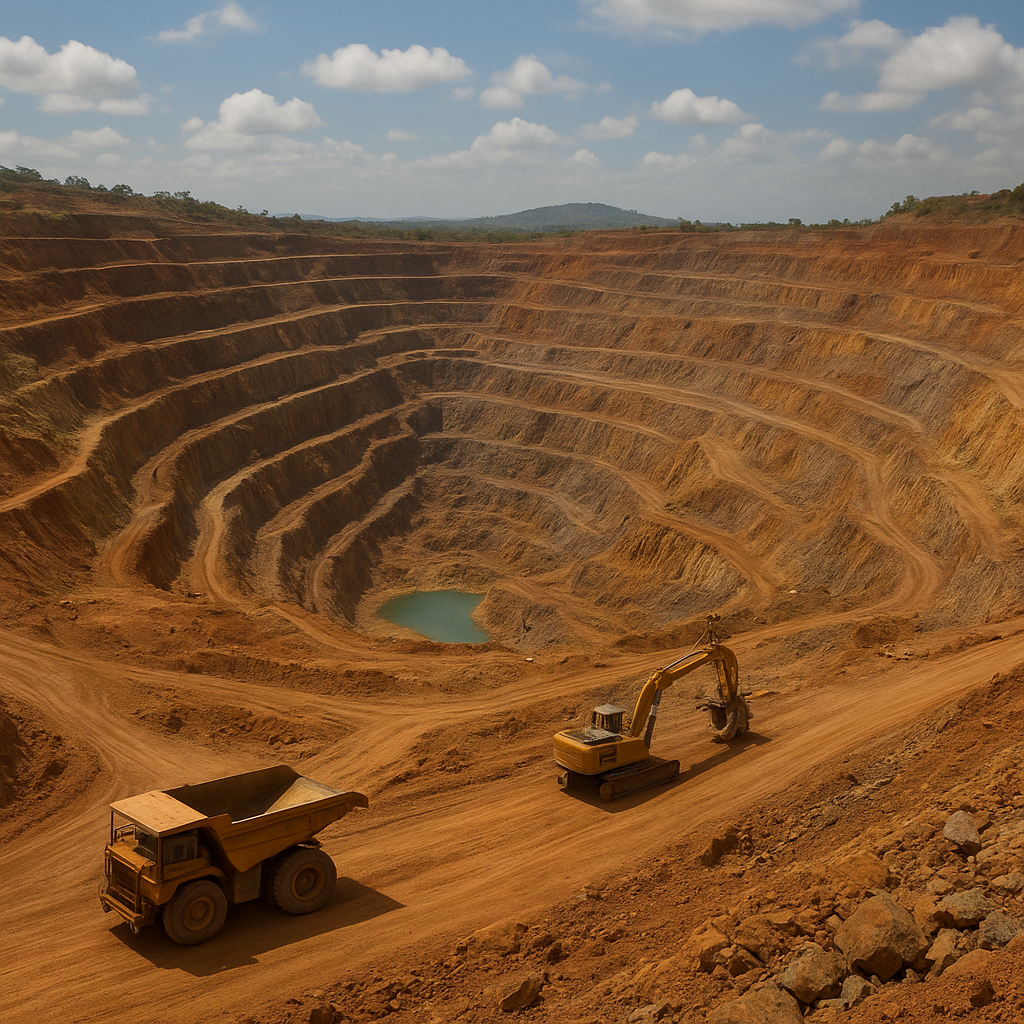
The Sambaru Mine in Tanzania represents one of the many focal points of gold exploration and mining activity in East Africa. While not as globally famous as some large-scale operations, Sambaru encapsulates the layered story of geology, local livelihoods, investment, and environmental stewardship that defines modern mineral extraction in the region. This article explores where Sambaru is located, what is extracted there, its economic importance, and several interesting aspects that illuminate both the promise and complexity of mining in Tanzania.
Location and geological setting
The Sambaru deposit lies within the broader gold-bearing terrains of northern Tanzania, part of the greenstone belts that characterize large portions of the country’s mineralized ground. These belts are seated on the East African Craton, whose ancient rocks preserve numerous gold-bearing structures formed by Archean and Proterozoic geological processes. Many Tanzanian gold deposits occupy shear zones, quartz veins, and sulfide-hosted systems within metavolcanic and metasedimentary sequences — geological settings that are also typical of the Sambaru area.
Although exact coordinates and administrative details vary by source, the mine is frequently associated with districts that form the so-called Lake Victoria goldfields, an extensive region known for hosting multiple producing mines, processing plants, and artisanal mining communities. The landscape in and around Sambaru combines small farming settlements, areas of scrub and woodland, and pockets of intensive mineral activity, with road links to regional centers that support logistics and labor movement.
What is extracted: geology of the mineralization
Gold is the primary commodity at Sambaru, typically occurring in veins and disseminated sulfide zones. Typical mineral assemblages in such deposits include gold associated with quartz, pyrite, arsenopyrite, and other sulfide minerals. Mineralization is often structurally controlled, concentrated along faults and shear zones where hydrothermal fluids once migrated and deposited gold.
Exploration programs in areas like Sambaru commonly use a combination of geological mapping, trenching, geochemical sampling, and geophysical surveys to delineate ore bodies. Drilling campaigns convert those targets into defined resources and help determine whether mineralization is amenable to open-pit or underground mining. Metallurgical testing guides the processing route: many Tanzanian gold ores are oxidized near surface and easier to treat, while deeper sulfide-rich zones may require flotation and pressure oxidation or roasting before gold extraction.
Associated minerals and by-products
- Silver: commonly occurs with gold and can be a minor by-product in concentrates or dore.
- Sulfide minerals: pyrite and arsenopyrite influence processing decisions and environmental management.
- Trace elements: mercury, lead, or other metals may be present in trace amounts, especially where artisanal miners have historically worked.
Mining methods and local practices
At sites like Sambaru, mining activity often spans a spectrum from organized, company-led operations to artisanal and small-scale mining (ASM) by local groups. Large operators may develop open pits, create waste rock facilities, and build processing plants employing carbon-in-leach (CIL) or similar technologies. ASM activities, meanwhile, can be informal, using basic tools, rudimentary crushing and gravity separation, and sometimes hazardous chemicals such as mercury for gold recovery.
Key operational considerations include:
- Choice of mining method — open pit vs. underground — driven by ore geometry, depth, and grade.
- Ore processing strategy — direct cyanidation for free-milling ore vs. flotation and pressure oxidation for refractory ore.
- Water management and tailings disposal — critical in environmentally sensitive areas and for regulatory compliance.
- Engagement with artisanal miners — whether through formalization programs, integration into supply chains, or conflict management.
Economic significance
Gold mining is a cornerstone of Tanzania’s mineral economy, and mines like Sambaru contribute to several layers of economic activity. At the national level, gold is one of the most valuable export commodities, supporting foreign exchange earnings and government revenue through royalties, taxes, and, in some cases, ownership stakes. At the regional level, mining operations can stimulate the local economy through job creation, procurement of goods and services, and investment in infrastructure.
For local communities near Sambaru, economic impacts include direct employment in mining and processing, as well as indirect opportunities in transport, hospitality, and small-scale commerce. The presence of a mine can catalyze improvements in road networks, electrification, and health or education facilities when companies engage in community development programs. However, benefits are uneven and often depend on governance, contract terms, and the ability of local stakeholders to negotiate favorable outcomes.
- Employment: mining offers formal jobs and skills training that are often scarce in rural areas.
- Revenue: royalties and taxes contribute to district and national budgets, funding public services.
- Local procurement: goods and services sourced locally can multiply the economic footprint of a mine.
Social and environmental considerations
Mining in and around Sambaru intersects with pressing social and environmental challenges. The environmental footprint of extraction includes land disturbance, habitat loss, water use, and the potential for chemical contamination. Cyanide and mercury, used in gold recovery, are particularly concerning when improperly managed. Tailings storage facilities require robust design and oversight to prevent failures and long-term seepage.
Socially, mining activities can affect land rights, agricultural livelihoods, and cultural sites. Conflicts may arise between companies and local communities over compensation, access to resources, and perceived inequities in benefit sharing. Conversely, responsible operations that invest in local infrastructure, health, and education can deliver tangible improvements in quality of life.
- Environmental mitigation: progressive rehabilitation, controlled tailings management, and water treatment are essential.
- Health risks: dust, chemical exposure, and unsafe artisanal practices pose real challenges.
- Community relations: transparent engagement, grievance mechanisms, and inclusive hiring improve outcomes.
Regulation, governance, and formalization
Tanzania’s mining sector operates under national legislation that governs licensing, royalties, environmental protection, and local content. Over recent years, the country has revised regulatory frameworks to increase state participation and ensure a greater share of mining benefits stays in-country. Such policy changes affect projects like Sambaru through fiscal terms, licensing requirements, and environmental permitting.
Formalizing artisanal miners — bringing them into legal frameworks, providing training, and improving techniques — is a priority for many stakeholders because it reduces environmental harm, increases safety, and enables miners to access better markets. Some initiatives encourage cooperative structures, responsible sourcing programs, and small-scale mechanization that preserves livelihoods while reducing the negative impacts of informal mining.
Interesting aspects and historical context
Tanzania has a long history of gold mining that stretches back to pre-colonial times, when local communities exploited alluvial gold in rivers and streams. Colonial and post-colonial eras introduced more systematic exploration and industrial-scale operations. The Sambaru area shares in this layered history: traces of old workings, both artisanal and earlier mechanized efforts, can often be found alongside newer infrastructure.
Among the more interesting facets of mining regions like Sambaru are:
- Archaeological layers: sometimes, ancient river-placer workings and historical artifacts are discovered during exploration.
- Community ingenuity: artisanal miners often develop highly adapted local techniques for prospecting and recovery that reflect deep local knowledge of mineral occurrences.
- Biological surprises: disturbed landscapes occasionally reveal rare plant species or unique ecological niches that warrant conservation attention during rehabilitation efforts.
Challenges and future prospects
The future of mines such as Sambaru will be shaped by several intersecting trends: exploration success and resource delineation, commodity price dynamics, regulatory stability, and the global shift toward higher environmental and social standards in mining finance and offtake. Technological advances in ore-sorting, processing, and environmental management can enhance the viability of lower-grade deposits and reduce impacts.
Key opportunities and challenges include:
- Exploration potential: deeper or lateral extensions of known mineralization may expand the resource base.
- Access to capital: smaller projects sometimes struggle to secure financing unless they demonstrate clear environmental, social, and governance (ESG) credentials.
- Responsible mining: aligning operations with international best practices can open premium markets and reduce long-term liabilities.
- Community integration: partnerships with local stakeholders increase social license to operate and create more durable benefits.
Practical considerations for stakeholders
Different stakeholders approach Sambaru with distinct priorities. Investors care about resource size, grade, and regulatory risk. Local communities prioritize jobs, land rights, and environmental protection. Regulators focus on ensuring that mining contributes to national development while adhering to safety and environmental standards. NGOs and development agencies emphasize formalization of ASM, pollution control, and equitable benefit-sharing.
Practical steps that can enhance positive outcomes include:
- Transparent contracts and community consultation processes to build trust and clarity.
- Investment in training and small-business development to diversify local economies beyond mining.
- Adoption of technologies that minimize water use, reduce toxic emissions, and allow for efficient reclamation.
- Programs to integrate artisanal miners into formal supply chains, providing legal recognition and safer methods.
Why Sambaru matters
Although Sambaru may not dominate global headlines like some mega-projects, it exemplifies the layered reality of gold mining in Tanzania: a melding of ancient geology, modern extraction techniques, local livelihoods, and national economic strategy. The mine serves as a microcosm for exploring how resource-rich regions can pursue development while managing environmental and social responsibilities. Its significance lies not only in ounces recovered but in how the activity shapes communities, landscapes, and local economies for generations.

