
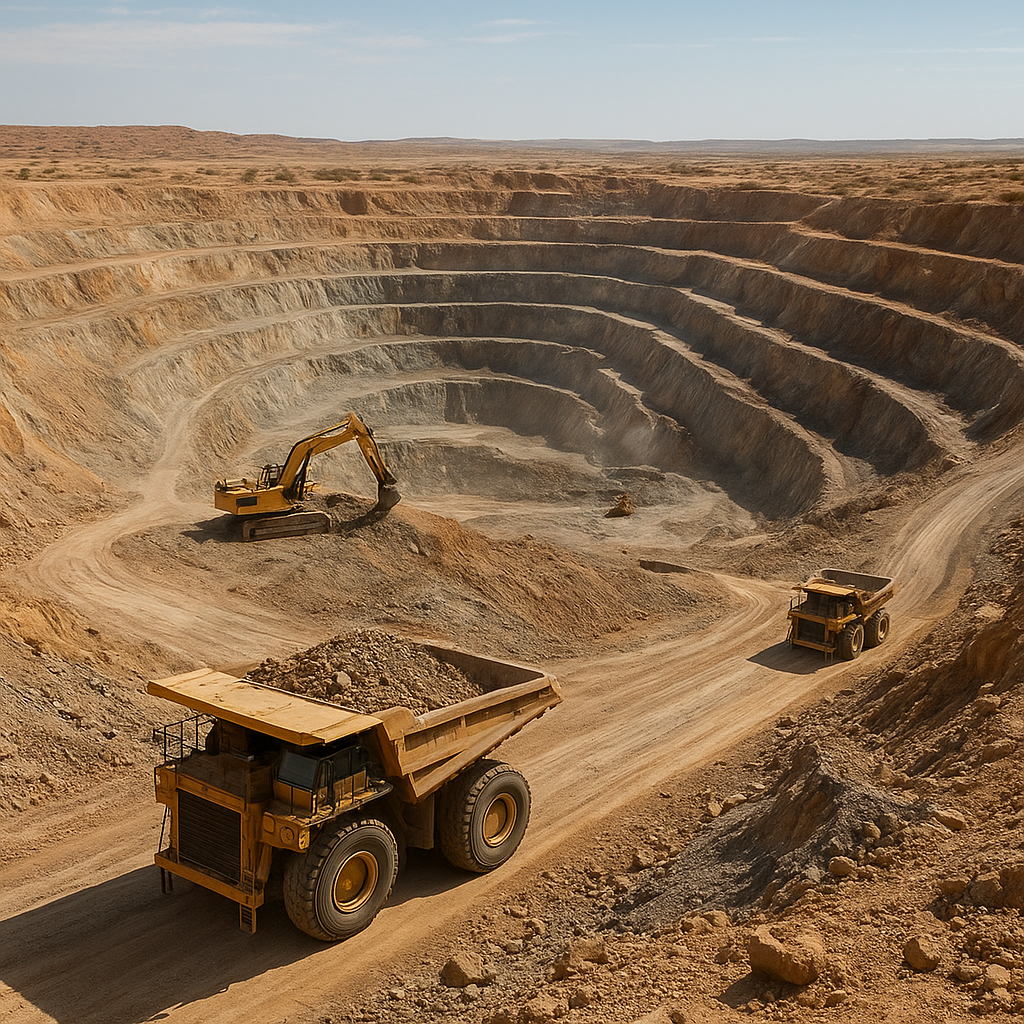
The Guelb Moghrein operation is one of Mauritania’s best-known mineral projects — a combined copper‑gold deposit that has served as an important node in the country’s growing mining sector. Located in the western part of the country, the site illustrates how a single modern mine can influence local infrastructure, national export earnings and the regional economy while also posing typical environmental and operational challenges of desert resource development. This article explores where Guelb Moghrein is, what is produced there, its economic significance to Mauritania and multiple aspects that make the project noteworthy.
Location and regional setting
Guelb Moghrein is situated in western Mauritania, in the administrative region that includes the mining town of Akjoujt. The mine lies in a semi‑arid to arid landscape on the Sahel–Sahara transition, a setting characterized by sparse vegetation, broad plains and limited surface water. Because of the remoteness of the site, logistics and access have been central considerations for development: ore and concentrate are transported to ports on the Atlantic coast for export, while supplies and personnel arrive by road or via regional air services when required.
The mine’s proximity to established mining communities has advantages for labor recruitment and local services. At the same time, its desert environment imposes constraints: the provision of reliable power, sourcing of water for processing, dust control and road maintenance all require careful planning. Guelb Moghrein’s presence has thus driven upgrades to local transport links and power arrangements in the vicinity, often done in coordination with national authorities and private contractors.
Geology and types of mineralization
The orebody at Guelb Moghrein reflects a combination of geological processes that created concentrated metal zones containing both copper and gold. Mineralization is hosted in igneous and related volcanic‑sedimentary rocks and includes both oxide and sulphide zones. This mixed character is important because it affects mining and processing choices — oxide material can sometimes be treated with simpler processes, while sulphide ore commonly requires flotation and further concentrate handling.
Key geological features
- Hydrothermal alteration halos and intrusive bodies that localized metal deposition.
- Zones of supergene enrichment near the surface that enhanced copper grades in upper profiles.
- Vertical and lateral variations in gold distribution, making selective ore handling and grade control important.
For geologists and exploration teams, deposits like Guelb Moghrein are valuable case studies in how co‑localized copper and gold mineralization form in Precambrian to younger settings in West Africa. The presence of both metals in saleable products — copper concentrate often carrying a gold credit — improves the economics of processing compared to single‑metal deposits.
Mining method and processing
Guelb Moghrein is operated predominantly as an open pit mine, a common choice for near‑surface, bulk disseminated deposits. Open‑pit mining allows economies of scale and straightforward truck‑and‑shovel operations. Over the life of the operation the pit geometry has evolved through staged expansions as ore zones were delineated and mined.
Processing chain
- Crushing and grinding to liberate copper and gold minerals from host rock.
- Flotation circuits to produce a copper concentrate; gold is often recovered as a by‑product within that concentrate or through additional processing routes.
- Concentrate dewatering, transport to port facilities and export to smelters or refineries abroad.
Modern processing plants at such operations typically include water recycling systems to limit freshwater intake and tailings facilities engineered to regional standards. Metallurgical performance, grade control and plant uptime all directly influence the throughput and revenue of the operation.
Production profile and operational history
Since coming into full production, Guelb Moghrein has contributed meaningful quantities of copper and gold to the export mix of Mauritania. Production is the outcome of coordinated mining, processing and logistics activities: the open pit supplies blended ore to the plant, the flotation circuit produces a concentrate, and the concentrate is then shipped to international customers.
Operational challenges typical of the site include maintaining steady feed grades as the pit deepens, optimizing recoveries for mixed oxide‑sulphide ores, and managing seasonal logistics constraints. The mine’s management has historically focused on sustaining steady operations through a combination of technical optimization and investment in on‑site infrastructure.
Economic significance to Mauritania
Guelb Moghrein plays multiple economic roles at both local and national levels. As a producing mine it generates export earnings, fiscal revenue and employment — all critical to a resource‑rich but otherwise sparsely populated country. The project contributes to the diversification of Mauritania’s mineral export base beyond iron ore and gold, reinforcing the country’s attractiveness to mining investors.
- Exports: Concentrates shipped from the mine add foreign exchange that supports national balance of payments.
- Fiscal revenues: Royalties, taxes and other payments flow to central and regional governments, funding public services.
- Employment and skills: The mine creates direct jobs and stimulates secondary employment in transport, services, catering and maintenance.
- Local procurement: Contracts for goods and services benefit local suppliers and can encourage the growth of small and medium enterprises.
Beyond immediate revenues, the mine acts as a catalyst for further exploration and investment in Mauritania. Demonstrated success in operating a complex copper‑gold project increases geological understanding of the region and can lead to additional discoveries, thereby sustaining long‑term economic potential.
Environmental management and social responsibility
Operating in a sensitive desert environment requires careful management of environmental footprints and social impacts. Key concerns at Guelb Moghrein include water use, dust suppression, tailings storage, biodiversity, and the social well‑being of nearby communities. Modern mining operations typically implement an array of mitigation measures:
- Water recycling and efficient process water circuits to minimize freshwater abstraction.
- Progressive rehabilitation of disturbed areas and slope stabilization to reduce erosion and visual impacts.
- Engineered tailings facilities with monitoring and seepage controls, and contingency plans for extreme events.
- Community engagement programs focusing on local employment, health, education and infrastructure improvements.
Social license to operate is essential. Mining companies at sites like Guelb Moghrein usually pursue formal agreements with local communities and authorities that address employment, procurement, community development and grievance mechanisms. These arrangements aim to ensure that benefits are shared while reducing conflict and promoting long‑term sustainability.
Interesting aspects and broader implications
Several elements of the Guelb Moghrein story make it compelling both to mining professionals and to observers interested in resource development in Africa:
1. Copper-gold pairing
The combination of significant copper and gold values within a single deposit enhances the flexibility and resilience of project economics. Gold credits can materially improve the net revenue derived from copper concentrates, while copper provides scale and steady cash flow.
2. Operating in an arid environment
Desert operations create technical and human challenges: sourcing water, protecting workers from heat, designing dust control programs and ensuring reliable power. How these are addressed is often a model for other projects in similar climates.
3. Regional development multiplier
A mine the size of Guelb Moghrein can act as a hub for economic activity, encouraging secondary investment in roads, telecommunications and services. Over time, this infrastructure can reduce the cost of future exploration and mining projects in the region.
4. Exploration upside
Many established deposits continue to reveal extensions or satellite zones through modern exploration techniques. The presence of a producing operation makes on‑site testing and expansion drilling more economical, increasing the chance of extending mine life or discovering new orebodies nearby.
5. International linkages
Guelb Moghrein feeds into global supply chains: concentrate shipments go to smelters and refineries in other countries, and international capital and technical expertise often support operations. These linkages expose the project to commodity price dynamics and global market conditions.
Operational risks and opportunities
Like all mines, Guelb Moghrein faces a set of risks — commodity price volatility, technical recovery challenges, infrastructure failures, environmental incidents and socio‑political shifts. However, these risks can be managed or converted into opportunities by investing in technology, strengthening community relations, maintaining high environmental standards and extending exploration programs.
- Technology adoption: Automation, remote monitoring and process optimization can improve safety and lower costs in remote sites.
- Value addition: Improvements in concentrate quality or downstream processing arrangements can capture more value locally or in regional hubs.
- Capacity building: Training and local hiring increase the pool of skilled labor and reduce operating risks associated with turnover.
Through careful management of these elements, projects similar to Guelb Moghrein can remain productive contributors to both corporate portfolios and national development plans for many years.
Concluding observations
Guelb Moghrein represents more than a single resource deposit: it is a case study in how mining can reshape regional economies, present engineering and environmental challenges, and create opportunities for long‑term development in resource‑rich countries. Its mixed copper‑gold character, operation in an arid landscape, and role within Mauritania’s export economy make it an instructive example for policymakers, investors and communities alike. Continued attention to technical optimization, environmental stewardship and local engagement will determine how the mine’s legacy unfolds over coming decades.

