
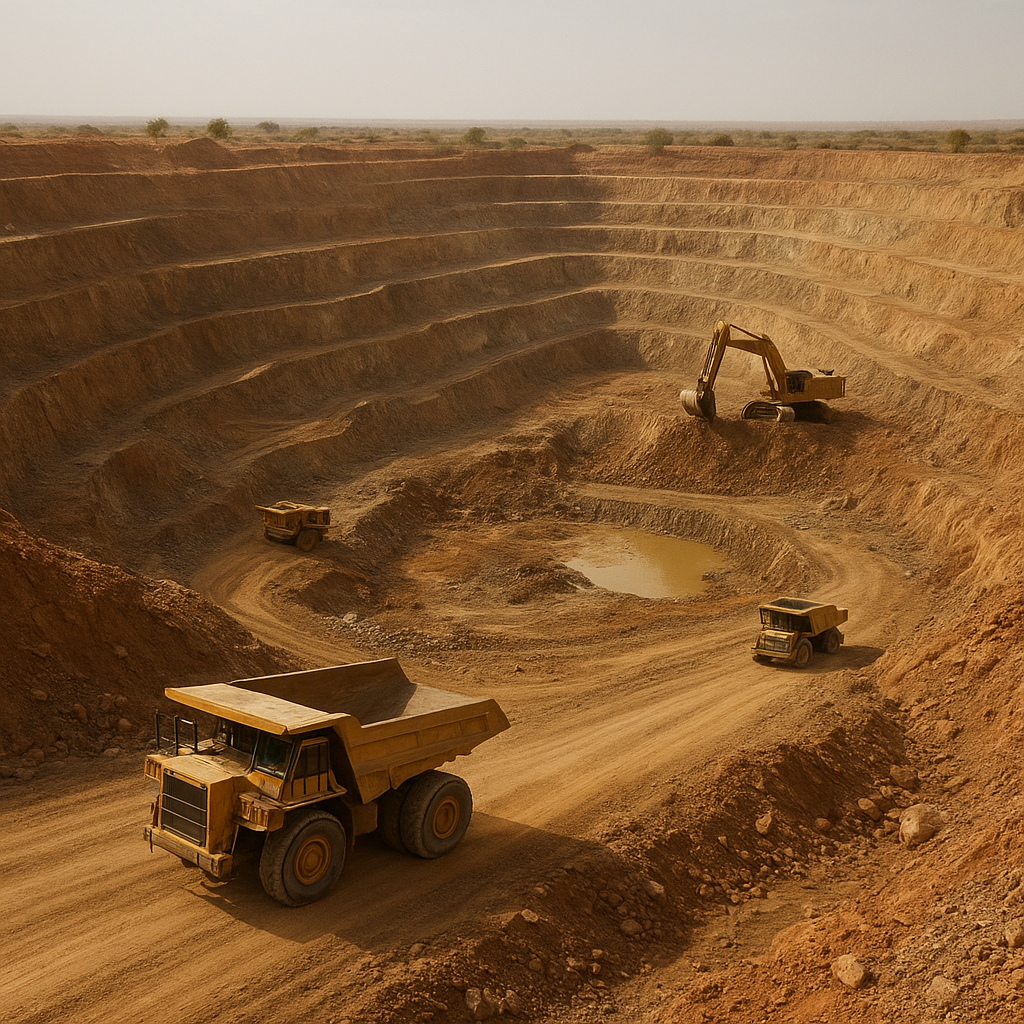
The Sadiola gold operation is one of West Africa’s best-known mining sites, combining a long operational history with a complex social and environmental footprint. Located in the western part of the country, the mine has been an important source of foreign exchange, employment and regional infrastructure development. This article examines the mine’s location and geology, its operational history and ownership, the nature of its extraction and processing, and the broader economic, social and environmental issues associated with large-scale gold production in Mali.
Location and geological setting
The Sadiola mine sits in the western reaches of Mali, within the Kayes administrative area, close to the border with Senegal. The site is accessible by road from regional hubs and has historically benefited from logistical links that were developed to serve multiple mining projects in the area. The deposit is hosted in the classic West African greenstone terranes known for their mineral endowment.
Geologically, the Sadiola deposit is part of the Birimian rocks that extend across several countries in the region. These rocks typically contain gold-bearing quartz veins and disseminated sulphide mineralization within metavolcanic and metasedimentary sequences. The typical mineralization style at Sadiola is that of a low- to medium-grade, large-tonnage deposit amenable to open-pit extraction — a model that has made many West African operations economical and attractive to international investors.
History and ownership structure
The Sadiola mine was developed in the later decades of the 20th century and entered production as part of the wave of international investment into West African gold resources. Over time it has been operated as a joint venture involving international mining companies alongside the Malian state, reflecting common contractual frameworks in the region where government participation is mandated or negotiated.
Ownership arrangements at Sadiola have evolved through corporate restructurings, farm-ins and changes in the global mining industry. The partnership model — combining international technical and financial capacity with a local sovereign stake — has influenced how revenues, taxes and community agreements were structured. These partnership dynamics have important implications for governance, transparency and the distribution of benefits from the mine.
Mining methods and processing
Sadiola has been exploited principally as an open-pit mine. Open-pit operations at Sadiola have involved large-scale earthmoving, drilling, blasting and haulage of ore and waste rock. The ore is typically crushed and milled on site and then subjected to chemical extraction processes common in the gold industry.
Processing at the Sadiola complex uses conventional techniques: crushing, grinding and carbon-in-pulp or carbon-in-leach recovery circuits are employed to extract gold from finely ground ore. These technologies allow the recovery of gold from lower-grade material by treating a large tonnage of rock. Tailings from processing are stored in engineered facilities that require ongoing monitoring and management to prevent environmental incidents.
Production, reserves and exploration
Over its operational life, Sadiola has been a major contributor to Mali’s mined gold volumes. The mine’s production profile has been shaped by reserve definition, ore grade fluctuation, commodity prices and operational decisions such as pit optimization and waste stripping. Mining operations in such deposits frequently move through multiple phases — initial open pits, expansions, cutbacks and sometimes the exploitation of lower-grade satellite zones or sulphide resources.
Exploration around and beneath the existing pits has aimed to extend the mine life by identifying additional mineralized zones. Exploration techniques have included conventional drilling, geochemical sampling and geophysical surveys. The long-term viability of operations like Sadiola depends on successful exploration results, efficient mining of lower-grade material when prices permit, and investments in processing improvements.
Economic significance
The economic role of Sadiola in Mali has been multifaceted. At a national level, gold is a leading export earner for Mali, and large mines contribute directly to government revenues through royalties, corporate taxes and dividends where the state holds an ownership stake. Foreign direct investment in mining has also supported the development of roads, power infrastructure and services that benefit wider economic activity.
Locally, the mine has provided employment opportunities — both direct jobs in mining, processing and administration, and indirect employment through contracting, transport and service industries. Skills training, procurement of local goods and community development programs associated with the mine have been important aspects of the company-community relationship.
However, the distribution of economic benefits is not automatic; it depends on contract terms, transparency in revenue management, the capacity of local institutions, and how companies implement local procurement and workforce development policies. Where governance is strong, the presence of a large mine can catalyze sustainable growth. Where governance is weak, tensions can arise over perceived unfair distribution of wealth.
Social impacts and community relations
Mining activity at Sadiola has had significant social impacts on surrounding communities. Employment and community investment programs have improved livelihoods for many households, but there have also been disruptions associated with land use change, displacement and altered access to natural resources. Negotiated compensation, resettlement programs and investment in social infrastructure such as schools and clinics have been elements of the development model for the mine.
Community relations require ongoing attention. Mines operate for decades and initial agreements can become strained if expectations change or if social needs evolve faster than company programs. Robust grievance mechanisms, transparent benefit-sharing arrangements and genuine participation of local stakeholders in decision-making are important for maintaining social license to operate.
Artisanal mining, security and interactions
In the broader region around Sadiola, artisanal and small-scale miners (ASM) are active. ASM often operates in parallel to large-scale mines, sometimes within concession boundaries, seeking to recover gold from spoil, tailings or small deposits. These activities can become a source of tension due to safety risks, environmental degradation and disputes over land access.
Large-scale operators and governments frequently have to balance enforcement of concession rights with measures to provide alternative livelihoods or integrate ASM into formalized frameworks. Conflict can arise when ASM activity is criminalized without viable alternatives, or when artisanal miners are seen as a health and safety liability. Collaborative approaches that formalize artisanal activity, offer training and provide controlled access to certain zones have been trialed in various jurisdictions with mixed results.
Environmental management and rehabilitation
The environmental footprint of a mine like Sadiola includes landscape disturbance from open pits, waste rock and tailings storage, water use and the potential for chemical contamination if processing reagents escape containment. Effective environmental management is therefore central to responsible operation.
Regulatory requirements and international best practices demand that mining companies implement comprehensive environmental impact assessments, pollution control measures, water management systems and progressive rehabilitation of disturbed areas. Rehabilitation plans address soil stabilization, revegetation with native species and the safe closure of tailings facilities. Long-term monitoring is necessary to ensure that mitigation measures remain effective after mine closure.
Community concerns often focus on water quality, dust, noise and land loss. Transparent monitoring programs, community access to environmental data and participatory rehabilitation planning help build trust. Increasingly, companies are required to set aside closure funds and to present legally binding closure plans to ensure that post-mining liabilities do not fall solely on the state.
Regulatory, fiscal and governance issues
Mali’s legal framework for mining shapes the operation of projects like Sadiola. Fiscal terms, licensing procedures, environmental regulation and local content provisions determine how revenues are shared and what obligations operators have toward communities and the environment. International investors and lenders typically expect clear and stable regulations to justify long-term investments.
Governance challenges in resource-rich countries can influence public perceptions of mining projects. Transparency initiatives, such as public reporting of payments to governments and community consultation processes, are mechanisms that help link mining revenues to broader development outcomes. The effective use of mining-derived revenues for education, health, infrastructure and economic diversification is key to turning finite mineral wealth into lasting prosperity.
Interesting facts and wider context
- Sadiola is part of a cluster of significant gold operations in western Mali, including neighboring deposits that have collectively helped make Mali one of Africa’s largest gold producers.
- The region’s geology — the Birimian greenstone belts — is shared with other prolific gold-producing countries in West Africa, underlining a continental pattern of mineral endowment.
- Large-scale mines like Sadiola often operate in remote areas, which has led operators to invest in community infrastructure such as roads, clinics and schools, creating knock-on benefits beyond the mine site.
- Modern processing methods used at Sadiola allow the economic recovery of gold from what were once considered low-grade deposits, illustrating technological shifts that have transformed the mining landscape.
- Environmental and social obligations mean that the legacy of a mine is judged as much by post-closure land use and community wellbeing as by the volume of metal produced.
Operational challenges and future prospects
Mines like Sadiola face a range of operational challenges: fluctuating gold prices, changes in input costs, the need for continuous exploration success, and increasing scrutiny on environmental and social performance. Climate considerations — such as water availability and extreme weather events — add another layer of operational risk that companies must manage.
Future prospects for the area depend on the continued discovery of economically mineable ore, improvements in processing efficiency, and a regulatory environment that supports sustainable development. Investment in local capacity-building and clear mechanisms for channeling mining revenues into productive sectors of the economy are important for long-term benefits.
Concluding observations
Sadiola’s story illustrates many of the central themes of modern resource extraction in West Africa: abundant mineral potential, significant economic opportunity, long-standing corporate-state partnerships, and complex social and environmental responsibilities. The mine’s impact has extended beyond the extraction of gold to shape local economies, infrastructure and governance debates. How the remaining resource base is managed, how closure is handled, and how communities are engaged will determine the lasting legacy of the operation.

