
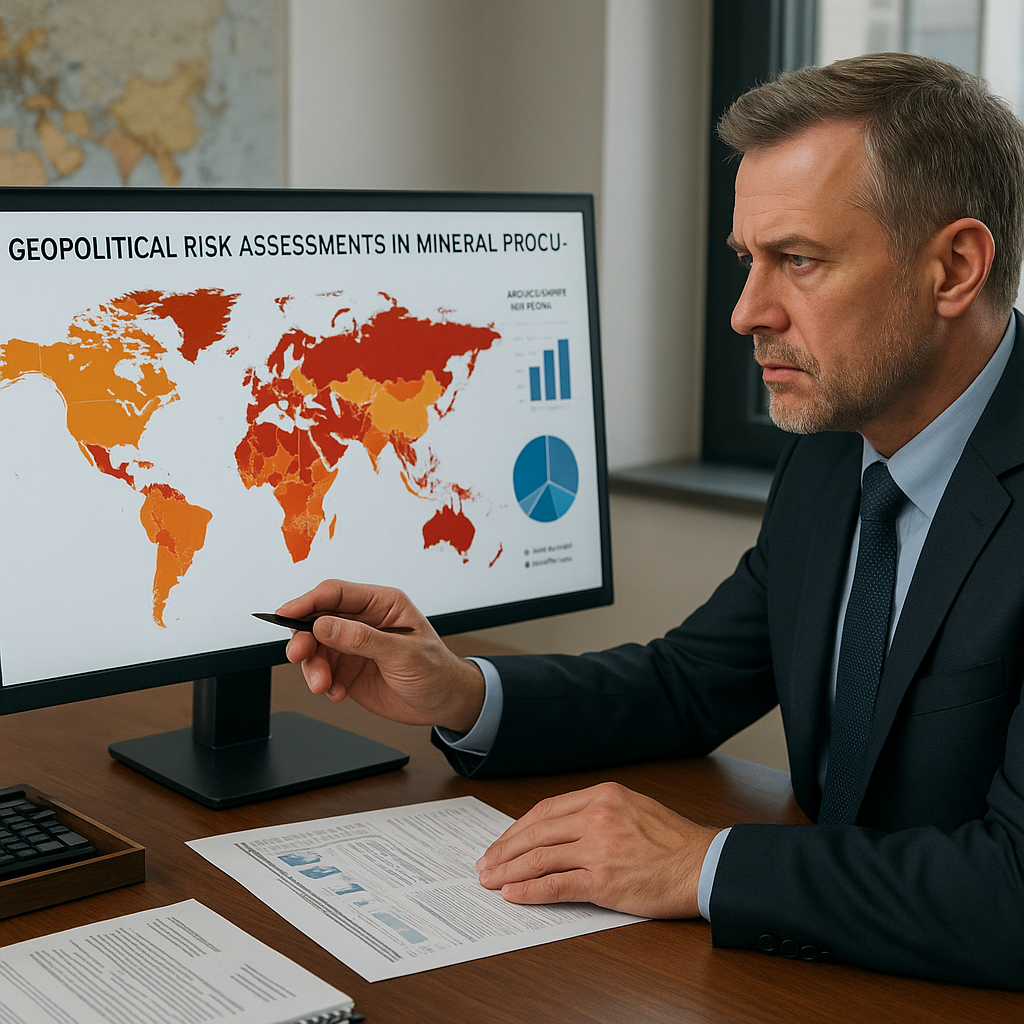
Geopolitical dynamics increasingly shape the landscape of global mineral markets. For companies and governments engaged in sourcing essential raw materials, robust assessment frameworks are no longer optional: they are strategic imperatives. This article examines the tools, methodologies and practical actions needed to integrate geopolitical risk analysis into mineral procurement processes. It highlights how an understanding of political drivers, market structure and stakeholder behavior can protect supply lines, reduce costs and support long-term sustainability goals. Special attention is paid to how procurement teams can operationalize insights through policy, contracts, technology and partnerships to build greater resilience in the face of growing uncertainty. Critical mineral security is a cross-cutting priority for industries from electronics to clean energy; procurement must therefore be forward-looking and analytically rigorous.
Understanding the geopolitical context of minerals
Mineral markets are shaped by a complex mix of geology, economics and state behavior. The extraction and movement of resources such as copper, lithium, cobalt, nickel and rare earth elements are concentrated in particular countries and regions, and those countries’ domestic politics and foreign policy choices can directly affect availability and price. A procurement team that ignores geopolitical signals risks supply interruptions, sudden cost increases and compliance breaches.
Key geopolitical drivers
- Resource nationalism and export controls: Governments may impose taxes, royalties, quotas or export bans to capture greater value or secure domestic supply.
- Sanctions and trade disputes: Diplomatic tensions can disrupt trade flows or restrict access to technology and financing.
- Conflict and instability: Armed conflict, civil unrest or weak rule of law in producing countries can halt operations or raise security costs.
- Strategic state-led industrial policy: Nations may prioritize domestic champions, subsidize strategic industries or pursue bilateral mineral diplomacy.
- Environmental and social policy shifts: Stricter environmental regulation, land rights issues and indigenous claims can delay or deny projects.
- Supply concentration and market dominance: Single-country dominance (e.g., for certain rare earths) creates leverage and vulnerability.
Interpreting these drivers requires not only macro-level analysis but also place-based intelligence. Local permitting processes, community relations and the stability of contractor relationships matter as much as headline-level trade policies.
Methodologies for geopolitical risk assessment in procurement
Effective assessment blends qualitative judgment with quantitative tools. Procurement teams should integrate traditional political risk methods with supply-chain specific analytics to produce actionable recommendations. Core components include mapping, scenario analysis, metrics and continuous monitoring.
Supply mapping and dependency analysis
- Trace material flows from mine to final component to identify chokepoints and single-source dependencies.
- Use tiered supplier mapping (Tier 1, Tier 2, etc.) to reveal upstream exposures beyond direct contracts.
- Quantify dependency through concentration metrics (Herfindahl-Hirschman Index applied to supplier shares) and endurance metrics (days of supply on hand).
Scenario and stress testing
- Construct geopolitical scenarios—e.g., export embargoes, rapid nationalization, or escalation of sanctions—and model their impacts on supply, price and timelines.
- Run stress tests that combine price shocks, logistics disruption and regulatory changes to estimate financial and operational resilience.
Indicators, data sources and monitoring
- Develop early-warning indicators: policy announcements, election outcomes, military movements, major contract renegotiations.
- Leverage diversified data: trade statistics, shipping data (AIS), news analytics, social media sentiment, and proprietary on-the-ground reporting.
- Establish dashboards that integrate these inputs for continuous forecasting and immediate alerts.
Integrating ESG and compliance
Political risk is often intertwined with environmental, social and governance (ESG) issues. Assessments should incorporate regulatory compliance, human rights risks, corruption exposure and environmental permitting hurdles. Robust due diligence reduces legal risk and supports reputational resilience.
Mitigation strategies: procurement levers and operational measures
Once risks are identified, procurement can deploy a range of tools to reduce exposure. These interventions vary by cost, lead time and strategic fit; an effective program mixes short-term tactical moves with long-term structural changes.
Portfolio and sourcing strategies
- Diversification: Source the same mineral from multiple countries and multiple suppliers to lower the probability of total supply failure.
- Long-term contracts and offtake agreements: Lock in volumes and price formulas with protective clauses for political events and force majeure.
- Strategic stockpiles: Maintain buffer inventories calibrated to the risk profile and lead times of critical inputs.
- Substitution and design flexibility: Invest in material substitution or redesign to reduce dependence on the riskiest inputs.
Commercial and financial instruments
- Political risk insurance and trade credit: Transfer some loss exposure to insurers for events like expropriation or embargoes.
- Hedging strategies: Use futures, options or contracts for difference to manage price volatility tied to geopolitical events.
- Flexible financing: Structure financing to include renegotiation mechanisms or multi-jurisdictional collateral arrangements.
Partnerships, local engagement and vertical integration
- Joint ventures with local firms can reduce political friction and build local buy-in.
- Invest in community development and transparent benefit-sharing to reduce social conflict risk.
- Consider vertical integration—owning or financing upstream assets—to secure access and exert greater operational control.
Technology and operational resilience
- Digital traceability (e.g., blockchain) to verify origin and compliance across tiers.
- Advanced analytics and AI for predictive monitoring of political events and their supply implications.
- Flexible logistics planning, including alternative routes and multi-port capability, to respond to disruptions.
Embedding geopolitical assessment into procurement processes
To be effective, geopolitical risk assessment must be institutionalized within procurement governance. Ad hoc analysis is insufficient when supply chains span multiple jurisdictions and strategic technologies.
Governance and decision rights
- Create cross-functional risk committees that include procurement, legal, compliance, finance and country/regional experts.
- Define decision thresholds for escalation—e.g., when a country risk score crosses a boundary, procurement options must be re-evaluated.
- Integrate geopolitical risk into procurement KPIs and supplier performance reviews.
Contract design and clauses
Contracts should explicitly address political events, defining triggers and remedies. Useful clauses include:
- Force majeure tailored to political risks
- Stabilization clauses and dispute resolution mechanisms
- Termination rights with graduated penalties
- Compliance warranties for sanctions, export controls and human rights
Supplier development and audits
Active supplier engagement—capacity building, compliance training and periodic audits—reduces sudden surprises. Include geopolitical performance indicators in supplier scorecards and incentivize investments that mitigate shared risks.
Case studies and practical examples
Real-world examples illustrate how geopolitical analysis changes procurement choices:
- Cobalt sourcing: Companies exposed to supply from the Democratic Republic of Congo often combine traceability, supplier audits and investments in alternative projects to mitigate risks tied to conflict and labor rights.
- Rare earth elements: Dependence on a single dominant producer has led nations to develop recycling programs, diversify mining partnerships and fund domestic processing capacity to avoid strategic bottlenecks.
- Chilean copper: Political shifts and resource taxation debates in major producing countries drive commodity projections and contracting strategies, prompting firms to hedge and to seek long-term offtakes tied to development support.
Preparing for the strategic future of mineral procurement
The energy transition and digitalization will intensify demand for certain minerals, heightening geopolitical stakes. Procurement teams must therefore anticipate structural changes in the market and align sourcing with broader national and corporate strategies. Key future-facing actions include:
- Mapping criticality across product lines and investing in alternative technologies where feasible.
- Building alliances—public-private partnerships and international coalitions—to secure diversified supply chains.
- Accelerating circular economy initiatives to reduce raw mineral demand and vulnerability.
- Embedding advanced analytics and scenario-based planning into standard procurement cycles.
In this evolving environment, procurement becomes not just a cost function but a strategic arm supporting competitive advantage. By integrating geopolitical insight, rigorous analysis and practical mitigation levers—ranging from contractual protections to community engagement—organizations can manage exposure and turn uncertainty into an area of comparative strength. Procurement leaders who treat geopolitical risk as a continuous, dynamic process will be better placed to ensure reliable access to the minerals that underpin tomorrow’s technologies and to navigate the shifting terrain of global supply.
