
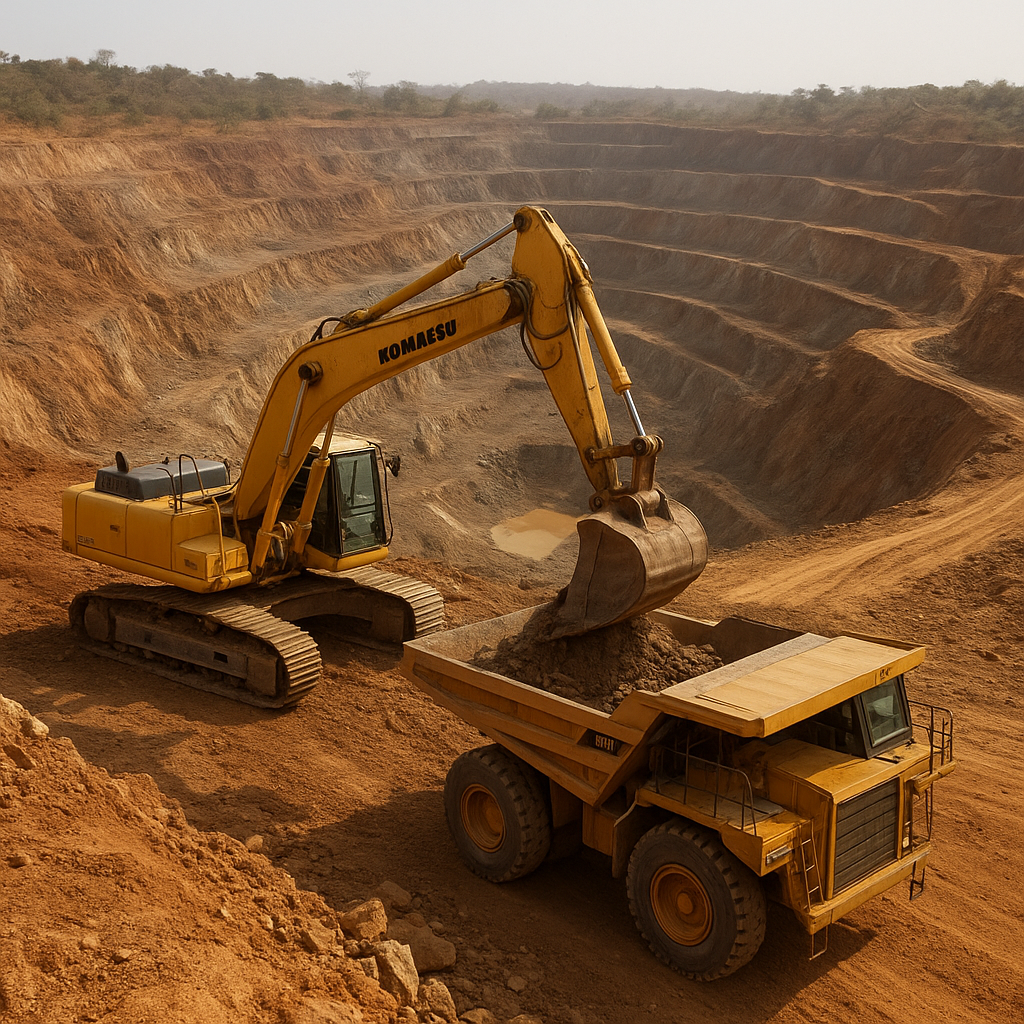
The Morila mine is one of West Africa’s better-known gold operations, located in the southern part of the country of Morila sits within the broader mineral-rich region of southern Mali. This article explores where the deposit is found, what is extracted there, its economic importance to the country and local area, and a number of technical, social and environmental aspects that make the project notable. The discussion emphasizes geology, mining and processing methods, the role of the site in national exports, the interaction with artisanal miners, and ongoing questions about closure and rehabilitation.
Where Morila is located and its geological setting
Morila is situated in southern Mali, within the gold-endowed belts of West Africa. The deposit sits in a region underlain by Birimian-age rocks — a term widely used to describe the early Proterozoic greenstone and volcano-sedimentary successions that host many of West Africa’s major gold deposits. These geological units are typically structurally complex, with repeated shearing and folding that have concentrated gold into quartz veins, sulphide lenses and disseminations.
The mine lies inland from the southern border of Mali, in a zone characterized by tropical savannah vegetation and gently rolling topography. Accessibility is via regional roads that connect the property to larger urban centers; historically, infrastructure improvements associated with the mine have included road upgrades, power and water supply works that serve both the operation and nearby communities. The climate is seasonal, with a rainy season that affects site access and water management planning.
What is extracted and how it is produced
The primary commodity produced at Morila is gold. The deposit was developed as an open-pit operation, which is the most common method for large, near-surface gold deposits in the Birimian belts. Open-pit mining at Morila involves systematic drilling, blasting and loading of ore and waste, then hauling material to a processing plant where the value-bearing portion is separated and processed.
Processing has historically relied on conventional milling and carbon-in-leach (CIL) techniques to liberate and recover gold from ore. A typical treatment flow includes crushing and grinding to reduce ore particle size, followed by cyanide leaching where gold is dissolved into solution and then adsorbed onto activated carbon. Carbon stripping and electrowinning recover the gold from the carbon, with final smelting producing dore bars for sale. Tailings are managed in engineered storage facilities, and water is recycled as much as possible to reduce fresh water demand.
Over the life of many Birimian operations, initial ore grades tend to be relatively high because mining begins in the richer near-surface zones; later stages often rely on lower-grade material, stockpile reprocessing or small satellite pits to sustain throughput. This pattern has been evident at Morila as well, prompting continued exploration around the main pit and investment in processing of lower-grade material and potential retreatment of tailings.
Economic significance and contribution
The economic footprint of Morila extends beyond the tonnage of metal produced. Gold mining in Mali is a major driver of foreign exchange earnings, and Morila has been a contributor to national exports and government revenue through royalties, corporate taxes, and payroll-related taxes. The operation has historically created both direct formal employment opportunities for skilled and unskilled workers and indirect jobs in services, logistics, and local supply chains.
Local procurement is a significant channel for economic benefit: supplies, contracting services, and small business activity around a mine site often expand as a result of sustained operations. Infrastructure improvements undertaken by mining companies — such as road rehabilitation, electrification projects, or community water supply works — may deliver public goods that persist after mining activity ceases.
- Revenue generation: Payments to the national government and local authorities in the form of royalties and taxes support public finances.
- Employment and skills: The site has required a range of technical, managerial and operational roles that help build local capacity.
- Local business development: Transport, catering, maintenance and retail services typically grow to meet the demand of the operation and its workforce.
- Foreign exchange: Export of gold contributes to balance-of-payments stability for Mali.
At the same time, reliance on gold as a major export can expose the national economy to price volatility. Declines in global gold prices or disruptions to operations for technical or security reasons can reduce national income, emphasizing the need for economic diversification and prudent fiscal management.
Social dimensions, artisanal mining and community relations
Morila’s presence has influenced the social landscape in several ways. Formal employment and procurement create opportunities, but mines can also spur an influx of migrants and changes in local land use. One persistent dynamic in many West African gold districts is the prevalence of artisanal and small-scale gold mining (ASM). Around larger mines like Morila, artisanal miners may be attracted to residual mineralization in pit walls, waste dumps, river gravels, or tailings storage facilities.
Interactions between the large-scale operation and artisanal miners are multifaceted: in some cases there are cooperative arrangements or formalized artisanal zones; in others there are tensions over land access, safety, and environmental impacts. Managing these interactions requires robust community engagement plans, economic alternatives for local populations, and efforts to formalize and improve safety and environmental practices among ASM communities.
Community investment programs typically include support for health and education, water supply, agricultural initiatives and local enterprise development. The success and perception of such programs depend on sustained engagement, transparency about payments and benefits, and mitigation of adverse impacts from the operation.
Environmental management, tailings and rehabilitation
Environmental stewardship is a major responsibility for any modern mining operation. At Morila, key environmental topics include water resource management, cyanide handling and detoxification, tailings storage facility integrity, dust and noise control, and biodiversity protection. Managing the rainy season runoff and minimizing seepage from tailings are particular concerns in this climatic setting.
Best-practice management involves engineered tailings facilities, comprehensive monitoring programs, emergency response plans, and progressive rehabilitation of disturbed land. Progressive rehabilitation — restoring areas as mining advances, rather than waiting until closure — reduces the long-term footprint and can speed the return of land to productive uses such as agriculture.
Mine closure planning is integral to project design and financial provisioning; closure plans cover removal or containment of hazardous materials, landscape shaping, soil reconstruction, re-vegetation, and long-term monitoring. Successful closure often requires collaboration between the company, government regulators and local communities to define acceptable post-mining land uses and to ensure that financial guarantees are in place to meet rehabilitation obligations.
Security, governance and operational challenges
Operating in parts of Mali brings a set of governance and security considerations that can affect mining projects. Political stability, regulatory predictability and effective law enforcement influence investment decisions, project timelines and operating costs. In regions where security incidents occur, mining companies may implement heightened security measures and contingency plans to protect staff and assets, which can add to the operational complexity and expense.
Transparent contracts, clear fiscal regimes and constructive engagement between companies and national authorities improve the sustainability of mining projects. Ensuring that mining benefits flow to local populations in a visible and accountable manner helps to build social license to operate and mitigate local grievances.
Interesting aspects and technical highlights
A number of characteristics make Morila stand out among West African gold operations:
- High initial ore grades: Like several other Birimian deposits, early production profiles often produced robust cash flow because the first pits accessed relatively high-grade ore. Rapid payback of construction costs is a notable legacy of these early stages.
- Tailings and reprocessing potential: Advances in metallurgical techniques and changing economics make retreatment of tailings and lower-grade stockpiles a recurring point of interest for operators seeking to extend project life.
- Joint-venture legacy: The mine’s development involved international partnerships that brought capital, technical expertise and global market access, while also involving national stakeholders in revenue sharing arrangements.
- Artisanal activity and its management: The persistent presence of small-scale miners around the site illustrates the complexity of managing resources that have both industrial and informal extraction activity.
- Adaptation to changing ore profiles: As near-surface resources are exhausted, technical teams focus on exploration for nearby deeper or satellite deposits and on adapting processing for lower-grade material to maintain throughput.
Exploration and future potential
Exploration around established mines is cost-advantaged because infrastructure already exists; drill programs, geophysical surveys and targeted trenching may reveal extensions of known mineralization or new deposits nearby. The potential to discover satellite orebodies or deeper feeders beneath the main pit is an ongoing driver of exploration investment. Discoveries that extend mine life can deliver substantial incremental value without the capital intensity of establishing a greenfield operation.
Technological trends
Modern mining projects employ a range of technologies to improve safety, efficiency and environmental performance. Remote sensing and drone mapping enhance geologic understanding and monitoring; automation and fleet management systems improve haulage efficiency; and improved process controls can raise recovery rates. In the environmental sphere, improved tailings technologies and cyanide destruction systems reduce long-term risks.
Concluding remarks on significance and complexity
Morila exemplifies many of the features that characterize large gold operations in West Africa: it is hosted in Birimian greenstone terrains, developed as an open-pit mine with conventional milling and leaching, and has produced meaningful economic benefits in terms of foreign exchange and local employment while also raising social and environmental challenges. The interplay between large-scale mining and artisanal activity, the need for careful rehabilitation planning and the strategic importance of gold to Mali’s economy are all central to understanding the mine’s broader significance.
Moving forward, the story of Morila will be shaped by exploration outcomes, commodity price dynamics, corporate strategies for tailings retreatment and low-grade processing, and the effectiveness of governance and community relations efforts. The site remains an instructive case for how resource wealth can be managed to deliver benefits while managing risks to people and the environment.

