Eudialyte is a striking and chemically complex mineral that captivates collectors, mineralogists, and economic geologists alike. Its vivid colors, unusual crystal chemistry and close ties to rare igneous rocks make it an object of both aesthetic admiration and scientific study. This article explores where eudialyte occurs, how it forms, its uses and economic potential, and some of the most interesting facts associated with this enigmatic mineral.
Geology and Occurrence
Eudialyte typically forms in a narrow range of igneous environments characterized by high alkalinity and low silica activity. These settings are collectively described as peralkaline magmatic systems, which include nepheline syenites, agpaitic pegmatites and other alkaline intrusive complexes. Because of the exceptional chemical conditions required for its formation, eudialyte is relatively rare and is most often found associated with other unusual minerals such as arfvedsonite, aegirine, rinkite-group minerals and various rare-earth elements-bearing phases.
Texturally, eudialyte is frequently found as anhedral to subhedral grains, aggregates or veins within coarse-grained alkaline rocks. It is not typically a major rock-forming mineral in terms of volume, but when present it can be conspicuous due to its intense coloration. The mineral commonly occurs in late-stage magmatic cavities, where volatile-rich fluids and residual melts concentrate incompatible elements—such as zirconium, niobium, and rare earths—allowing eudialyte to crystallize.
Because its formation depends on a restricted geological niche, eudialyte serves as a geological indicator of specialized magmatic processes. The presence of eudialyte-bearing rocks signals a magmatic history involving strong fractional crystallization, extreme alkali enrichment and often interaction with hydrothermal fluids. These processes concentrate economically important trace elements, which is why eudialyte-bearing complexes attract exploration interest.
Mineralogy, Chemistry and Crystal Structure
Eudialyte belongs to a group of chemically related minerals often referred to as the eudialyte group. The group is known for its remarkable compositional variability; members substitute a wide range of cations into their framework, producing numerous distinct species and local variants. The general framework is that of a complex cyclosilicate containing silicon-oxygen rings and large cavities that host a variety of cations and anions. Typical constituents include sodium, calcium, iron, manganese, zirconium and a suite of rare-earth elements.
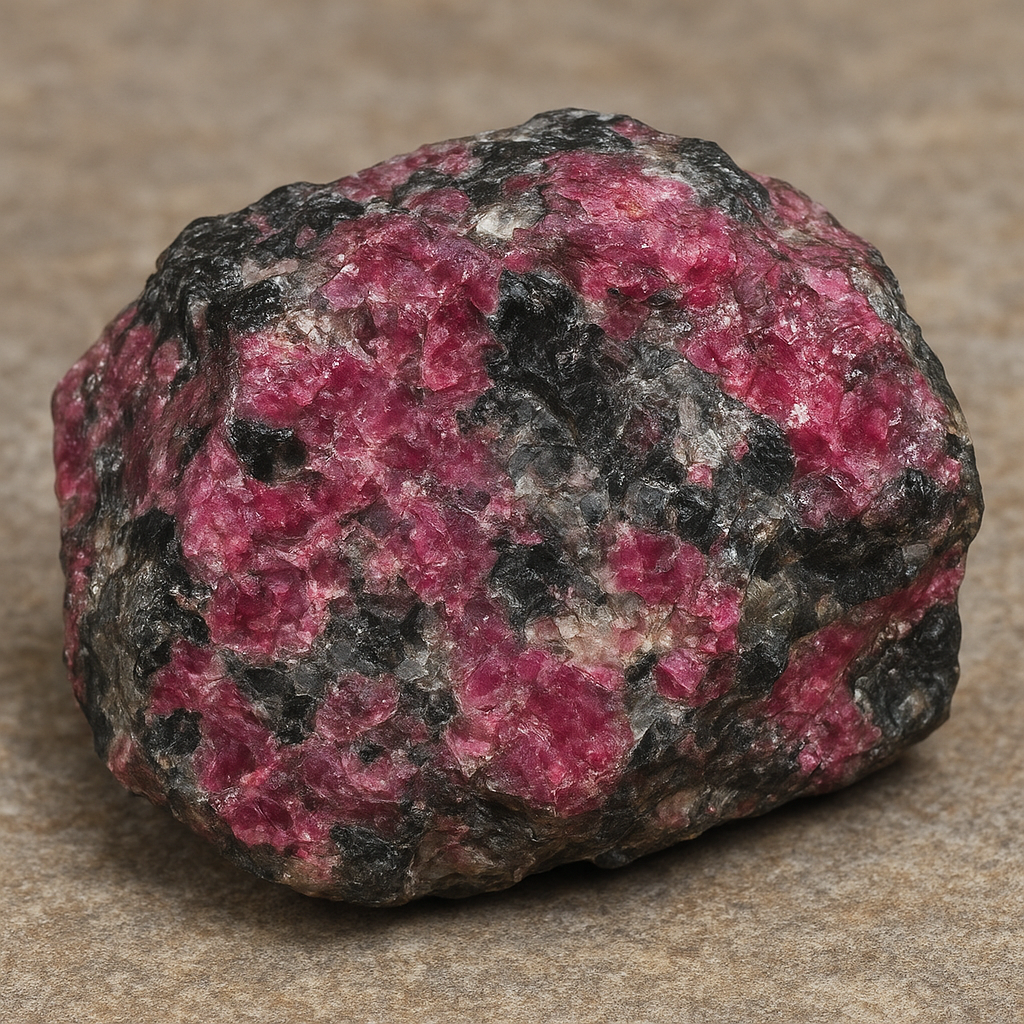
The crystal system of eudialyte is trigonal to rhombohedral, and well-formed crystals are relatively uncommon. Instead, the mineral most often appears as dense aggregates, nodules or fracture-filling masses. Colors range from deep raspberry red and pink to brown, yellow, and rarely green—color variations reflecting differences in iron, manganese and other substituting ions. Some specimens show attractive zonation or patterns that make them desirable for lapidary work.
Aside from its colorful appearance, eudialyte’s chemical complexity makes it a playground for mineralogists. New eudialyte-group species are still being described, often distinguished by the dominant occupant of a particular crystallographic site (for example, a rare-earth-dominant variety). This diversity is the product of the mineral’s structural ability to accommodate many different elements, including significant amounts of rare-earth elements (REEs) and other high-field-strength elements.
Notable Localities and Field Characteristics
Eudialyte occurs in several famous alkaline complexes around the world. Some of the most historically and scientifically important localities include:
- Lovozero, Kola Peninsula, Russia — a classic locality where spectacular red eudialyte crystals and nodules are found in nepheline syenites.
- Ilímaussaq complex, Greenland — known for its highly unusual agpaitic rocks and a diverse suite of eudialyte-group minerals rich in rare elements.
- Mont Saint-Hilaire, Quebec, Canada — a well-known mineral locality producing fine specimens appreciated by collectors.
- Other alkaline complexes and carbonatite-related environments — including sites in Scandinavia, Brazil, and select parts of eastern Europe and Africa.
In the field, eudialyte can be identified by its color and association with other alkalic minerals, but accurate identification requires chemical or X-ray analysis because many silicates can appear similar. Small samples may sometimes be mistaken for garnet or jasper when massive, so the mineralogical context and host rock are important clues.
Uses and Economic Importance
Historically, eudialyte has been valued primarily by collectors and as a lapidary material. High-quality translucent to opaque red and pink specimens are fashioned into cabochons, beads and decorative objects. As a gemstone, eudialyte is appreciated for its unusual color and rarity, but it is relatively soft and can be brittle, which limits its use in mainstream jewelry.
From an economic geology standpoint, interest in eudialyte centers on its potential as a source of zirconium and rare-earth elements. Some eudialyte-bearing complexes contain significant quantities of these elements hosted in eudialyte or associated minerals. Research and experimental mining projects have considered eudialyte as an alternative ore mineral for zirconium and REEs, especially where conventional zircon or bastnäsite resources are scarce or difficult to exploit.
However, using eudialyte as an ore presents challenges. Its variable chemistry and the dispersed nature of suitable deposits make extraction and beneficiation complex. Environmental considerations also arise, since some eudialyte-bearing rocks contain accessory uranium and thorium that can complicate processing and waste management. Consequently, while eudialyte is a promising target in certain contexts, it is not yet a widespread commercial source of zirconium or rare earths.
Scientific and Technological Interest
Eudialyte occupies a unique niche in mineralogical research because it helps scientists understand extreme magmatic conditions and element partitioning in peralkaline systems. Studies of eudialyte chemistry illuminate how high-field-strength elements and REEs partition into late-stage melts and minerals. Such insights are useful for broader questions about crustal evolution, mineral deposit formation and the behavior of critical elements in magmatic and hydrothermal systems.
From a materials science perspective, the zirconium and rare-earth content of eudialyte has attracted attention for potential technological applications. Zirconium is used in ceramics, refractories and nuclear industries, while REEs are essential for modern electronics, magnets and catalysts. Although eudialyte is not currently a major industrial feedstock, ongoing advances in mineral processing and the demand for critical elements could change its economic relevance, particularly for complexes with high concentrations of target elements.
Cultural, Collecting and Miscellaneous Aspects
Beyond its geological importance, eudialyte has a place in the world of mineral collectors and in alternative cultural practices. Collectors prize well-preserved, vividly colored specimens and those showing unusual crystal habits or intergrowths with other rare minerals. Museums and private collections often display striking eudialyte nodules and sliced specimens that reveal internal textures and color zoning.
In metaphysical and crystal-healing communities, eudialyte is sometimes associated with emotional healing, grounding and enhanced creativity. These uses are cultural and symbolic rather than scientific, but they contribute to the mineral’s popularity among certain groups.
A few other noteworthy points:
- Radioactivity: Some eudialyte specimens may exhibit low levels of radioactivity due to trace uranium or thorium. This is typically minor but worth checking for specimens intended for display or sale.
- Fluorescence: Certain samples show weak fluorescence under ultraviolet light, an attractive feature for collectors.
- Scientific discovery: New members of the eudialyte group continue to be described, reflecting the mineral’s structural flexibility and capacity to host a wide array of elements.
Practical Tips for Collectors and Prospectors
If you are collecting eudialyte or exploring for eudialyte-bearing rocks, consider the following practical points:
- Look for eudialyte in coarse-grained alkaline rocks such as nepheline syenites and related pegmatites; these are the most promising host rocks.
- Learn to recognize associated indicator minerals like aegirine, arfvedsonite and alkaline feldspathoids, which often accompany eudialyte.
- Handle specimens with care—some eudialyte is brittle and can fracture when cut or polished. Work with experienced lapidaries if you plan to turn a specimen into jewelry.
- Check for radioactivity on specimens from unfamiliar localities and follow appropriate safety guidance if levels are elevated.