Elbaite is a striking and versatile member of the tourmaline family, celebrated for its extraordinary range of colors, complex crystal growth, and significance both as a gem and as a geological recorder. Named for the island of Elba, where early specimens attracted mineralogists, elbaite is the lithium-rich endmember of the tourmaline group and has become one of the most sought-after species among collectors, jewelers, and researchers. This article examines where elbaite forms, its defining physical and optical characteristics, applications in gemology and industry, and the fascinating topics that intersect with its study.
Occurrence and Geological Setting
Elbaite typically grows in silica-rich environments where fluids enriched in elements like lithium, boron and other trace metals concentrate during the late stages of magmatic activity. The most common geological setting is within granitic pegmatites, coarse-grained igneous bodies that serve as chemical factories for rare elements and unusual mineral species. Pegmatites supply the slow cooling and abundant volatile phases necessary for well-formed, often gem-quality elbaite crystals to develop.
Major localities
- Italy — the island of Elba is the historic type locality that gave the mineral its name.
- Brazil — Minas Gerais and the Paraíba region have produced many world-class crystals and gem material, including the famous Paraíba varieties.
- Afghanistan and Pakistan — pegmatites in the Himalayan and Hindu Kush regions yield fine tourmalines prized for their color and clarity.
- Madagascar and Mozambique — important African sources of a wide color palette, including bright blues and greens.
- United States — pegmatite districts in Maine and California have yielded significant gem- and specimen-quality crystals.
Beyond pegmatites, elbaite can form in hydrothermal veins and metasomatic zones where boron-bearing fluids interact with host rocks. The distribution and chemistry of trace elements in these fluids determine the crystal’s color, zoning and trace-element signature — making elbaite specimens valuable to geologists studying the evolution of their parent magmas and fluid systems.
Physical and Optical Properties
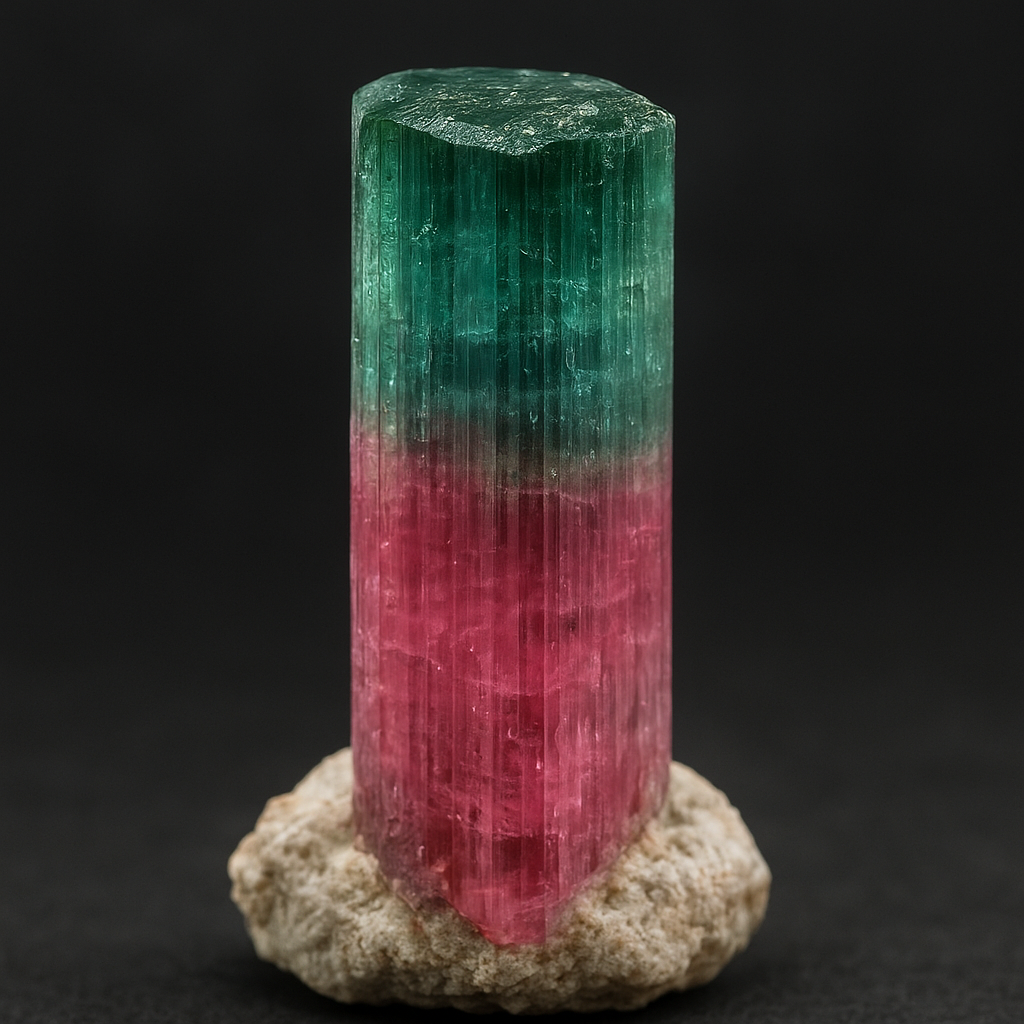
Elbaite belongs to the trigonal crystal system and commonly forms long, vertically striated prismatic crystals with triangular or rounded cross-sections. These crystals often show striking color zoning, where concentric bands of different hues develop during changing conditions of growth. Common habits include slender prisms that may be terminated by pyramidal faces; crystal sizes can range from tiny gems to spectacular museum specimens several centimeters long or larger.
Color and the cause of variety
One of the most remarkable attributes of elbaite is the breadth of its color palette — from intense blues and greens to pinks, reds, yellows, and colorless stones. Trace elements are responsible for these hues:
- Manganese (Mn) often imparts pink to red tones; highly Mn-rich elbaites are termed rubellite.
- Iron (Fe) contributes green, blue, brown and black shades.
- Copper (Cu), rare but famously present in Paraíba material, produces vivid electric blue to bluish-green colors.
- Chromium (Cr) and vanadium (V) can give intense green colors in some African localities.
Many elbaite crystals display pleochroism, a strong change of color when viewed from different directions under polarized light. This optical effect, along with high refractive indices (typically around 1.62–1.65) and a vitreous luster, contributes to the gem’s attractiveness and complicates cutting decisions for lapidaries seeking to maximize color and brilliance.
Other physical traits
On the Mohs scale elbaite ranges around 7 to 7.5, making it durable enough for everyday jewelry when set and cared for properly. The mineral frequently contains internal features — inclusions such as needles, two-phase fluid inclusions, and growth tubes — which can add to a specimen’s interest or, in some cases, lower clarity. Unique inclusion patterns are sometimes used to fingerprint provenance or to distinguish natural from treated or synthetic material.
Gemological Uses, Varieties and Treatments
As a gem, elbaite’s diversity of color and crystal habit have given rise to a number of popular trade names and varieties. Among the most celebrated are watermelon tourmaline (pink core with green rim), indicolite (blue), verdelite (green), and the aforementioned Paraíba-type copper-bearing stones. Certain cut styles — such as long baguettes, tapered emerald cuts, and deep-cut brilliants — are chosen specifically to display color zoning, pleochroism, or the vividness of Paraíba hues.
Cutting and valuation
Cutting elbaite requires attention to pleochroism and color zoning: aligning the table and pavilion to present the most desirable color face-up is a key skill. When properly cut, high-quality elbaites can rival other colored gemstones in brilliance and depth of color. Valuation depends on color intensity, clarity, size, and rarity of the color. Exceptionally vivid copper-bearing Paraíba pieces, for example, command premium prices on the international gem market.
Treatments and synthetic material
Some elbaite gems undergo treatments to enhance or modify color. Common interventions include heating and, less often, irradiation. Heating can reduce brownish tones and enhance pinks or blues depending on the chemistry; however, many collectors and connoisseurs prefer untreated stones, especially in high-value specimens. Synthetic tourmaline exists but is relatively uncommon in the market compared with other gemstones; gemological testing typically can distinguish synthetics and simulants by their inclusion patterns, growth structures, and spectroscopic signatures.
Scientific and Industrial Applications
Apart from its gemological appeal, elbaite and tourmaline-group minerals are important in scientific research. Their complex crystal chemistry and zoning patterns serve as records of fluid composition, temperature and pressure changes during pegmatite evolution. By analyzing trace elements and isotopic ratios in elbaite, geoscientists reconstruct the history of the host magmas and the sources of rare elements like lithium and boron.
Tourmaline minerals exhibit both piezoelectricity and pyroelectricity — electrical polarization generated by mechanical stress or temperature change. Historically, these properties attracted interest for use in early scientific instruments and experimental devices. Today, most industrial uses rely on engineered materials, but crushed tourmaline powder is marketed in small-scale applications such as cosmetic and hair-care products for its purported negative-ion generation; however, such commercial uses are largely qualitative and not a significant economic driver for gem-quality elbaite.
Research directions
Current research on elbaite focuses on high-resolution trace-element mapping, fluid inclusion microanalysis, and crystal growth experiments that aim to better constrain the conditions under which gem-quality crystals form. Studies of copper-bearing elbaites from Paraíba and similar deposits investigate how unusual trace-element signatures were concentrated, providing both economic exploration clues and insights into the mobility of metals in late-stage magmatic fluids.
Care, Collecting and Cultural Aspects
Collectors prize elbaite for the combination of aesthetic beauty and geological story. When assembling a collection, many enthusiasts seek well-terminated crystals with sharp striations and demonstrable zoning, while jewelers focus on cut stones that balance color and clarity. Because elbaite can display fragile terminations and internal stress, careful handling is important.
- Cleaning: Warm soapy water and a soft brush are generally safe; avoid high-temperature steam cleaning and ultrasonic methods when the stone has visible fractures or inclusions.
- Setting: Protective settings that guard the girdle and corners can increase the longevity of mounted stones, especially for rings and bracelets.
- Storage: Store independently or wrapped to prevent abrasion with other gems; long-term exposure to strong sunlight may cause some color change in certain specimens.
Beyond physical care, elbaite carries cultural and metaphysical associations in many traditions. Often promoted in gemstone lore for balancing and protective qualities, it is a favorite among crystal healers and spiritual practitioners. Whether taken seriously as therapy or appreciated as folklore, these beliefs add to the mineral’s social value and market interest.
Elbaite remains a subject where aesthetics, science and commerce intersect: from the miner who recovers a spectacular crystal in a pegmatite pocket, through the gemcutter who unlocks its beauty, to the geochemist who reads its growth history. Its vivid colors and structural complexity continue to inspire research and admiration, and new discoveries — especially of rare chemistries like copper-bearing examples — keep elbaite prominent among the world’s most fascinating gemstones.