
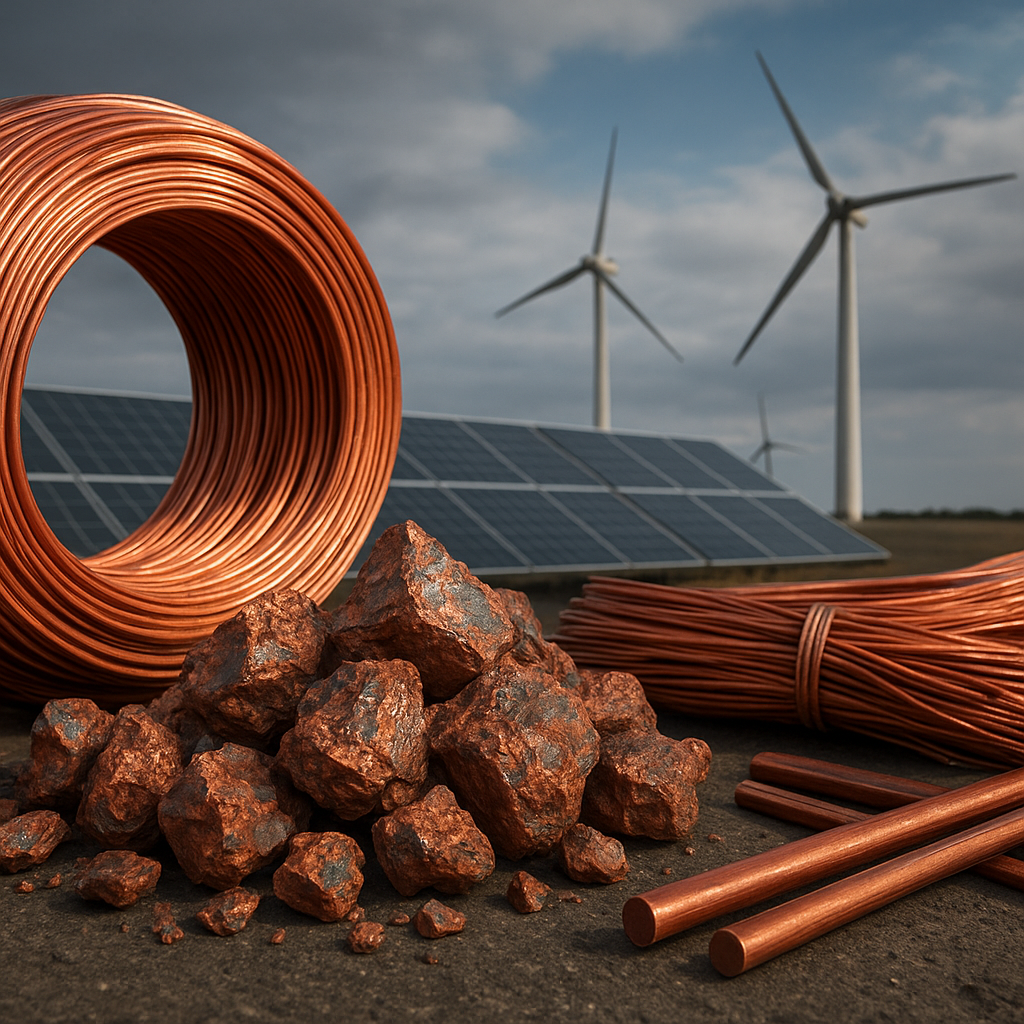
The global transition to a low-carbon economy is reshaping demand for critical materials. Among them, copper stands out as a foundational metal for modern renewable energy systems, electrification of transport, and grid expansion. Rising appetite for clean technologies combined with constrained mine output and long lead times for new projects is creating a market environment where shortages are increasingly plausible. This article examines the supply and demand dynamics behind current tensions, explores the implications for renewable deployments, and outlines practical strategies and policy responses that could reduce the risks posed by constrained copper availability.
Supply and demand dynamics driving copper pressure
Copper’s unique combination of electrical conductivity, malleability, and durability makes it difficult to fully replace in many energy applications. Demand is being driven by multiple concurrent trends: large-scale deployment of solar and wind, expansion and reinforcement of electricity transmission and distribution networks, proliferation of EVs and electric motors, and growth in energy storage systems relying on copper-intensive components. At the same time, supply is constrained by geological, technical, economic, and geopolitical factors.
Key supply-side constraints
- Ore grade decline and slower discovery rates: Easily accessible, high-grade deposits have been mined for decades, pushing producers into lower-grade ores that require more capital and energy.
- Long lead times for new mines: From discovery to production, major copper projects commonly take a decade or more due to permitting, infrastructure, and financing hurdles.
- Capital intensity and investor appetite: Mining projects compete for capital with other sectors; environmental and social governance (ESG) concerns can delay or block development.
- Processing bottlenecks: Concentrators, smelters, and refineries are complex and expensive; underinvestment in midstream capacity creates choke points even when ore is available.
- Geopolitical concentration: A handful of countries account for a large share of mine production and processing, which amplifies supply risk from political instability or export policy shifts.
Demand acceleration
Electrification pathways are copper-intensive. A single offshore wind farm, for example, may require thousands of tonnes of cable and grounding copper for interconnection and grounding. Solar farms and rooftop installations use copper in inverters, wiring, and transformers. Electrifying buses, trucks, and cars substantially increases per-vehicle copper content compared to internal combustion engine vehicles. Grid modernization — including smart grids and distributed generation — further lifts copper requirements. These cumulative demands feed into long-term structural growth for the metal.
Impacts of copper shortages on renewable energy projects
When copper supplies tighten, the effects propagate across project costs, timelines, technology choices, and strategic planning. Some impacts are immediate and transactional; others influence the pace and shape of the energy transition.
Cost inflation and project economics
Higher copper prices increase upfront capital expenditures for renewable projects. For utility-scale solar and wind, cabling, substations, and transformers are cost components that scale with copper prices. Developers operating on thin margins may defer or downscale projects, slowing deployment rates. Higher commodity costs can also shift levelized cost of energy (LCOE) forecasts, potentially altering the comparative economics between technologies.
Delays and supply-chain bottlenecks
Prolonged shortages or volatile pricing can create procurement challenges. Contractors may face long lead times for specialized copper-intensive components, leading to construction delays. In some cases, buyers may be forced to accept lower-quality substitutes or to redesign systems to use alternative materials, both of which carry performance and reliability trade-offs.
Technology substitution and design changes
Manufacturers and engineers may respond by substituting copper with other materials where feasible. Aluminum is a common alternative in overhead conductors and some cabling applications due to lower cost and lighter weight, but aluminum typically requires larger cross-sections and different joining techniques. In motors and transformers, copper-to-aluminum substitution can reduce efficiency or increase size. Where substitution is possible, it often entails complex redesigns, new standards, and additional testing, which can slow deployment and increase non-material costs.
Implications for energy security and resilience
Concentrated processing capacity and long supply chains raise the risk of localized outages or political disruptions translating into global project impacts. Grid upgrades and distributed renewable installations are intended to enhance energy security, but if the metal inputs are scarce, the rollout of resilience-enhancing infrastructure may be impaired at precisely the time it’s needed.
Strategies to mitigate copper-related risks
Risk mitigation requires action across industry, finance, and policy. Some measures are technical and operational; others are structural or market-based. A coordinated approach can reduce vulnerability while smoothing the transition to low-carbon energy systems.
Improve material efficiency and design optimization
- Design for minimal copper usage: Engineers can optimize conductor sizes, use higher-efficiency transformers, and refine motor winding techniques to lower copper content without compromising performance.
- Advanced power electronics: Innovations in power conversion can reduce reliance on bulky copper conductors by enabling higher-frequency or higher-voltage solutions that use less material.
- Modular and standardized components: Standardization reduces bespoke orders and improves procurement flexibility, allowing buyers to source from multiple suppliers.
Scale up recycling and circular economy approaches
Recycling is one of the fastest ways to increase available copper without new mining. Urban mining — recovering copper from demolished buildings, old electrical equipment, and end-of-life vehicles — can provide a meaningful secondary supply. Policies that encourage collection, standardize material recovery, and support downstream refining of secondary copper can accelerate circular flows.
Diversify supply and invest in processing capacity
Encouraging investment in midstream processing facilities reduces bottlenecks that can turn ore into usable refined copper. Diversifying geographic sources of both mined ore and refining capacity reduces geopolitical risk. Public-private partnerships and targeted incentives can help bridge the long lead-times and high upfront costs that deter private capital.
Strategic stockpiles and procurement strategies
- Strategic reserves: Governments or industry consortia might maintain buffer stocks of refined copper or key components to cushion short-term disruptions.
- Long-term contracts and hedging: Developers can secure supply and price certainty through long-term purchase agreements, tolling arrangements, or financial hedges.
- Local content and nearshoring: Procuring from regional suppliers shortens supply chains and enhances resilience, though it may increase costs in the short term.
Policy and market measures to align copper supply with clean energy goals
Policy interventions can accelerate mitigation efforts and coordinate cross-sectoral responses. Well-designed policies reduce market friction while avoiding unintended consequences that could stall investment.
Support for sustainable mining and critical minerals strategies
Governments can facilitate responsible expansion of mining where environmental and social standards are met, expedite permitting for transformational projects, and invest in exploration incentives to discover new deposits. Critical minerals strategies — identifying priority metals and creating comprehensive plans — help align industrial policy with climate objectives.
Incentives for recycling and circular manufacturing
Tax credits, subsidies, and regulatory frameworks that reward recycling infrastructure, urban mining initiatives, and product designs that prioritize disassembly can increase secondary copper flows. Extended producer responsibility schemes encourage manufacturers to recover copper at end-of-life and create closed-loop systems.
R&D and standards for substitution and efficiency
Public funding for R&D can accelerate development of low-copper alternatives where technically and economically viable, while standards bodies ensure safe and interoperable substitution practices. Investments in battery chemistries, power electronics, and conductor materials can reduce copper intensity per unit of service delivered.
Investment signals and corporate preparedness
Investors and corporate procurement teams must treat copper as a strategic input. Integrating metal risk into project appraisal, supply-chain due diligence, and financial stress testing helps firms avoid costly surprises. Transparent disclosure of material dependencies, sourcing practices, and mitigation plans becomes a competitive advantage in capital markets increasingly focused on climate risk and operational resilience.
Ultimately, the relationship between copper supply and the pace of renewable energy deployment is not purely deterministic. Policy choices, innovation, and coordinated industry action can mediate raw material constraints. But ignoring copper’s central role risks raising costs and slowing the energy transition at a moment when speed is critical. Managed proactively, the challenges around copper can become an impetus for greater material efficiency, stronger circular economies, and smarter infrastructure planning that support durable progress toward decarbonization.
