
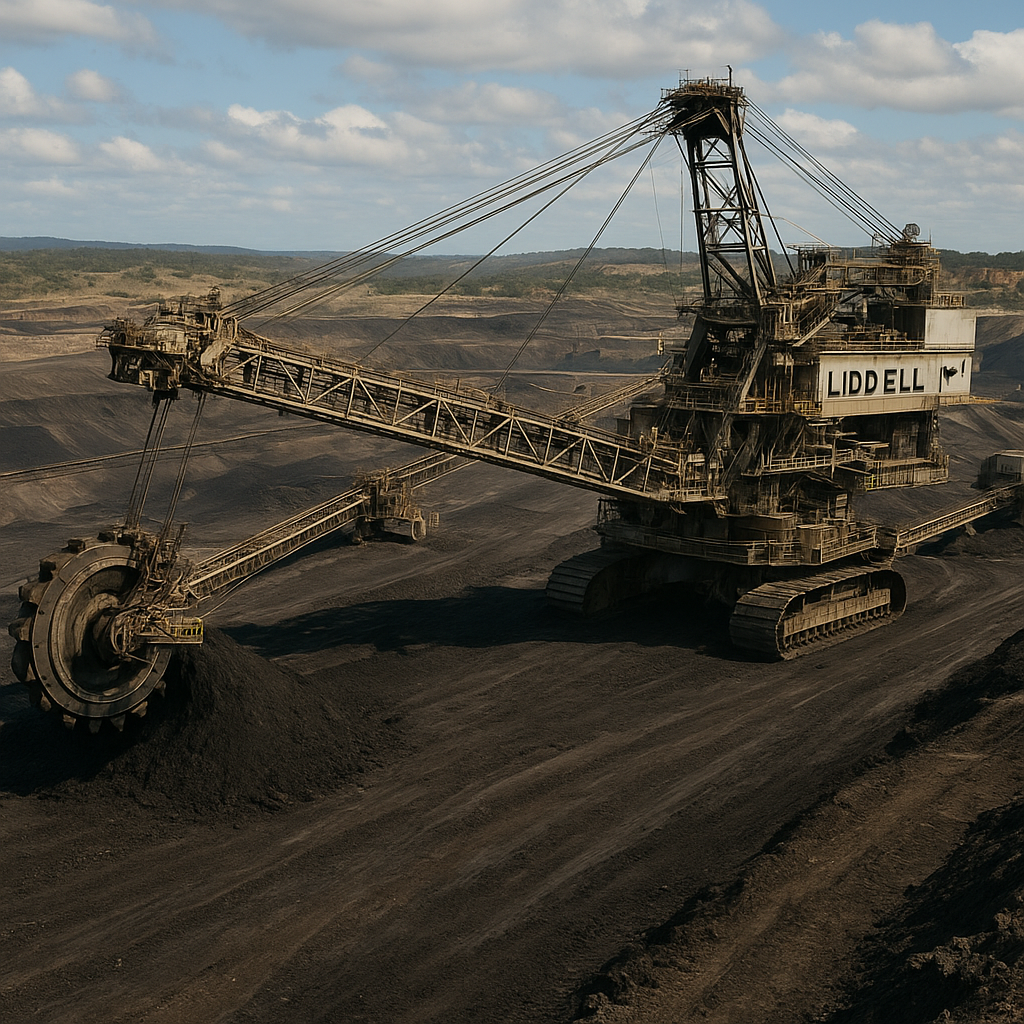
The Liddell mine, located in the heart of the Hunter Valley, is one of Australia’s long-standing coal operations. Its presence has shaped regional transport networks, supported power generation and contributed significantly to local employment for decades. The mine sits within a geologically rich system of coal seams that have supplied both domestic energy markets and export markets. This article explores where the mine is located, what is extracted there, its economic importance and a selection of intriguing facts and historical details that help explain why Liddell remains a notable name in Australia’s mining landscape.
Location and Geological Setting
The Liddell mine is situated in the Hunter Valley region of New South Wales, in the eastern part of the Australian continent. The Hunter Valley is one of the country’s most important coal-producing regions and is located roughly between the towns of Singleton and Muswellbrook, north of Sydney. The Liddell operation lies within the Sydney Basin, a geological province known for its extensive Permian-age coal measures.
Geologically, the coal seams mined around Liddell formed during the Permian period, when widespread swamps and peat-forming environments allowed large accumulations of plant material that later transformed into coal under heat and pressure. The beds in this region include a range of seam thicknesses and qualities, which makes the area suitable for different mining methods. The stratigraphy and seam continuity in the Sydney Basin have facilitated both open-cut and underground mining techniques over the decades.
What Is Extracted: Coal Types and Quality
The primary product of the Liddell mine is coal, predominantly used for power generation. The coal type is principally thermal coal, which is burned to generate electricity in coal-fired power stations. Thermal coal from the Hunter Valley typically has properties appropriate for electricity generation: calorific value, moisture, ash and sulfur contents that are compatible with many power station boiler designs.
While thermal coal is the main commodity, the Hunter Valley deposits include seams that could be used for other purposes, and quality can vary between seams and over time as different parts of the deposit are worked. Historically, coal from Liddell and nearby operations supplied the adjacent Liddell Power Station as well as other domestic power stations, and some volumes have also entered export chains bound for East Asian markets. The balance between domestic supply and export has shifted with market demand, infrastructure constraints and policy changes.
Mining Methods and Operational Features
Over its life, Liddell has employed a combination of mining techniques to extract coal efficiently and safely. The choice between underground mining and open-cut mining depends on seam depth, thickness and local topography. Underground longwall methods have been common for extracting continuous, thick seams, providing high extraction rates and reducing the surface footprint compared with large open pits. Open-cut operations, where feasible, allow for lower-cost extraction of near-surface seams but require substantial land disturbance and rehabilitation planning.
Modern mining at Liddell has relied on large-scale machinery, sophisticated ventilation and monitoring systems for underground work, and haulage and conveyor systems to move coal to preparation plants. Coal handling and preparation facilities sort and wash the product to meet customer specifications; this preprocessing improves combustion characteristics and reduces impurities before the coal is sent to rail or road transport.
Logistics and Transport
Efficient transport links are essential for any major mine. The Liddell operation benefits from proximity to established rail corridors that connect the Hunter Valley mines to ports and domestic consumers. A key export gateway is the Port of Newcastle, one of the world’s largest coal export ports, which handles vast tonnages of thermal coal destined for international markets.
For domestic supply, rail lines deliver coal to power stations across New South Wales and beyond. The logistics network also includes private rail infrastructure, roads used for heavy vehicle access, loading facilities and stockyards. Maintaining and upgrading these transport links is central to the economic viability of the mine and to the reliability of supply for customers.
Economic Significance
The economic role of the Liddell mine spans local, regional and national scales. At the local level, the mine provides direct employment for miners, engineers, equipment operators and administrative staff. Indirect employment arises through contractors, suppliers and service industries that support mining operations—everything from mechanical servicing and explosives supply to accommodation and hospitality for a mobile workforce.
Regionally, Liddell is part of an industrial cluster in the Hunter that includes multiple mines, power stations, rail operators and port terminals. This cluster supports a significant portion of New South Wales’ mining GDP and contributes to state revenues through royalties, taxes and fees. The mine’s spending on goods and services stimulates smaller businesses in nearby towns, creating a multiplier effect that helps sustain regional economies that might otherwise struggle with limited employment diversity.
At the national level, coal remains an important export commodity for Australia. Although market dynamics are changing and there is increasing attention on energy transition, thermal coal exports continue to generate foreign exchange and support trade balances for coal-producing states. Liddell’s output—while principally focused on thermal coal for electricity generation—has been part of Australia’s broader mining export portfolio and has helped maintain shipping and logistics industries connected to coal export chains.
Environmental and Social Considerations
Mining operations inevitably raise environmental and social questions. The Liddell mine, like other coal operations in the Hunter Valley, must manage challenges including land disturbance, dust, water use, surface and groundwater impacts, biodiversity offsets and greenhouse gas emissions associated with coal combustion downstream.
Regulatory frameworks in New South Wales impose conditions on mining projects designed to mitigate environmental harm. These include requirements for progressive rehabilitation of disturbed land, water management plans to protect catchments and aquifers, monitoring for air quality and noise, and measures to protect threatened species or habitats affected by mining. Public consultations, community benefit agreements and investments in local infrastructure are commonly part of the social license to operate.
The broader climate debate also centers on coal’s role in carbon emissions. Thermal coal is a major source of CO2 when burned for electricity. This has driven policy discussions, investment shifts toward renewables and commitments by some energy companies to reduce reliance on coal-fired generation over time. Mines like Liddell have faced pressure to demonstrate responsible environmental management, to engage transparently with communities and to plan for post-mining land uses that deliver enduring value.
Interesting Historical and Technical Notes
- Liddell Mine has been part of the Hunter Valley’s mining tapestry for many decades, reflecting the long history of coal extraction in the region.
- The mine’s location within the Hunter Valley places it in one of Australia’s earliest developed coal provinces, where coal fueled early industrialization and urban growth along the eastern seaboard.
- Technological advances in mining equipment and safety systems have transformed productivity and working conditions in operations like Liddell, illustrating the industry’s ongoing modernization.
- The regional rail networks built to serve coal mines have had broader economic spillovers, enabling other industries to access markets and accelerating regional development.
Another notable point is the relationship between mine sites and adjacent power generation. Historically, co-location of mines and coal-fired power stations reduced transport costs and created integrated supply chains. The dynamics of this relationship have evolved as some power stations have aged, closed or been converted to different fuel mixes, which in turn affects demand patterns for mines that supplied them.
Community and Workforce
Mining communities in the Hunter Valley have developed a distinct culture informed by mining cycles, fly-in-fly-out rostering and family ties to the land. Employment at a major operation provides skilled jobs and apprenticeships that support career development in trades, engineering and management. At the same time, communities face the social impacts of economic fluctuation, where periods of boom can be followed by downsizing or closures as reserves are exhausted or markets change.
Local businesses often depend on the mine for a portion of their revenue, which encourages collaboration between operators and community groups. Investment in community programs, educational initiatives and health services is commonly part of a mine’s corporate social responsibility efforts, aimed at ensuring that benefits extend beyond payrolls.
Regulatory Environment and Rehabilitation
Mining in New South Wales operates under a framework of state and federal regulations that govern approvals, environmental performance and post-mining rehabilitation. Operators must prepare rehabilitation plans that outline how land will be restored or repurposed after mining activity ceases. Common post-mining land uses include grazing, conservation reserves, forestry or industrial land, depending on soil, landscape and community needs.
Rehabilitation work can be extensive and expensive, involving reshaping landforms, capping and revegetation and managing water quality. Many modern operations undertake progressive rehabilitation—restoring parts of a mine while other parts remain operational—to reduce long-term liabilities and maintain community confidence that disturbed land will be returned to productive use.
Future Prospects and Transition
The future of any coal operation, including Liddell, is influenced by multiple factors: global energy demand, prices for thermal coal, domestic energy policy, environmental regulation and the pace of the global energy transition toward lower-emission sources. Operators may adapt by optimizing productivity, improving environmental performance, diversifying local economies or planning for mine closure and land repurposing.
There is growing attention on how former mine sites can be transformed. Successful transitions often combine rehabilitation, ecological restoration and community development plans that create new recreational, agricultural or conservation values for the land. Planning for these outcomes during a mine’s operational life increases the chances of a positive legacy once extraction ends.
Final Observations
Liddell has been more than a simple industrial site: it is a node in the region’s economic infrastructure, a source of employment and a focal point for discussions about energy, environment and regional development. Its coal resources, logistics connections and history place it among the notable Australian mining operations in the Hunter Valley. Understanding Liddell’s mining methods, economic role and environmental obligations provides insight into how contemporary coal mining operates within a landscape that is changing both economically and ecologically.

