
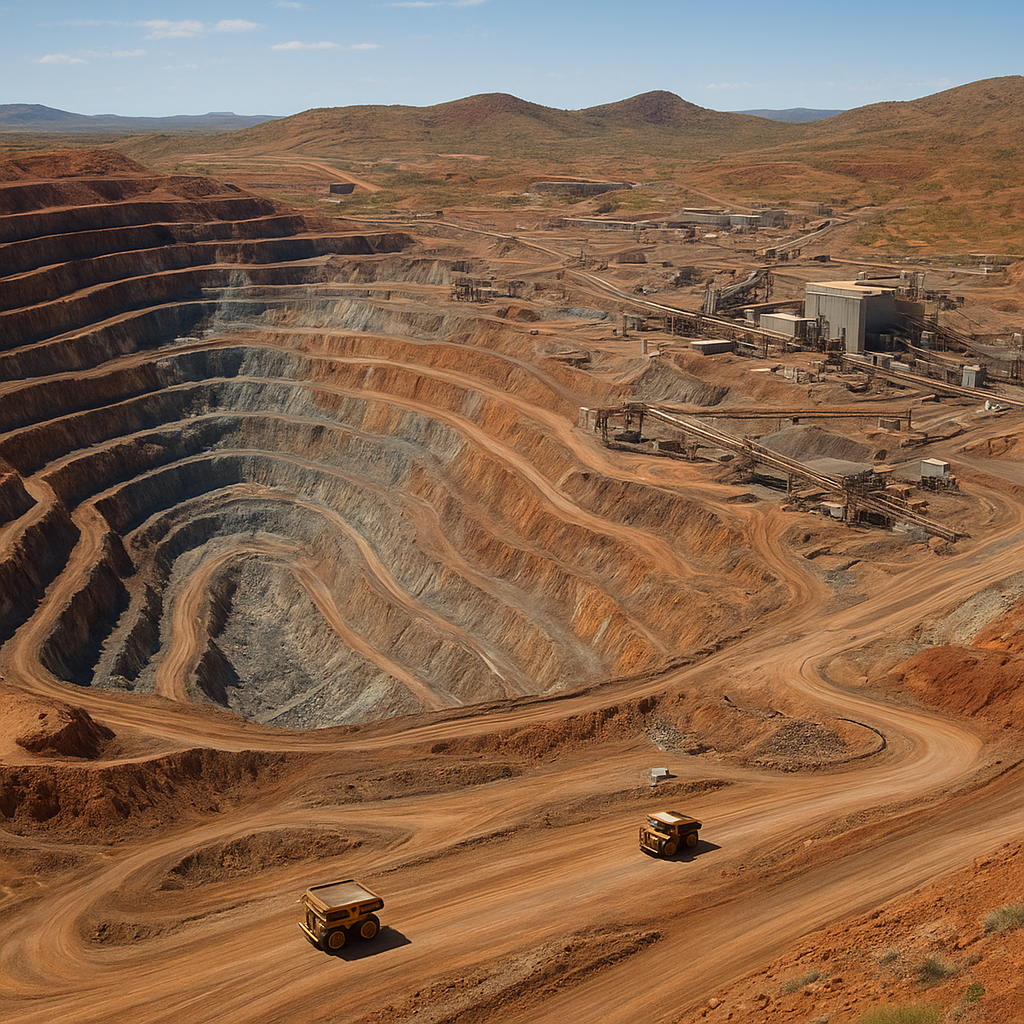
The Mount Isa mining complex in northwestern Queensland is one of the world’s great concentrated sources of base metals. For nearly a century the area around the town of Mount Isa has hosted large-scale extraction of copper, lead and zinc, creating a cluster of industrial facilities — underground mines, concentrators, smelters and refineries — that have shaped the region’s economy, infrastructure and identity. The story of Mount Isa is as much geological as it is social and technological: a tale of a massive orebody discovered in the Australian outback, developed into an integrated metallurgical complex, and sustained through cycles of commodity markets, innovation and environmental challenge.
Location and geological setting
Mount Isa lies in the heart of north-western Queensland, roughly 900–1,000 kilometres west of Townsville and 1,800 kilometres northwest of Brisbane. The settlement and industrial works sit on an uplifted plateau within the vast, sparsely populated Channel Country. The surrounding landscape of spinifex, low ranges and dry stony plains gives little hint of the rich mineralisation beneath the surface.
The mineral system at Mount Isa is a classic example of a giant volcanic-hosted massive sulfide and carbonate-hosted lead–zinc–silver system, together with significant copper zones. Multiple orebodies are stacked and contiguous, producing a polymetallic deposit that is unusually rich and extensive. The complex geology includes stratiform sulfide layers, cross-cutting veins and large replacement bodies that contain economically valuable concentrations of copper, lead, zinc, and associated precious metals such as silver and smaller amounts of gold.
The discovery of the Mount Isa deposits in the early 1920s and subsequent exploration revealed an exceptionally continuous and high-grade mineral system. That continuity allowed operators to plan long-term underground infrastructure rather than relying solely on shallow, short-lived open pits. Over the decades ongoing exploration and technical advances have continually extended the known limits of the orebodies, sustaining production far beyond early expectations.
Mining operations and products
The Mount Isa complex integrates multiple stages of mineral extraction and processing. Underground mining dominates, with a network of shafts, declines and haulage drifts that access ore at depths of several hundred metres. Mining methods have evolved from early stoping and open-cut operations to modern mechanised underground techniques, allowing safe and efficient extraction of vast ore volumes.
From ore to concentrate and metal
- Ore is brought from underground to surface and processed through grinding and flotation circuits in concentrator plants that separate sulfide minerals into distinct copper, lead and zinc concentrates.
- Some concentrates are treated on-site by smelting and refining facilities to produce refined metal products. Historically Mount Isa’s integrated metallurgical plants have produced copper cathode, lead bullion and zinc concentrates for further processing.
- The site has included smelters and refineries with complex metallurgy: electrolytic copper refining, lead refining, and zinc processing plants. These facilities convert concentrates into marketable metals or high-quality intermediates for export and domestic use.
Mount Isa’s product suite has included:
- Copper – primary metal produced as cathode or wire-grade cathode used in electrical and industrial applications.
- Lead – produced as lead bullion for use in batteries, construction and industrial alloys.
- Zinc – typically dispatched as concentrate or refined metal for galvanising, alloys and chemical uses.
- By-products – silver is commonly recovered as a valuable by-product from lead and zinc circuits; other minor metals and industrial minerals may also be extracted.
Logistics and infrastructure
Large-scale mining at Mount Isa requires substantial logistical support. Rail links connect the complex to the port of Townsville and other export terminals, enabling concentrate and refined product shipments to global markets. Regional infrastructure — roads, power transmission lines, water supply schemes and a local airport — has developed in parallel with the mine, providing services for an industrial workforce and the broader community.
Economic and social significance
The Mount Isa complex has been an economic linchpin for north-western Queensland and has contributed substantially to Australia’s resource sector earnings. Its economic significance can be considered at several levels:
- Local employment and services: The mines and associated processing plants are major employers in the region, supporting thousands of jobs directly and indirectly through contractors, suppliers and service industries. The town of Mount Isa grew around the industry and continues to rely heavily on mining-related activity for its economic base.
- State and national revenues: Royalties, taxes, and export earnings from the sale of copper, lead, zinc and associated metals contribute to Queensland’s and Australia’s fiscal position. The complex has been a steady source of commodity exports, helping to balance trade and underpin investment in public services.
- Downstream industry and skills: The presence of smelting and refining has supported local skills development in metallurgy, chemical processing and heavy engineering. These capabilities have knock-on effects for other sectors, creating a regional industrial ecosystem that extends beyond raw commodity extraction.
- Regional development and infrastructure: Investments in roads, water projects and power infrastructure tied to mining needs have benefited local communities and sometimes enabled broader regional development projects, including tourism and pastoral activity.
Ownership and corporate stewardship have evolved over time. Mount Isa was long associated with MIM Holdings before becoming part of larger corporate groups in the international resources sector. Today the operations are known under major mining companies which manage complex operational, commercial and environmental responsibilities. These corporations play a central role in ensuring continuity of mining activity and in negotiating with governments and communities on royalties, employment and social investment.
Environmental management, challenges and innovations
Mining on the scale of Mount Isa inevitably raises environmental and social management challenges. Over the decades attention has focused on air emissions, tailings management, water use, rehabilitation of disturbed land, and the health implications of historic smelting emissions on local populations.
Key environmental themes include:
- Emissions and health: Historical smelting and refining operations produced airborne emissions that led to elevated concentrations of lead and other metals in parts of the town. This prompted public health initiatives, monitoring programs and changes in processing technology to reduce stack emissions and limit community exposure.
- Tailings storage and water management: Large volumes of tailings require carefully engineered storage facilities, long-term monitoring and community engagement. Water use in arid and semi-arid regions requires sustainable planning and coordination with local stakeholders.
- Rehabilitation and legacy management: As mining progresses, reclamation of spent areas, ongoing monitoring, and remediation of legacy contamination become critical. Operators have invested in progressive rehabilitation and long-term closure planning to address post-mining land use.
- Technological innovation: To reduce environmental footprint and improve efficiency, Mount Isa operations have adopted modern dust control, emissions treatment, water recycling, and energy efficiency measures. Research into processing techniques and ore-sorting technologies has helped extend resource life while reducing waste.
Mount Isa has also been a testing ground for community-focused programs: blood-lead screening, public education campaigns, and partnerships between industry, health authorities and community groups. Regulatory frameworks and corporate responsibility programs have evolved jointly, reflecting both the scale of operations and the legitimate concerns of local residents and Indigenous communities.
History, community and interesting facts
The Mount Isa story dates back to the discovery of mineralisation in the early 1920s. From those early years a town grew rapidly to house miners and their families, along with schools, hospitals and civic institutions. The scale of the orebody and the demand for metals during the 20th century meant that Mount Isa became more than a transient mining camp; it established a long-term, multi-generational community that lives alongside industrial activity.
Some interesting aspects and milestones:
- The mine complex has been continuously developed for nearly a century, adapting through phases of mechanisation, metallurgical innovation and changing market conditions. Such longevity is rare and highlights both the size of the resource and the effectiveness of successive engineering solutions.
- Mount Isa is often described colloquially as The Isa, and the town hosts annual events that reflect its outback and mining heritage. The social fabric of the town includes a strong tradition of volunteerism, local sporting leagues, and cultural festivals that celebrate both Indigenous and settler histories.
- The operations have been associated with several technical firsts in Australian metallurgy, including approaches to smelting and refining that were developed to handle the specific chemistry of Mount Isa ores. These technical capabilities have informed processing practice in other parts of the world.
- The integration of mining, smelting and refining on one site reduces logistics and creates efficiencies, but it also concentrates environmental responsibilities. That concentration has led to a high level of local engagement around environmental monitoring and public health, making Mount Isa a reference case in community-industry relations.
Future prospects and regional importance
The future of Mount Isa mining depends on a combination of resource potential, commodity prices, technological adaptation and community licence to operate. Continued exploration has the potential to identify extensions of known orebodies and new deposits in the broader district. Technological improvements in ore processing, automation and emissions control can extend the productive life of the complex while reducing environmental impacts.
For the region, the significance of Mount Isa goes beyond immediate production volumes. The complex supports a specialised workforce, local suppliers and infrastructure that anchors the regional economy. Investment in education, training and health services linked to the mining sector strengthens local capacity and facilitates more diversified regional development in the long term.
Mount Isa remains emblematic of Australian resource industry: a combination of rich geology, engineering ambition, community resilience and evolving stewardship. As global demand for base metals continues to be driven by infrastructure, electrification and industrial processes, the Mount Isa complex is likely to retain a notable place in both national resource strategy and global supply chains.

