Brookite is a compelling and often overlooked member of the titanium-oxide family. As one of the naturally occurring forms of titanium dioxide, it occupies an intriguing position between the more familiar anatase and rutile polymorphs. Its distinct crystal chemistry, uncommon occurrence in nature, and growing importance in nanoscale science make brookite a subject of interest for mineralogists, materials scientists, and environmental technologists alike. This article explores brookite’s structure and properties, where it forms and how it is discovered, and the expanding range of applications and research directions that make it relevant today.
Crystal structure, physical and electronic properties
Atomic arrangement and symmetry
Brookite crystallizes in an orthorhombic lattice, which distinguishes it from the tetragonal lattices of the other common TiO2 forms. The atomic arrangement in brookite causes a more complex coordination environment for titanium and oxygen atoms, with a distinctive pattern of TiO6 octahedra that are slightly distorted and tilted. This structural complexity leads to characteristic crystal habits—often tabular or blade-shaped crystals, sometimes exhibiting twinning and skeletal growth.
Optical and electronic characteristics
As a form of titanium dioxide, brookite is an oxide semiconductor with a relatively wide optical bandgap. The reported bandgap of brookite typically lies between the values for anatase and rutile, commonly cited around 3.0–3.2 eV depending on measurement method, particle size, and degree of structural disorder. This energy range places brookite in the near-ultraviolet-absorbing category, which is important for photo-driven processes.
Electronically, brookite behaves as an n-type semiconductor in many synthetic forms, with intrinsic defects and oxygen vacancies affecting carrier concentration and recombination dynamics. The complex crystal symmetry also influences the effective masses of charge carriers and the mobility pathways within the crystal, which are active areas of theoretical and experimental investigation.
Crystal habit and diagnostic methods
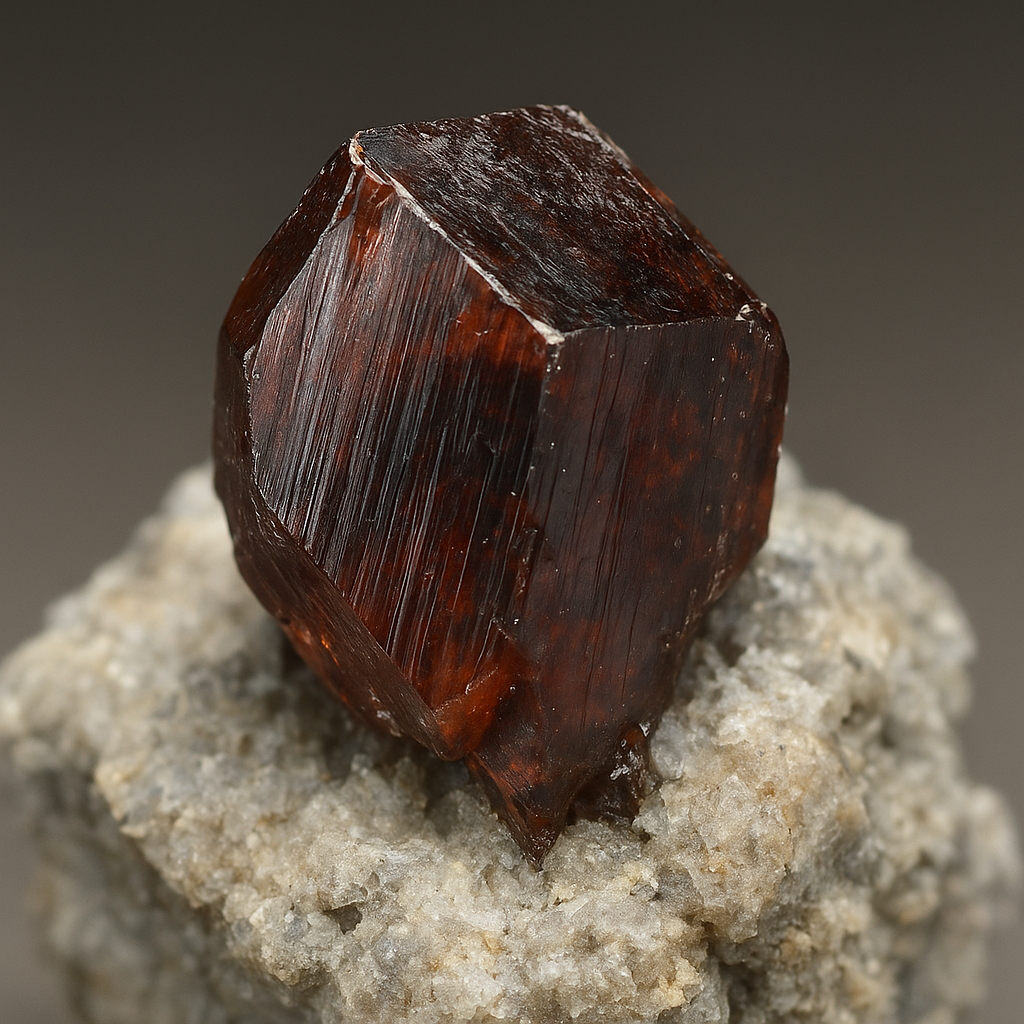
Natural brookite typically forms small, stout, prismatic or tabular crystals that can show striations and multiple twinning. It is often recognized in hand specimens by its adamantine to submetallic luster, brownish to reddish-brown color, and relatively high relief under the microscope. Identification in the laboratory is most reliably achieved using X-ray diffraction (XRD), where brookite displays a distinct set of reflections; Raman spectroscopy and electron microscopy (SEM/TEM) are also routinely used to confirm phase, morphology, and nanoscale features.
Occurrence and geological settings
Natural environments and formation processes
In the geological record, brookite is generally less common than the other TiO2 polymorphs, but it appears across a variety of environments. It can form as an accessory mineral in metamorphic rocks, in hydrothermal veins, and as a product of low-pressure contact metamorphism or alteration of primary Ti-bearing phases. Brookite also appears in placer and alluvial deposits as durable grains derived from weathering-resistant parent rocks.
Typical formation scenarios include:
- Hydrothermal precipitation at moderate temperatures where kinetics and fluid chemistry favor brookite nucleation over anatase or rutile.
- Diagenetic or low-grade metamorphic conditions where titanium mobility and local chemical environment stabilize the brookite structure.
- Secondary alteration of ilmenite or titaniferous minerals where oxidation and remobilization produce TiO2 assemblages.
Associated minerals and paragenesis
Brookite is commonly found in association with other Ti-bearing and oxide minerals, and its paragenesis often includes minerals such as ilmenite, rutile, anatase, hematite, and various silicates. In hydrothermal systems, it can coexist with quartz, chlorite, and epidote, while in metamorphic terrains it may be intergrown with garnet or mica depending on bulk chemistry and metamorphic grade.
Notable localities and collecting
Although the spatial distribution of brookite crystals is patchy, collectors and researchers can encounter it in alpine fissures, skarn deposits, and some placer concentrations. Individually well-formed crystals suitable for study or display are prized by mineral collectors because they are less common than comparable rutile or anatase specimens. In many cases, local microenvironments—such as cavities or late-stage veins—produce the small, gemmy crystals that display brookite’s characteristic luster.
Synthesis, stabilization and nanoscale engineering
Routes to synthetic brookite
Because natural brookite is relatively rare, a great deal of modern research focuses on synthetic routes that yield brookite, particularly at the nanoscale. Common laboratory methods include hydrothermal and solvothermal synthesis, sol–gel processes with controlled hydrolysis, and template-assisted growth. Key variables affecting phase outcome are pH, temperature, titanium precursor chemistry, and the presence of mineralizers or surfactants that direct nucleation.
Stabilization strategies and phase control
One challenge is that brookite is often metastable with respect to rutile (thermodynamically more stable at high temperatures) and anatase (often kinetically favored at low temperatures under certain conditions). Researchers employ strategies such as:
- Careful control of synthesis temperature and time to avoid thermal transformation.
- Doping with cations or anions that preferentially stabilize the brookite lattice.
- Using soft templates or organic surfactants to steer morphology and lower surface energy for certain facets.
- Creating core–shell or heterostructured particles that protect brookite against phase change.
These approaches permit the production of brookite in sizes and shapes optimized for specific properties and applications.
Nanoscale properties and measurement
At the nanoscale, brookite exhibits different optical and electronic behaviors from bulk crystals. Particle size, surface area, and defect populations strongly influence absorption edge, charge-carrier lifetimes, and reactivity. Techniques such as transmission electron microscopy (TEM), X-ray photoelectron spectroscopy (XPS), UV–Vis diffuse reflectance spectroscopy, and time-resolved photoluminescence are commonly applied to characterize these phenomena in synthetic brookite nanoparticles.
Applications, photocatalysis and emerging technologies
Photocatalysis and environmental remediation
Interest in brookite has grown significantly within the field of photocatalysis. While anatase and rutile traditionally dominate discussions of photocatalytic TiO2, brookite’s intermediate bandgap and unique surface facets can offer advantages in certain reactions. Pure brookite or brookite–anatase heterostructures have been shown to exhibit favorable charge separation properties, lowering electron–hole recombination and improving photocatalytic degradation of organic pollutants, dye molecules, and some persistent contaminants under UV illumination.
Researchers are exploring brookite-based materials for:
- Degradation of wastewater contaminants and pharmaceuticals.
- Antimicrobial surfaces that harness ROS (reactive oxygen species) generation under light.
- Photo-assisted oxidation processes for air-cleaning applications.
Because brookite can partner with anatase or rutile to form heterojunctions, engineered mixtures are often more effective than any single phase alone.
Energy applications: water splitting and photovoltaics
Brookite has been investigated for photoelectrochemical water splitting and related solar-energy conversion schemes. Its band-edge alignment and surface chemistry can be tuned to support hydrogen evolution reactions in conjunction with co-catalysts. While rutile and anatase still dominate commercial and laboratory efforts, brookite-based electrodes and composites are of interest where specific charge-transfer or surface-binding properties are required.
Sensors, pigments and niche uses
Though not a major industrial pigment like rutile-grade TiO2, brookite’s optical properties are relevant in specialized coatings, functional ceramics, and sensor surfaces where phase composition affects scattering or catalytic sensing response. In nanocomposite materials, brookite additions can modify optical absorption, refractive index, and surface reactivity in ways useful for tailored device functions.
Research frontiers and interdisciplinary interest
Fundamental studies and computational modeling
On the fundamental side, brookite stimulates theoretical and computational work aimed at understanding how crystal symmetry and atomic-scale distortions influence electronic band structure, defect formation energies, and surface reactivity. Density functional theory (DFT) and beyond-DFT methods are employed to predict how doping, strain, or facet exposure change properties relevant to catalysis and charge transport.
Heterojunction engineering and charge dynamics
Heterojunctions combining brookite with anatase or other semiconductors present a rich field for engineering charge dynamics. Type-II or Z-scheme-like arrangements can be devised to spatially separate reduction and oxidation sites, improving overall photocatalytic efficiency. Understanding the interfacial chemistry and the role of surface states is critical to optimizing these composite systems.
Environmental and health considerations
As synthetic brookite nanoparticles move into experimental applications, assessing environmental fate, toxicity, and life-cycle impacts becomes essential. Studies examine particle persistence, propensity to generate reactive oxygen species in biological contexts, and mechanisms for removal or immobilization in treatment systems. Responsible development of brookite-containing technologies requires integrating materials performance with environmental safety assessments.
Historical notes, mineral collecting and curiosities
Naming and discovery
Brookite was named after the British mineralogist Henry James Brooke, recognizing early work in mineral classification. Historically, its identification predates many modern analytical techniques, and its recognition as a distinct TiO2 polymorph enriched the understanding of polymorphism and phase stability in oxide minerals.
Collector interest and unique specimens
Collectors prize brookite crystals for their lustrous appearance and crystallographic forms. Fine specimens often show flattened, tabular forms with good transparency and can be attractive when associated with contrasting matrix minerals. Because brookite crystals are typically small, fine microcrystalline aggregates and polished sections are common ways to display and study the mineral.
Curiosities and surprising findings
Among the interesting aspects of brookite research are:
- The role of very small changes in synthesis chemistry in switching among the TiO2 polymorphs—an illustration of the subtle interplay between thermodynamics and kinetics.
- The way brookite-containing composites can outperform single-phase materials in certain light-driven reactions.
- Ongoing discoveries about brookite-like structures and titanium oxides with related but distinct stoichiometries and defect chemistries, showing the richness of titanium oxide chemistry beyond the textbook three phases.
Practical challenges and future directions
Scaling and manufacturing challenges
Transitioning brookite from laboratory curiosity to industrially relevant material involves challenges in scalable synthesis, phase purity control, and ensuring long-term stability under operating conditions (e.g., thermal and chemical stress). Advances in continuous-flow hydrothermal synthesis and green chemistry approaches may help address some of these obstacles.
Interdisciplinary opportunities
Brookite sits at the intersection of mineralogy, materials science, and environmental technology. Future work is likely to be collaborative, bringing together computational materials design, advanced characterization (in situ spectroscopy, ultrafast techniques), and application-driven engineering to optimize brookite-containing systems for specific technological goals—whether pollutant degradation, solar-fuel generation, or sensor devices.
Understanding brookite involves appreciating both its geological story and its potential as a functional material at the nanoscale. As methods improve for controlled synthesis and phase engineering, brookite’s unique combination of crystal symmetry, electronic structure, and surface chemistry will ensure it remains a stimulating subject for research and selective application development in the decades to come.