Brazilianite is a striking and relatively rare phosphate mineral prized for its intense yellow-green color and often slender, prismatic forms. Found primarily in granite-derived pegmatites, it occupies a curious place between serious scientific interest and the world of gem and mineral collecting. This article explores where brazilianite occurs, why it forms, what makes it valuable, how it is used, and a few fascinating details that make the mineral memorable to collectors, gem cutters, and researchers alike.
Geology and occurrence
Where brazilianite is most commonly found
Brazilianite’s best-known and most productive localities are in the state of Minas Gerais in Brazil, where classic specimens come from granite-pegmatite bodies. The mineral is also reported from a handful of other pegmatite fields worldwide, including select occurrences in Canada (notably the Bancroft area, Ontario) and isolated reports from a few other countries. However, the Brazilian pegmatites remain the type and most famous localities, yielding the finest, often museum-quality crystal specimens.
Geologic setting and formation processes
Brazilianite is a phosphate mineral that typically forms in late-stage, phosphate-rich fluids within zoned pegmatite intrusions. These fluids are highly enriched in volatile components and incompatible elements, which concentrate in the final stages of magma crystallization. Within these fluids, phosphates like brazilianite can crystallize in cavities and replace earlier phosphate minerals. The habit and size of crystals are heavily influenced by the open-space growth conditions often present in pegmatite pockets, where slow cooling and high fluid activity allow unusually large, well-formed crystals to develop.
Associated minerals
- muscovite and other mica species
- quartz (often smoky or clear)
- feldspar
- amblygonite and other phosphate minerals
- pyrite and other sulfides
These associations are typical of complex granite pegmatites, where zonation creates distinct mineral parageneses: early feldspars and quartz, intermediate micas, and late-stage phosphate-bearing pockets where brazilianite is concentrated.
Physical and chemical properties
Chemistry and crystallography
The chemical formula of brazilianite is NaAl3(PO4)2(OH)4, which places it among the aluminium-rich phosphate minerals. It crystallizes in the monoclinic system and commonly forms elongated, prismatic, or columnar crystals that can be terminated with pinacoidal faces. Its habit is often strikingly acicular to prismatic, and the best specimens display sharp, well-developed faces.
Color, transparency and optical features
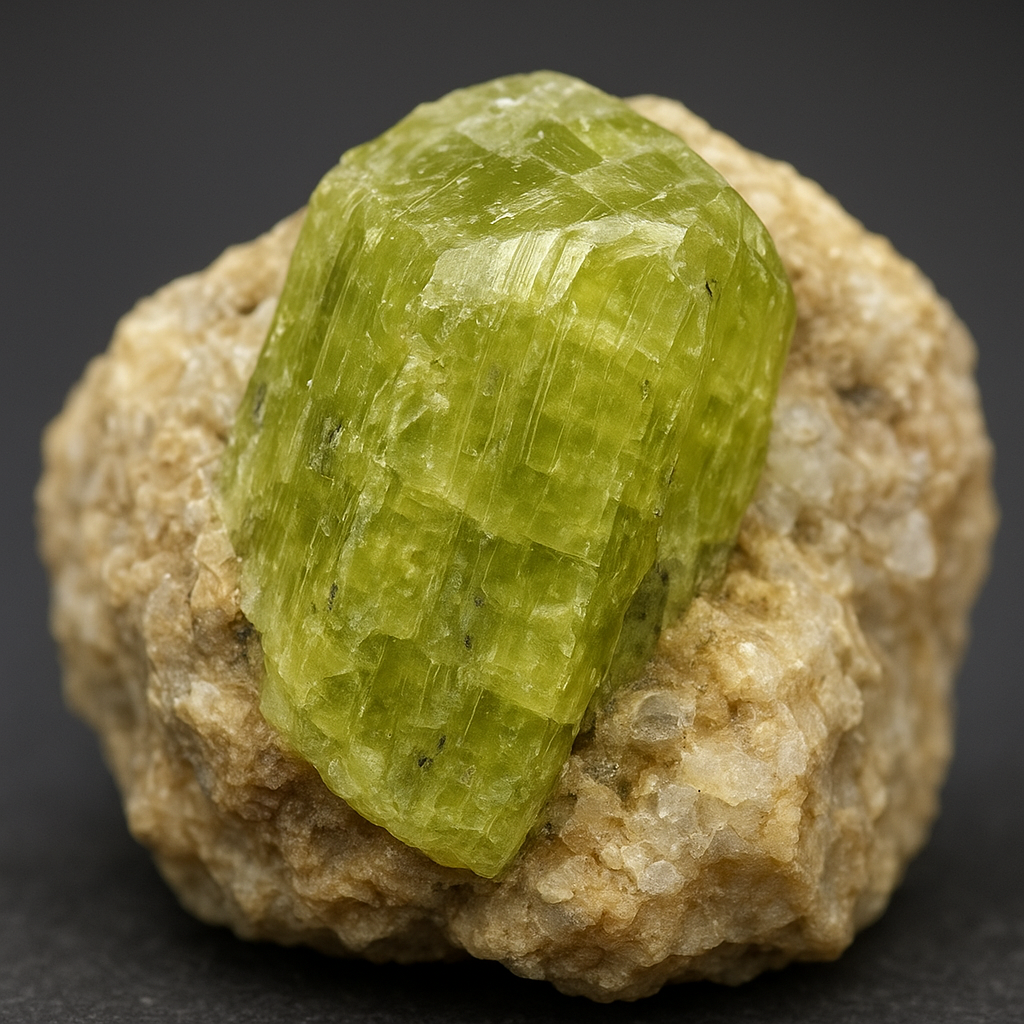
Brazilianite’s signature colors are vivid yellow through greenish-yellow to apple-green. Color intensity depends on trace chemistry and the presence of inclusions. The mineral frequently shows excellent transparency to translucent qualities, and on well-formed crystals, a bright vitreous luster enhances visual appeal. Brazilianite often exhibits strong pleochroism—different colors when viewed along different crystallographic axes—which is a diagnostic optical property for gemologists.
Hardness, density, and durability
On the Mohs scale, brazilianite has a hardness of approximately 5.5 to 6.0. Its specific gravity is moderate, typically around 2.95–3.05. The combination of modest hardness and a tendency to show distinct cleavage or parting means brazilianite is not among the most durable gems. Care must be taken in cutting, setting and wearing brazilianite jewelry. For collectors, however, these physical properties do not detract from the specimen value—in some cases they increase the desirability of intact, uncut crystals.
Microscopic and advanced properties
Under polarized light and in thin section, brazilianite shows characteristic optical behavior consistent with its monoclinic symmetry and anisotropic nature. It displays moderate birefringence and refractive indices that allow gemologists to separate it from look-alikes. Some specimens may contain inclusions—fluid pockets, minute crystals of associated minerals, or mica films—that both influence color and provide clues to the conditions of formation.
Uses, value and gemological aspects
Collector specimens and museum pieces
Brazilianite is most important as a collector mineral. Large, gemmy crystals, often associated with mica or set in matrix, command high prices at auctions and among private collectors. Some museum specimens of brazilianite are spectacularly large and transparent, prized for their color and crystal perfection. The rarity of fine specimens from classic Brazilian localities has helped create a strong market niche.
Gem use and cutting considerations
Faceted brazilianite gemstones exist and are admired for their intense, saturated color. Yet, cutting brazilianite presents challenges:
- its cleavage and tendency to fracture require expert lapidary skills;
- heat sensitivity and potential for fading or damage under strong light/heat during cutting or setting must be considered;
- its intermediate hardness means faceted stones can be scratched more easily than harder gems like corundum.
Because of these issues, brazilianite is most often cut into larger display gems, collectors’ pieces, or protective-cabochon settings rather than everyday wear rings. When used in jewelry, precautions—protective bezel settings, cautious wear, and periodic inspection—are recommended.
Industrial and scientific uses
Brazilianite has no major industrial role due to its scarcity and the availability of more common phosphate minerals for industrial purposes. Scientifically, however, brazilianite is valued in mineralogical and petrogenetic studies as an indicator of late-stage pegmatitic processes. Researchers investigate its formation to better understand the behavior of phosphates, volatiles, and incompatible elements during the final stages of granite and pegmatite evolution.
Collecting, cutting and care
Tips for collectors
Collectors seek out brazilianite for specific qualities: color saturation, crystal transparency, size, and association with attractive matrix minerals such as mica. When evaluating specimens, consider:
- color uniformity and intensity;
- presence and visibility of damage, chips or cleavage planes;
- quality of crystal faces and terminations;
- attractive mineral associations and provenance (documentation of locality).
Authenticity and provenance documentation can greatly enhance value, particularly for specimens from classic localities in Brazil.
Guidance for gem cutters
Experienced lapidaries working with brazilianite recommend slow, careful cutting using gentle laps and cooling to reduce thermal shock. Many cutters prefer cabochons or shallow faceting to minimize stress on cleavage planes. Avoiding excessive heat, using proper lubrication, and anticipating cleavage direction can reduce waste and produce attractive finished gems.
Cleaning and maintenance
Because of its cleavage and intermediate hardness, brazilianite should be cleaned with mild soap and warm water using a soft brush. Ultrasonic cleaners or steam cleaning are not advised for valuable specimens or finished gems that may contain internal stresses or healed fractures. Store brazilianite items separately to prevent scratches from harder minerals or metals.
Historical, cultural and metaphysical notes
Discovery and naming
Named for its country of origin, brazilianite was first recognized and named after notable finds in Brazilian pegmatites. The mineral’s association with the gem and mineral trade in the mid-20th century established it as a collector favorite, and subsequent discoveries in other localities extended scientific and hobbyist interest.
Confusion with other gems
Because of its yellow-green color, brazilianite is sometimes mistaken for peridot, chrysoberyl, or even certain forms of tourmaline. However, its combination of optical and physical properties—visible pleochroism, specific refractive indices, and cleavage behavior—helps gemologists identify it reliably.
Metaphysical and metaphoric interest
Within crystal-enthusiast communities, brazilianite is often attributed with properties related to clarity, mental focus, and emotional uplift. While these claims are not scientifically substantiated, they do contribute to brazilianite’s popularity among some collectors and metaphysical practitioners. Such uses are cultural and personal rather than material applications of the mineral.
Interesting facts and notable specimens
Outstanding crystal sizes and aesthetics
Some of the most celebrated brazilianite specimens are elongated prisms reaching many centimeters in length. In certain pegmatite pockets, brazilianite grew in association with flat sheets of mica, resulting in dramatic, display-ready specimens where the transparent yellow-green crystals appear to float above or within shimmering muscovite layers.
Museum highlights and famous pieces
Museums and private collections that focus on crystallography and pegmatite minerals often exhibit brazilianite for its combination of color and form. These pieces show the exceptional late-stage growth conditions of pegmatites and are used in educational displays about mineral formation and crystallography.
Research directions and open questions
What scientists are still investigating
Although brazilianite’s basic chemistry and crystallography are well understood, researchers continue to explore details of its paragenesis and the fluid chemistry that concentrates aluminum- and sodium-rich phosphates in pegmatite pockets. Topics of ongoing study include:
- trace-element substitutions that influence color and pleochroism;
- fluid inclusion studies to reconstruct temperature and pressure conditions during growth;
- the role of volatiles and late-stage hydrothermal processes in producing large crystals.
Potential new localities
Because brazilianite forms in very specific geochemical environments, the discovery of new localities usually depends on finding pegmatites with comparable late-stage phosphate enrichment. Exploration guided by geochemical understanding of phosphate behavior in fractionating granitic systems may eventually reveal additional occurrences, but high-quality gemmy crystals like those from Brazil remain uncommon.
Practical summary for enthusiasts
For mineral collectors, gem cutters and curious observers, brazilianite is an object of multifaceted appeal. It combines a distinctive color and aesthetic with interesting geological origins within pegmatite systems. Its modest durability limits everyday jewelry use but increases the value of uncut and museum-grade crystals. Scientifically, it serves as a window into late-stage magmatic and hydrothermal processes that create the most spectacular specimens in pegmatite mineralogy.
Whether admired as a faceted stone, a museum specimen, or a curiosity from the depths of a pegmatite pocket, brazilianite remains one of the more evocative phosphate minerals—both a geological marker and a collector’s treasure.