
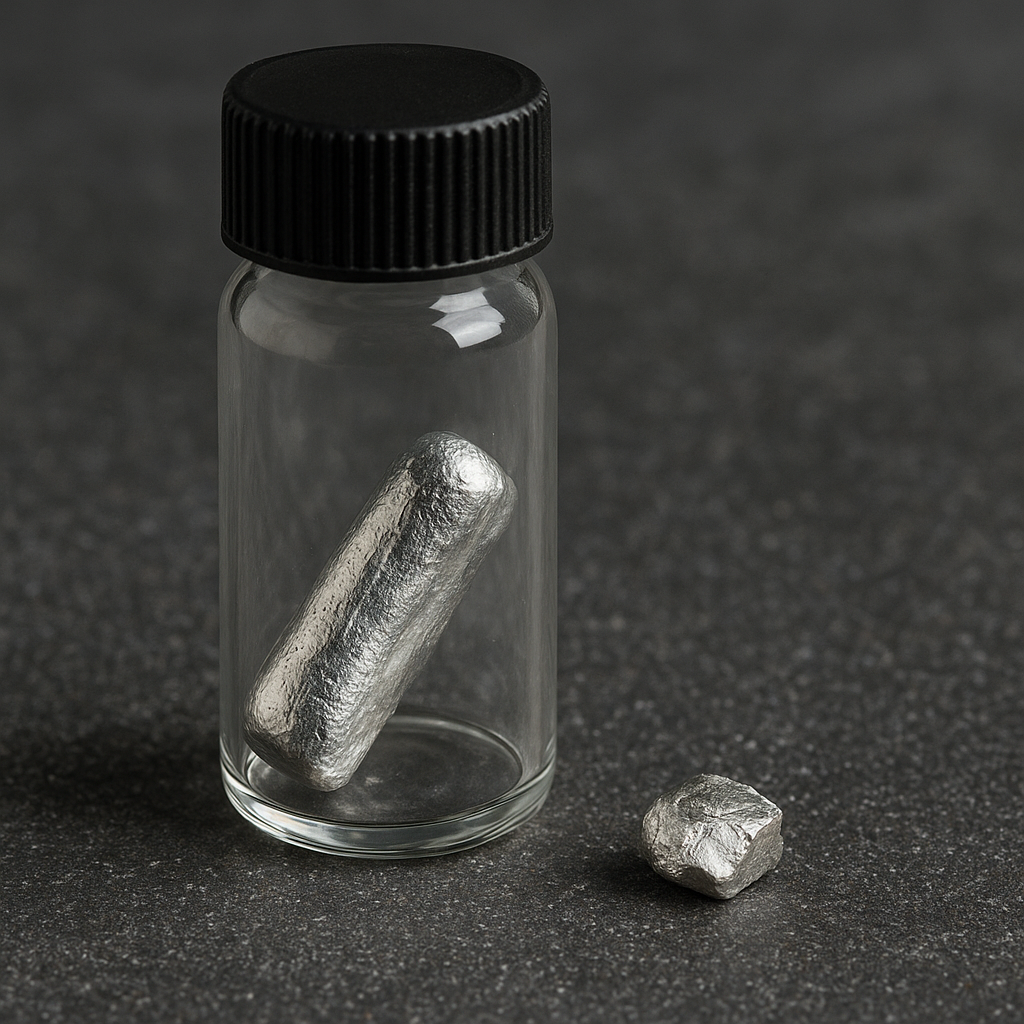
Cesium is one of the most intriguing elements on the periodic table: soft, highly reactive, and central to technologies that measure time and manipulate the quantum states of atoms. Its chemistry and isotopes link geology, industry, medicine and cutting-edge physics. This article explores where cesium is found, how it is obtained, the many ways humans use it, and a selection of especially interesting scientific and historical facts that illuminate why cesium matters beyond its modest place in the table of elements.
Physical and chemical characteristics
Cesium (chemical symbol Cs) is an alkali metal with atomic number 55. It has a lustrous, silvery-gold appearance and is so soft that it can be cut with a knife. One striking physical property is its low melting point of about 28.5 °C, which means it can melt on a hot day to form a corrosive liquid metal. Cesium’s outer electron configuration is 6s1, which gives it the characteristic reactivity of the alkali metals: it loses its single valence electron easily and forms +1 cations.
Several properties contribute to cesium’s uniqueness in both practical and scientific contexts. It has among the lowest first ionization energies of the naturally occurring elements, making it highly electropositive. It displays strong spectral lines in the blue region of the visible spectrum—indeed its name derives from the Latin caesius, meaning “sky-blue,” in reference to those spectral lines, which helped early spectroscopists identify it.
Natural cesium is dominated by a single stable isotope, Cs-133, which underlies its role in timekeeping. However, a number of radioactive isotopes such as Cs-137 exist, and these play major roles in medicine, industry and environmental science.
Where cesium occurs and how it is extracted
Cesium is relatively rare in the Earth’s crust but is concentrated enough in a few minerals to be economically extracted. The principal ore is pollucite (CsAlSi2O6), a cesium-bearing aluminosilicate that is mined where pegmatite deposits are rich in rare elements. Major historical and current sources include deposits in Canada (Bernic Lake/Tanco), Zimbabwe (Bikita), and certain pegmatite fields in Brazil and Namibia.
In nature, cesium is typically associated with potassium and rubidium; it tends to concentrate in late-stage hydrothermal fluids and in the residual products of magma fractionation. Because cesium behaves chemically like potassium, geochemical processes that concentrate potassium may also enrich cesium.
Extraction of cesium metal normally begins with mining and beneficiation of pollucite or other cesium-bearing minerals. Chemical processing yields cesium salts—most commonly cesium chloride or cesium sulfate—followed by reduction (for example with sodium metal) to produce metallic cesium under controlled, inert-atmosphere conditions. Because metallic cesium reacts violently with air and water, it is stored under inert oil or contained in sealed ampoules.
Major applications of cesium
Timekeeping, navigation and fundamental physics
Cesium’s role in precision timekeeping is arguably its most famous application. The definition of the SI second is based on the frequency of the hyperfine transition of the ground state of Cs-133 atoms. Atomic cesium clocks—especially cesium fountain clocks—measure this transition with extraordinary precision, providing primary frequency standards for international timekeeping. These clocks are essential for global navigation satellite systems (GNSS), telecommunications, and tests of fundamental physical laws.
Beyond classical precision timing, cesium atoms are widely used in experiments in quantum physics. Cold-atom techniques using cesium—laser cooling, Bose-Einstein condensation and atom interferometry—allow researchers to explore quantum many-body physics, perform precision measurements of fundamental constants, and develop ultra-sensitive sensors such as atomic gravimeters and magnetometers.
Nuclear technology, medicine and radiological uses
Radioactive isotopes of cesium are important in both beneficial and problematic contexts. Cs-137 is produced in significant quantities during nuclear fission and is a major component of radioactive fallout from reactor accidents. It emits penetrating gamma radiation via the short-lived daughter Ba-137m and has a half-life of about 30 years, which makes it both hazardous and useful in long-lived radiological applications.
- Medical and industrial irradiators: sealed Cs-137 sources are used for sterilizing medical equipment and for gamma irradiation in industrial settings.
- Brachytherapy: certain isotopes such as Cs-131 have found niche uses in brachytherapy (internal radiation therapy), for example in prostate cancer, because of their specific half-lives and radiation emission properties.
- Environmental tracer: Cs-137 is widely used as a tracer for studying soil erosion, sediment movement and ecological pathways due to its release history (from atmospheric nuclear tests and accidents) and detectability.
Because cesium isotopes can cause long-term contamination, management, monitoring and remediation are significant concerns in nuclear safety and environmental protection.
Industrial chemistry and drilling fluids
Cesium compounds have specialized industrial uses. One of the most commercially significant applications is cesium formate, used as a heavy, water-soluble drilling fluid in the oil and gas industry. Cesium formate brines provide high density while remaining non-corrosive and biodegradable under certain formulations—allowing safer drilling in high-pressure wells and in sensitive environments where traditional chloride brines would be problematic.
Cesium salts also influence the optical and electrical properties of glasses and ceramics. Because cesium ions are large and polarizable, small additions can modify refractive indices and other properties in specialty optical materials.
Electronics, photocathodes and magnetometry
Cesium has long been used to enhance the performance of photoemissive surfaces and vacuum-tube technologies. Cesium-coated cathodes lower work function and improve electron emission, which was valuable in early radios, photomultiplier tubes, and image intensifiers. Modern photodetectors and vacuum electronics still exploit cesium compounds in certain niche devices.
Cesium vapor magnetometers use the magnetic-sensitive transitions of cesium atoms to detect minute magnetic fields with high sensitivity, making them useful in geophysical surveys, archaeology and fundamental physics experiments looking for tiny magnetic anomalies.
Materials science and emerging technologies
Recent advances in materials science incorporate cesium into novel functional materials. For example, cesium-based perovskites (such as CsPbI3 and mixed-cation variants) have been investigated for use in next-generation solar cells and light-emitting devices. Incorporating cesium can stabilize perovskite structures and improve thermal and environmental stability—one route toward making perovskite photovoltaics more commercially viable.
In cutting-edge research, cesium atoms are also used as components of quantum simulators and processors. Their atomic structure and the ability to tune interatomic interactions make cesium attractive for experiments that aim to simulate complex quantum systems.
Environmental fate, health and safety
Chemical and radiological properties dictate how cesium behaves in the environment and how it should be handled. Metallic cesium reacts violently with water and must be stored under kerosene or in sealed containers under inert gas. Contact with air or water is dangerous, producing caustic cesium hydroxide and hydrogen gas that can ignite.
Radioactive cesium isotopes raise long-term environmental and public-health issues. After atmospheric releases, Cs-137 is deposited on soils and vegetation and is taken up by crops and animals. Because cesium ions chemically resemble potassium, biological uptake can be significant; however, it is also influenced by soil composition, especially clay content and potassium levels. Remediation strategies include removal of contaminated topsoil, addition of potassium fertilizers to reduce plant uptake, and administration of sequestrants such as Prussian blue (ferric hexacyanoferrate), which binds cesium in the gut and reduces biological absorption.
International efforts to manage cesium contamination after nuclear accidents—most notably Chernobyl (1986) and Fukushima (2011)—have provided extensive practical experience in monitoring, land management and food safety interventions. The relatively long half-life of Cs-137 means that affected areas may require management for decades.
Historical notes and interesting facts
Cesium was discovered spectroscopically by Robert Bunsen and Gustav Kirchhoff in 1860. They identified bright blue lines in the spectrum of mineral water residues, which indicated the presence of a previously unknown element. The discovery story reflects the power of spectroscopy to reveal atomic identities long before chemical isolation was straightforward.
Because of its visible spectral signature, cesium played an early role in the development of analytic spectroscopy. Its distinctive lines also make cesium useful in calibration lamps for spectroscopic instruments.
Cesium’s connection to the definition of the second is an example of how a single atomic property can influence global infrastructure. The hyperfine transition frequency of Cs-133 provides a reproducible physical standard that underpins precision timing across the world. Even when newer clock technologies such as optical lattice clocks show potential to surpass cesium in stability, cesium clocks remain the legal basis for the SI second and a cornerstone of practical timekeeping.
Another less-expected fact: cesium atoms have been cooled to form Bose-Einstein condensates, and their scattering behavior can be finely tuned using magnetic Feshbach resonances. That tunability makes cesium a versatile tool for experiments probing quantum phases, superfluidity and few-body quantum effects.
Research frontiers and future prospects
Several research directions promise to keep cesium scientifically and technologically relevant. Optical atomic clocks based on other atoms or ions have achieved remarkable precision, but cesium-based microwave clocks and cesium fountains remain key references; efforts to link cesium clocks with optical clocks and to improve cesium clock technologies continue.
In quantum information science, cesium’s atomic structure is exploited for quantum simulation and sensing. Development of portable atomic sensors—gravimeters, accelerometers and magnetometers—often uses cesium or rubidium atoms as the sensing medium. Enhancements in laser-cooling, vacuum packaging, and microfabrication could bring cesium-based quantum sensors into broader field use.
Materials science applications, notably in perovskite photovoltaics and in specialty optical glasses, may grow if stability and manufacturing challenges are overcome. The oil and gas industry’s use of cesium formate shows how a single niche application can sustain demand for a relatively rare element; future shifts in energy practice or new industrial uses could change the economics of cesium supply.
From a societal perspective, managing the legacy of radioactive cesium remains important. Improved remediation methods, better models of ecological transfer, and more effective public communication about risks are ongoing needs wherever cesium isotopes have contaminated environments.
Final observations
Cesium combines simple chemical behavior with complex and far-reaching applications. It links 19th-century spectroscopy to 21st-century quantum technologies, and its isotopes bridge useful medical and industrial roles with significant challenges in radiological safety. Whether in the precise tick of an atomic clock, the heavy brine that stabilizes a drilling operation, or the sensitive magnetometer mapping subtle variations in Earth’s field, cesium plays diverse roles that reflect both the beauty and responsibility inherent in harnessing the elements.