Benitoite is a small but spectacular mineral known for its vivid blue color and striking optical behavior. Discovered in the early 20th century and forever tied to a single California locality, it has become a symbol of geological rarity and gemological fascination. This article explores the mineral’s chemistry and physical properties, the geological environments in which it forms, its uses in jewelry and science, and a selection of intriguing facts that underscore why benitoite continues to command attention from collectors and researchers alike.
Mineralogy and physical properties
At the heart of benitoite’s appeal is its unusual chemical composition and crystal habit. The mineral’s formula, BaTiSi3O9, incorporates barium and titanium in a silicate framework, producing a dense structure that crystallizes in the trigonal system. Individual crystals are typically well-formed, often showing sharp, triangular cross-sections and a distinctive prismatic habit. Despite usually occurring as small specimens, benitoite crystals can display exceptional clarity and brilliance when free of inclusions.
Optical characteristics
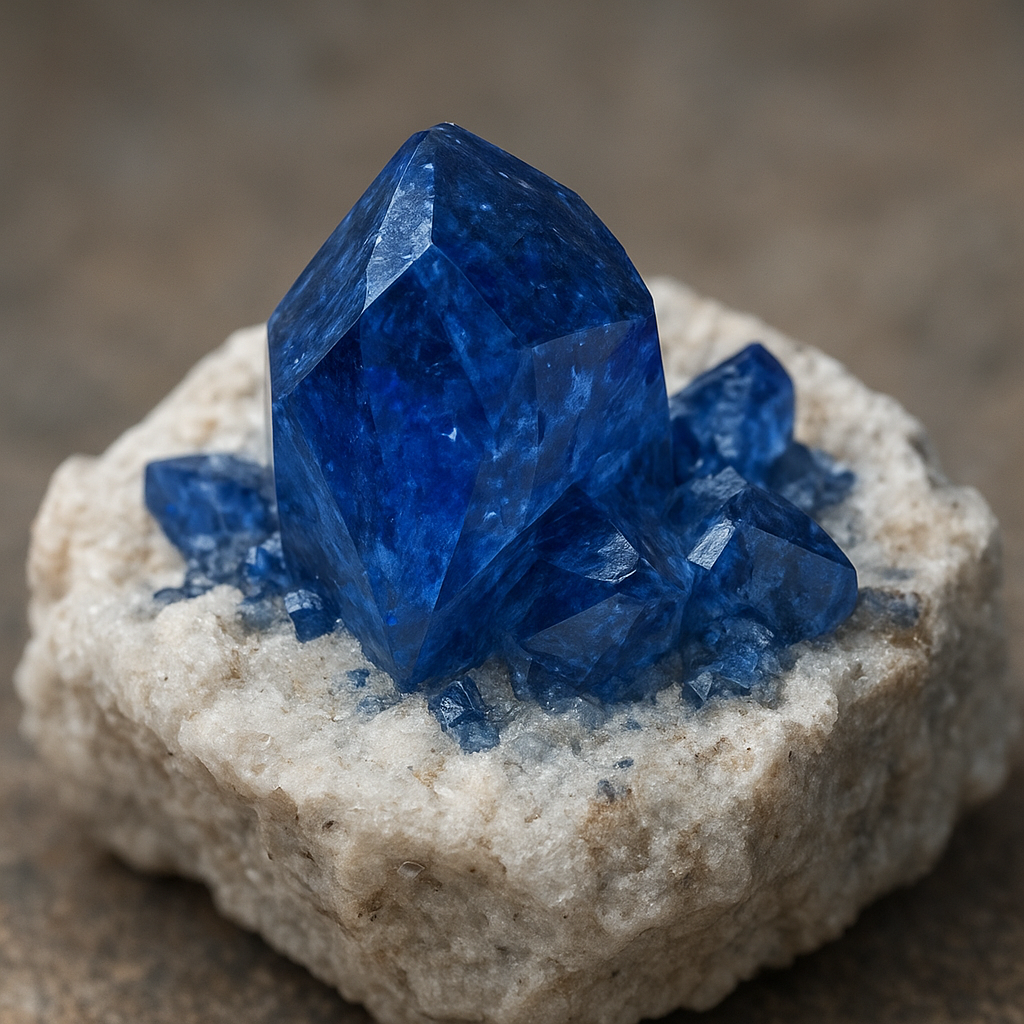
- Color: Most prized benitoite is an electric to deep sky-blue, sometimes with violet undertones. Paler and colorless crystals also occur but are much less valued.
- Fluorescence: One of benitoite’s most dramatic features is its intense blue fluorescence under shortwave ultraviolet light. Even specimens that appear muted in daylight can glow vividly under UV, making them visually memorable.
- Luster and brilliance: When faceted, benitoite can display a lively luster and attractive dispersion, contributing to its desirability as a gem.
Physical and mechanical data
Benitoite is relatively hard for a gem mineral, with a hardness around 6 to 6.5 on the Mohs scale. Its specific gravity is moderately high due to the presence of barium, making it noticeably heavier than many common silicate gems. The mineral has distinct cleavage and can be brittle, so cutting and setting require skill to avoid breakage along structural planes. Because of its crystal habit and cleavage, cutters often favor preserving weight by choosing cuts that minimize contact with cleavage directions.
Where benitoite is found and the geology behind it
The name benitoite comes from San Benito County in central California, the location of its type occurrence. The discovery in 1907 put this mineral on the map: it was identified in a hydrothermally altered serpentinite and natrolite-rich environment within the drainage basin associated with New Idria. For nearly a century, that locality — commonly referred to as the Benitoite Gem Mine — has been the primary source of gem-quality benitoite.
Geological setting and associated minerals
Benitoite forms in a very specific environment: low-silica, barium-rich hydrothermal veins cutting serpentinite and related ultramafic rocks. The mineral is commonly associated with natrolite, neptunite, and joaquinite, among others. Notably, specimens of deep-blue benitoite perched on black, bladed crystals of neptunite and white natrolite matrices have become iconic images in mineral collecting. These mineral associations hint at a complex hydrothermal history with fluids rich in barium and titanium reacting with the host rock under restricted conditions.
Other occurrences
Although San Benito County remains the most famous and productive source, small amounts of benitoite have been reported from a few other localities worldwide. Most of these occurrences produce material that is either microscopic, altered, or lacking in the intense blue color prized by gem cutters. The overall rarity of gem-quality material makes any additional occurrence noteworthy, but none have matched the historical significance and gem potential of the California deposits.
Gemological uses and market considerations
Benitoite’s role as a gemstone is shaped by rarity, color, and optical performance. When cut well, high-quality pieces exhibit brilliant blue hues and strong internal sparkle. Their combination of color and fluorescence can create a unique visual effect not commonly seen in other gems.
Cutting and jewelry
- Cutting challenges: Benitoite’s cleavage and relatively modest hardness require experienced lapidaries. Cuts are chosen to maximize color and minimize exposure of cleavage faces.
- Popular cuts: Oval, cushion, and modified brilliant cuts are common for faceted benitoite; the aim is to balance face-up size with retention of vivid color.
- Setting and care: Because of its brittleness and cleavage, benitoite is often set in protective settings — bezel mounts or halo styles that shield the stone. Wearers should avoid rough activity and aggressive cleaning methods; ultrasonic cleaners and steam cleaning are generally discouraged.
Rarity and value
The market value of benitoite is driven by size, clarity, and the richness of its blue color. Fine stones over one carat are uncommon, and stones above two carats in attractive color are extremely rare and command high prices. Collectors prize fine crystals on matrix, especially specimens showing the classic combination of blue benitoite on black neptunite and white natrolite. For this reason, the specimen market often values certain benitoite pieces more highly than cut gems of similar weight.
Scientific interest, luminescence, and synthetic considerations
Beyond its gemological allure, benitoite has attracted scientific attention for several reasons. Its unusual combination of elements and its luminescent behavior make it an interesting subject for mineralogical and materials research.
Crystal chemistry and formation processes
Researchers study benitoite to better understand barium and titanium behavior in low-silica hydrothermal systems. The mineral’s structure — a titanium-containing silicate framework stabilized by large barium ions — is unusual and offers insight into how rare-element minerals can concentrate under specific geochemical conditions. Detailed studies of trace elements and zonation patterns in benitoite crystals can reveal cooling histories and fluid evolution at the host locality.
Luminescence mechanisms and applications
The intense shortwave UV fluorescence of benitoite has prompted spectroscopic studies to identify the mechanisms behind its glow. While the presence of titanium and the crystal field environment are central to its luminescence, the exact activators and quenchers can vary with trace impurities and defects. Although benitoite itself is far too rare for industrial luminescent applications, understanding its behavior contributes to the broader knowledge of luminescent materials and can inspire synthetic analogs with tailored optical properties.
Collecting benitoite: ethics, access, and museum specimens
Collecting benitoite carries both practical and ethical considerations. The main historic mine in San Benito County has been closed to casual collecting at various times, and access has been restricted to protect both public safety and the remaining resource. High-quality specimens that emerged during the early 20th century and mid-century mining eras are now dispersed across private collections and museums.
Museum highlights and public exhibits
Major mineral museums and certain state institutions display classic benitoite specimens, often emphasizing the striking blue-on-black aesthetic. Because of their appeal, such specimens are used to educate the public about mineral formation, local geology, and the importance of preserving rare mineral sites. Benitoite was officially designated the state gem of California, which has helped raise awareness and encourage preservation-minded policies for the region’s mineral heritage.
Ethical buying and provenance
Because of benitoite’s rarity, buyers should inquire about provenance and legal collecting status when acquiring significant specimens. Well-documented provenance enhances scientific and collector value, while specimens lacking legal or ethical provenance can present problems for museums and conscientious collectors.
Interesting facts and cultural resonance
Benitoite’s story merges geology, aesthetics, and local history in compelling ways. A few highlights show why it has captured imaginations beyond the mineralogical community:
- Rarity elevates benitoite from a regional curiosity to an internationally sought-after gem and specimen.
- Its ultraviolet-induced glow made benitoite a favorite for cabinet displays using shortwave UV lamps, producing a near-magical transformation when lights are switched on.
- Classic specimen pairings — blue benitoite on black neptunite and white natrolite — are visually iconic and among the most photographed combinations in mineral collecting.
- Benitoite’s discovery coincided with a period of active mineral exploration in the American West, and it remains a symbol of the unexpected treasures geology can produce in specific locales.
Practical advice for owners and enthusiasts
Owning benitoite, whether as a faceted gem or a specimen, comes with responsibilities to maintain and protect it. Here are practical tips for care and appreciation:
- Handle with care: avoid dropping or knocking benitoite against hard surfaces due to cleavage and brittleness.
- Store separately: keep benitoite pieces wrapped or in individual compartments to prevent abrasion from harder gems.
- Cleaning: use gentle soap, warm water, and a soft brush; avoid ultrasonic and steam cleaners unless a gemologist advises otherwise.
- Display responsibly: if using UV lighting for display, ensure exposure is limited to protect the specimen and nearby materials, and follow safety precautions for UV devices.
Where to learn more and see benitoite
For those who want to see benitoite in person or deepen their knowledge, several avenues exist. Mineral museums with strong American collections frequently exhibit benitoite specimens; mineral shows often feature dealers who specialize in rare California material; and academic papers provide detailed treatments of benitoite’s crystal chemistry and spectroscopy. Joining mineral clubs or online communities focused on rare gems can also provide access to up-to-date information about discoveries, auctions, and exhibitions.
Final note: Whether admired in a gloved-hand museum display, set into a protective and carefully crafted piece of jewelry, or examined under shortwave UV to reveal its inner brilliance, benitoite continues to reward close attention with a blend of scientific intrigue and aesthetic charm. Its unique chemistry, restricted occurrence, and the serendipity of its discovery make it an enduring symbol of the unexpected beauty hidden within Earth’s geological processes.